QUESTION IMAGE
Question
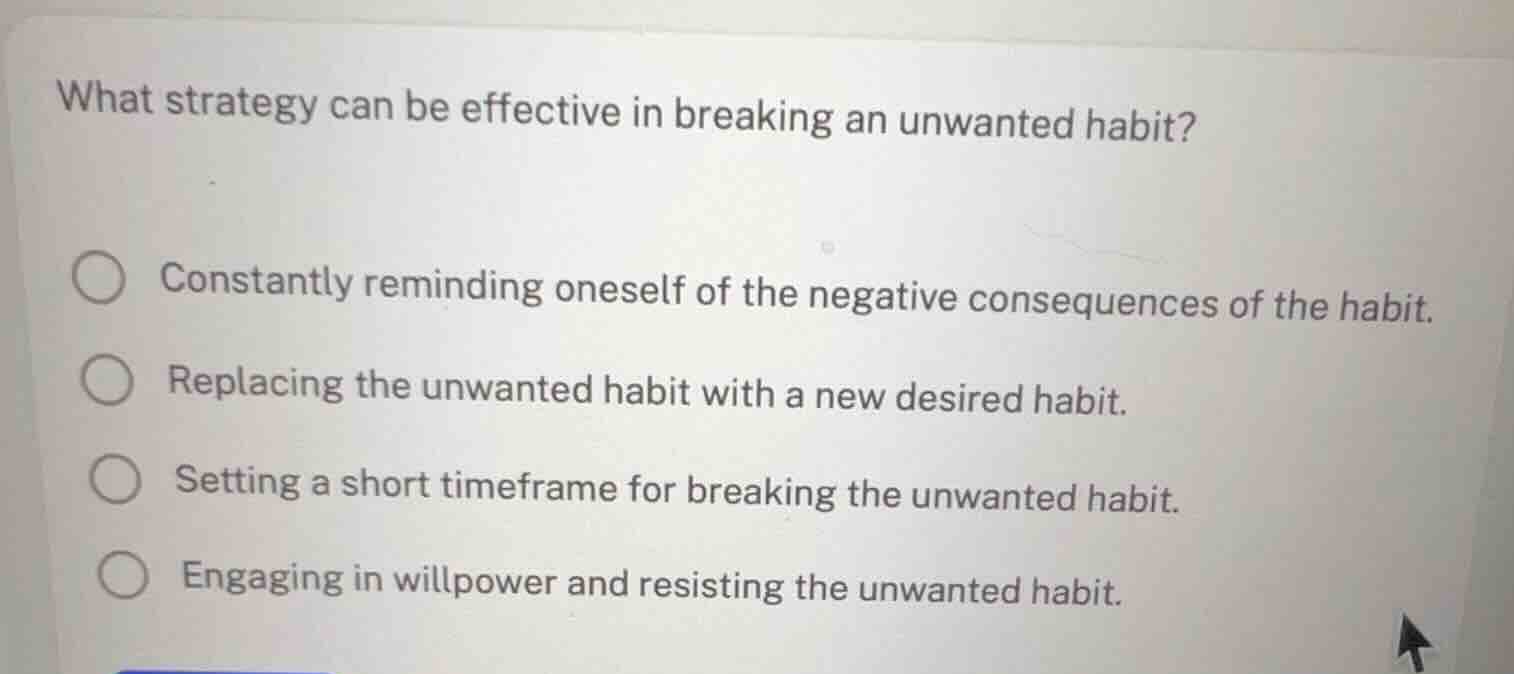
what strategy can be effective in breaking an unwanted habit?
constantly reminding oneself of the negative consequences of the habit.
replacing the unwanted habit with a new desired habit.
setting a short timeframe for breaking the unwanted habit.
engaging in willpower and resisting the unwanted habit.
<pre_analysis>
{
"quality": "clear",
"question_count": 1,
"skills_matched": [
"direct_cot",
"multiple_choice_formatter",
"explain_then_answer",
"tutor"
],
"needs_drawing": false,
"concepts_used": [
"Coping Mechanisms"
],
"new_concepts": [
"Habit Modification",
"Behavioral Conditioning"
],
"current_concepts": [
"Coping Mechanisms",
"Habit Modification",
"Behavioral Conditioning"
]
}
</pre_analysis>
<reasoning>
Analyze the psychology of habit formation
Habits are automated behavioral patterns triggered by specific environmental cues. They are deeply encoded in our neural pathways through a loop consisting of a cue, a routine, and a reward. Simply trying to suppress a habit using willpower or negative reminders is often ineffective because the underlying cue and reward pathways remain active.
Evaluate the strategy of replacement
To successfully break an unwanted habit, psychological research suggests utilizing Coping Mechanisms that focus on substitution. Because the neural pathways for the habit loop are already established, it is far more effective to keep the same cue and reward, but insert a new, healthier routine. This is known as habit replacement.
Assess the alternative options
- Constantly reminding oneself of negative consequences often increases stress, which can paradoxically trigger the unwanted habit as a coping response.
- Setting a short timeframe is unrealistic because neural pathways take time to reorganize.
- Relying solely on willpower is a limited resource that easily depletes under stress or fatigue.
Identify the correct choice
Replacing the unwanted habit with a new, desired habit directly addresses the behavioral loop, making it the most effective strategy among the choices provided.
</reasoning>
<answer>
<mcq-option>(A) Constantly reminding oneself of the negative consequences of the habit.</mcq-option>
<mcq-correct>(B) Replacing the unwanted habit with a new desired habit.</mcq-correct>
<mcq-option>(C) Setting a short timeframe for breaking the unwanted habit.</mcq-option>
<mcq-option>(D) Engaging in willpower and resisting the unwanted habit.</mcq-option>
</answer>
<post_analysis>
{
"subject": "Social Science",
"question_type": "Multiple Choice",
"knowledge_point": [
"Social Science",
"Psychology",
"Behavioral Psychology"
]
}
</post_analysis>
Snap & solve any problem in the app
Get step-by-step solutions on Sovi AI
Photo-based solutions with guided steps
Explore more problems and detailed explanations
<pre_analysis>
{
"quality": "clear",
"question_count": 1,
"skills_matched": [
"direct_cot",
"multiple_choice_formatter",
"explain_then_answer",
"tutor"
],
"needs_drawing": false,
"concepts_used": [
"Coping Mechanisms"
],
"new_concepts": [
"Habit Modification",
"Behavioral Conditioning"
],
"current_concepts": [
"Coping Mechanisms",
"Habit Modification",
"Behavioral Conditioning"
]
}
</pre_analysis>
<reasoning>
Analyze the psychology of habit formation
Habits are automated behavioral patterns triggered by specific environmental cues. They are deeply encoded in our neural pathways through a loop consisting of a cue, a routine, and a reward. Simply trying to suppress a habit using willpower or negative reminders is often ineffective because the underlying cue and reward pathways remain active.
Evaluate the strategy of replacement
To successfully break an unwanted habit, psychological research suggests utilizing Coping Mechanisms that focus on substitution. Because the neural pathways for the habit loop are already established, it is far more effective to keep the same cue and reward, but insert a new, healthier routine. This is known as habit replacement.
Assess the alternative options
- Constantly reminding oneself of negative consequences often increases stress, which can paradoxically trigger the unwanted habit as a coping response.
- Setting a short timeframe is unrealistic because neural pathways take time to reorganize.
- Relying solely on willpower is a limited resource that easily depletes under stress or fatigue.
Identify the correct choice
Replacing the unwanted habit with a new, desired habit directly addresses the behavioral loop, making it the most effective strategy among the choices provided.
</reasoning>
<answer>
<mcq-option>(A) Constantly reminding oneself of the negative consequences of the habit.</mcq-option>
<mcq-correct>(B) Replacing the unwanted habit with a new desired habit.</mcq-correct>
<mcq-option>(C) Setting a short timeframe for breaking the unwanted habit.</mcq-option>
<mcq-option>(D) Engaging in willpower and resisting the unwanted habit.</mcq-option>
</answer>
<post_analysis>
{
"subject": "Social Science",
"question_type": "Multiple Choice",
"knowledge_point": [
"Social Science",
"Psychology",
"Behavioral Psychology"
]
}
</post_analysis>