Sovi.AI - AI Math Tutor

Scan to solve math questions

QUESTION IMAGE

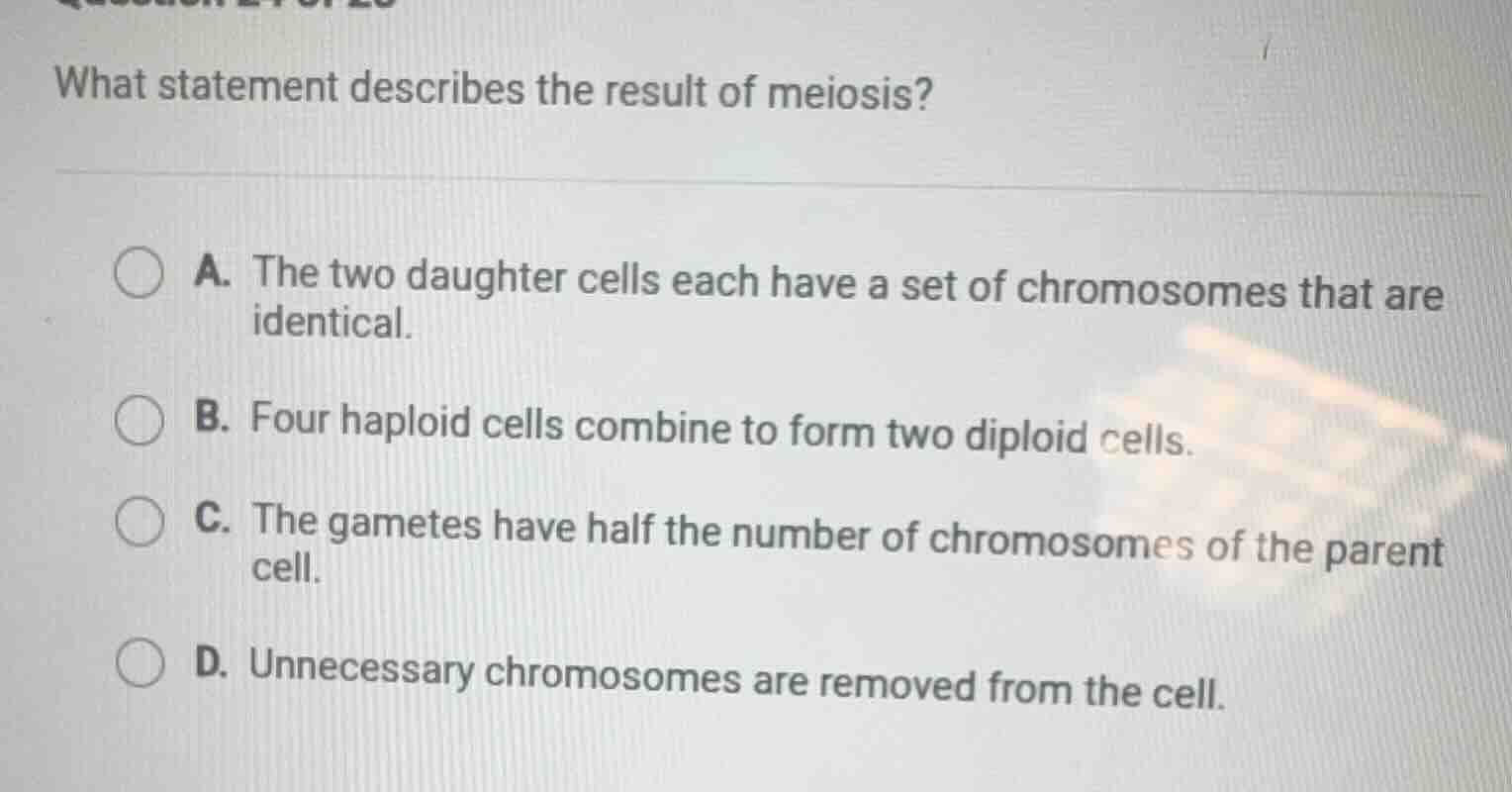
what statement describes the result of meiosis? a. the two daughter cel…

Question

what statement describes the result of meiosis?

a. the two daughter cells each have a set of chromosomes that are identical.
b. four haploid cells combine to form two diploid cells.
c. the gametes have half the number of chromosomes of the parent cell.
d. unnecessary chromosomes are removed from the cell.

Explanation:

Response

<pre_analysis>
{
"quality": "clear",
"question_count": 1,
"skills_matched": [
"direct_cot",
"multiple_choice_formatter",
"explain_then_answer",
"quick"
],
"needs_drawing": false,
"concepts_used": [],
"new_concepts": [
"Meiosis Outcomes"
],
"current_concepts": [
"Mitosis vs Meiosis",
"Haploid Cells",
"Meiosis Outcomes"
]
}
</pre_analysis>

<reasoning>

Analyze the definition of meiosis

Meiosis is a specialized form of cell division that reduces the chromosome number by half, resulting in the production of four genetically diverse haploid gametes from one diploid parent cell.

Evaluate the given options

  • A describes mitosis, which produces two genetically identical diploid daughter cells.
  • B is biologically incorrect; haploid cells do not combine in this manner to form diploid cells during division.
  • C correctly states that the resulting gametes have half the number of chromosomes of the parent cell (reducing ploidy from diploid \(2n\) to haploid \(n\)).
  • D is incorrect because chromosomes are not discarded as "unnecessary" during meiosis.

</reasoning>

<answer>
<mcq-option>(A) The two daughter cells each have a set of chromosomes that are identical.</mcq-option>
<mcq-option>(B) Four haploid cells combine to form two diploid cells.</mcq-option>
<mcq-correct>(C) The gametes have half the number of chromosomes of the parent cell.</mcq-correct>
<mcq-option>(D) Unnecessary chromosomes are removed from the cell.</mcq-option>
</answer>

<post_analysis>
{
"subject": "Natural Science",
"question_type": "Multiple Choice",
"knowledge_point": [
"Natural Science",
"Biology",
"Meiosis Outcomes"
]
}
</post_analysis>

Answer:

<pre_analysis>
{
"quality": "clear",
"question_count": 1,
"skills_matched": [
"direct_cot",
"multiple_choice_formatter",
"explain_then_answer",
"quick"
],
"needs_drawing": false,
"concepts_used": [],
"new_concepts": [
"Meiosis Outcomes"
],
"current_concepts": [
"Mitosis vs Meiosis",
"Haploid Cells",
"Meiosis Outcomes"
]
}
</pre_analysis>

<reasoning>

Analyze the definition of meiosis

Meiosis is a specialized form of cell division that reduces the chromosome number by half, resulting in the production of four genetically diverse haploid gametes from one diploid parent cell.

Evaluate the given options

  • A describes mitosis, which produces two genetically identical diploid daughter cells.
  • B is biologically incorrect; haploid cells do not combine in this manner to form diploid cells during division.
  • C correctly states that the resulting gametes have half the number of chromosomes of the parent cell (reducing ploidy from diploid \(2n\) to haploid \(n\)).
  • D is incorrect because chromosomes are not discarded as "unnecessary" during meiosis.

</reasoning>

<answer>
<mcq-option>(A) The two daughter cells each have a set of chromosomes that are identical.</mcq-option>
<mcq-option>(B) Four haploid cells combine to form two diploid cells.</mcq-option>
<mcq-correct>(C) The gametes have half the number of chromosomes of the parent cell.</mcq-correct>
<mcq-option>(D) Unnecessary chromosomes are removed from the cell.</mcq-option>
</answer>

<post_analysis>
{
"subject": "Natural Science",
"question_type": "Multiple Choice",
"knowledge_point": [
"Natural Science",
"Biology",
"Meiosis Outcomes"
]
}
</post_analysis>