QUESTION IMAGE
Question
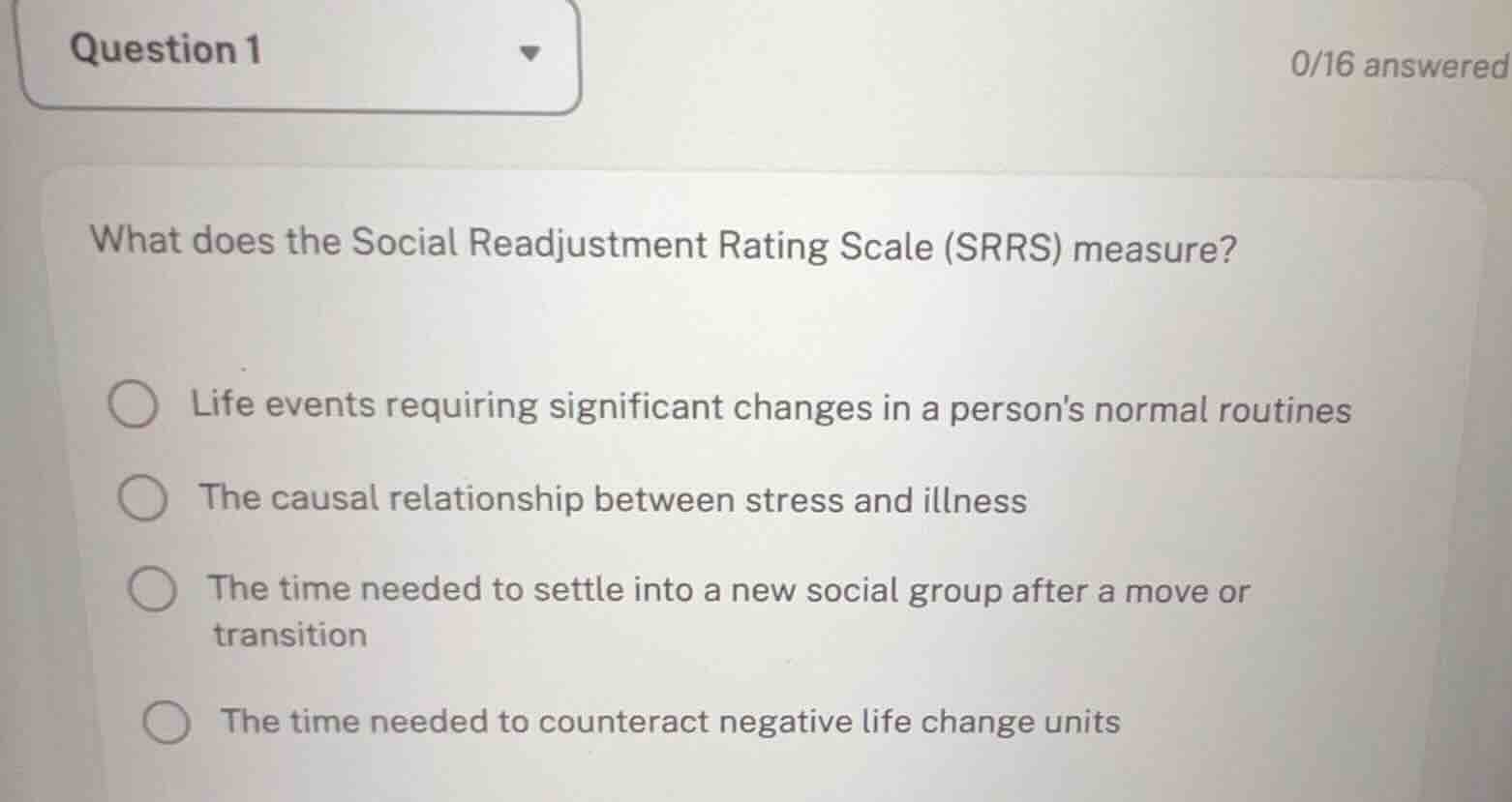
what does the social readjustment rating scale (srrs) measure?
- life events requiring significant changes in a persons normal routines
- the causal relationship between stress and illness
- the time needed to settle into a new social group after a move or transition
- the time needed to counteract negative life change units
<pre_analysis>
{
"quality": "clear",
"question_count": 1,
"skills_matched": [
"direct_cot",
"multiple_choice_formatter",
"explain_then_answer",
"tutor",
"mastery_adaptive_brevity"
],
"needs_drawing": false,
"concepts_used": [
"Social Readjustment Rating Scale",
"Life Change Units",
"Stress Measurement"
],
"new_concepts": [],
"current_concepts": [
"Social Readjustment Rating Scale",
"Life Change Units",
"Stress Measurement"
]
}
</pre_analysis>
<reasoning>
Define the purpose of the scale
Using the Social Readjustment Rating Scale and Stress Measurement knowledge points
The Social Readjustment Rating Scale (SRRS), developed by Thomas Holmes and Richard Rahe, is designed to identify and measure the amount of stress resulting from major life events.
Analyze the measurement unit
Using the Life Change Units knowledge point
The scale assigns numerical values, known as Life Change Units (LCUs), to 43 different life events. These events represent occurrences that require varying degrees of readjustment or significant changes in an individual's normal daily routines.
Evaluate the given options
- Option 1: "Life events requiring significant changes in a person's normal routines" directly matches the definition of what the SRRS measures through LCUs.
- Option 2: The scale does not measure a causal relationship itself, though researchers use its scores to study correlations with illness.
- Option 3: It does not measure the specific time needed to adjust to a new social group.
- Option 4: It does not measure time needed to counteract negative units.
</reasoning>
<answer>
<mcq-correct>(A) Life events requiring significant changes in a person's normal routines</mcq-correct>
<mcq-option>(B) The causal relationship between stress and illness</mcq-option>
<mcq-option>(C) The time needed to settle into a new social group after a move or transition</mcq-option>
<mcq-option>(D) The time needed to counteract negative life change units</mcq-option>
</answer>
<post_analysis>
{
"subject": "Social Science",
"question_type": "Multiple Choice",
"knowledge_point": [
"Social Science",
"Psychology",
"Stress and Health"
]
}
</post_analysis>
Snap & solve any problem in the app
Get step-by-step solutions on Sovi AI
Photo-based solutions with guided steps
Explore more problems and detailed explanations
<pre_analysis>
{
"quality": "clear",
"question_count": 1,
"skills_matched": [
"direct_cot",
"multiple_choice_formatter",
"explain_then_answer",
"tutor",
"mastery_adaptive_brevity"
],
"needs_drawing": false,
"concepts_used": [
"Social Readjustment Rating Scale",
"Life Change Units",
"Stress Measurement"
],
"new_concepts": [],
"current_concepts": [
"Social Readjustment Rating Scale",
"Life Change Units",
"Stress Measurement"
]
}
</pre_analysis>
<reasoning>
Define the purpose of the scale
Using the Social Readjustment Rating Scale and Stress Measurement knowledge points
The Social Readjustment Rating Scale (SRRS), developed by Thomas Holmes and Richard Rahe, is designed to identify and measure the amount of stress resulting from major life events.
Analyze the measurement unit
Using the Life Change Units knowledge point
The scale assigns numerical values, known as Life Change Units (LCUs), to 43 different life events. These events represent occurrences that require varying degrees of readjustment or significant changes in an individual's normal daily routines.
Evaluate the given options
- Option 1: "Life events requiring significant changes in a person's normal routines" directly matches the definition of what the SRRS measures through LCUs.
- Option 2: The scale does not measure a causal relationship itself, though researchers use its scores to study correlations with illness.
- Option 3: It does not measure the specific time needed to adjust to a new social group.
- Option 4: It does not measure time needed to counteract negative units.
</reasoning>
<answer>
<mcq-correct>(A) Life events requiring significant changes in a person's normal routines</mcq-correct>
<mcq-option>(B) The causal relationship between stress and illness</mcq-option>
<mcq-option>(C) The time needed to settle into a new social group after a move or transition</mcq-option>
<mcq-option>(D) The time needed to counteract negative life change units</mcq-option>
</answer>
<post_analysis>
{
"subject": "Social Science",
"question_type": "Multiple Choice",
"knowledge_point": [
"Social Science",
"Psychology",
"Stress and Health"
]
}
</post_analysis>