Sovi.AI - AI Math Tutor

Scan to solve math questions

QUESTION IMAGE

what role do cues play in habit formation? they decrease the time requi…

Question

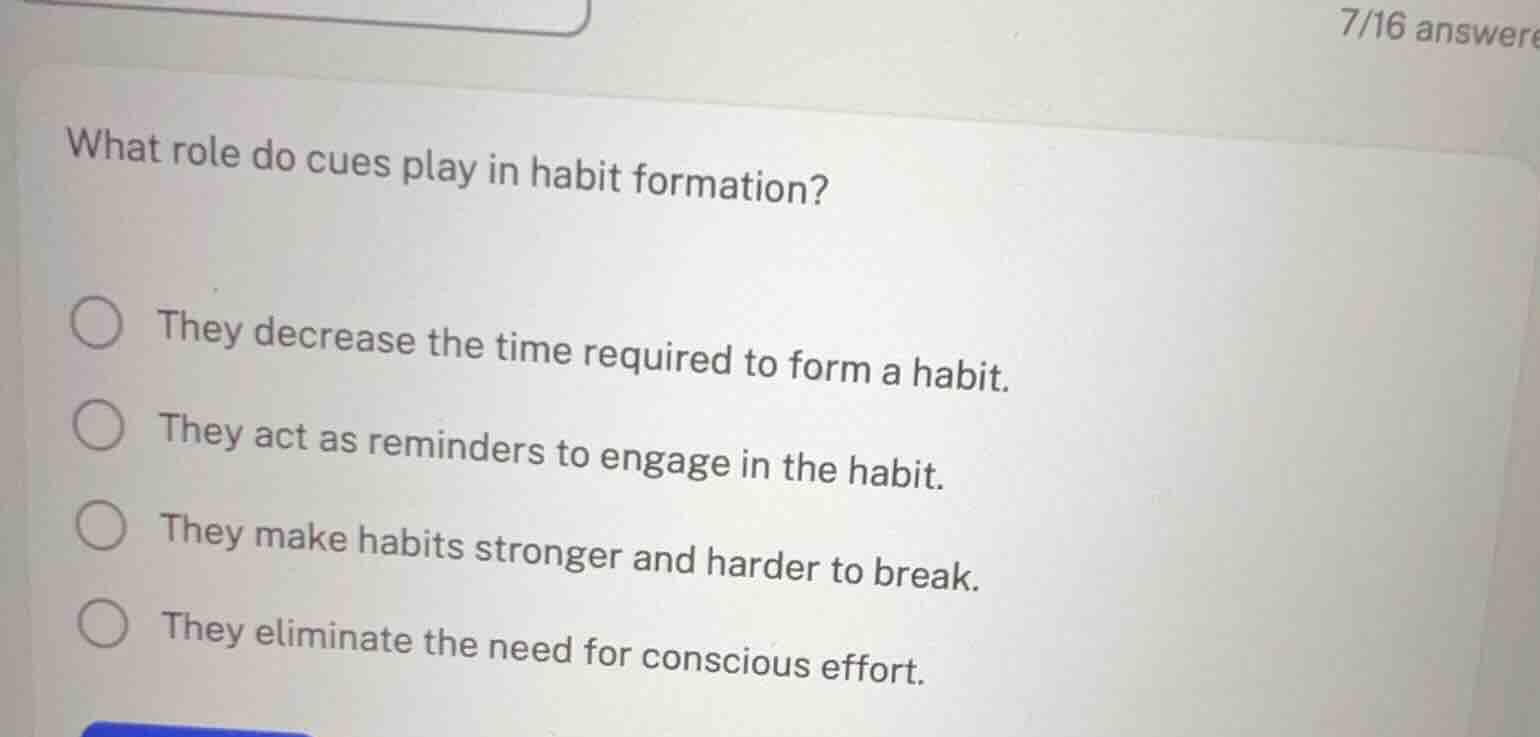
what role do cues play in habit formation?

they decrease the time required to form a habit.
they act as reminders to engage in the habit.
they make habits stronger and harder to break.
they eliminate the need for conscious effort.

Explanation:

Response

<pre_analysis>
{
"quality": "clear",
"question_count": 1,
"skills_matched": [
"direct_cot",
"multiple_choice_formatter",
"explain_then_answer",
"tutor",
"mastery_adaptive_brevity"
],
"needs_drawing": false,
"concepts_used": [
"Habit Cues",
"Habit Formation Psychology"
],
"new_concepts": [],
"current_concepts": [
"Habit Cues",
"Habit Formation Psychology"
]
}
</pre_analysis>

<reasoning>

Analyze the role of cues in habits

Using the Habit Cues and Habit Formation Psychology knowledge points, we analyze how a habit loop functions. A habit loop consists of three main components: a cue (trigger), a routine (behavior), and a reward. The cue is an environmental trigger that signals the brain to initiate a specific behavior. Therefore, cues act as reminders or triggers to engage in the habit.

Evaluate the given options

  • Option 1: "They decrease the time required to form a habit." Cues are triggers for behavior, but they do not directly alter the physiological timeline of neuroplasticity required to automate a habit.
  • Option 2: "They act as reminders to engage in the habit." This directly matches the psychological definition of a cue as a trigger or reminder that initiates the routine.
  • Option 3: "They make habits stronger and harder to break." Repetition and reward strength determine habit strength, not the cue itself.
  • Option 4: "They eliminate the need for conscious effort." While habits eventually require less conscious effort, it is the automaticity of the entire loop (not the cue alone) that reduces conscious control, and cues themselves do not eliminate this need.

</reasoning>

<answer>
<mcq-option>(A) They decrease the time required to form a habit.</mcq-option>
<mcq-correct>(B) They act as reminders to engage in the habit.</mcq-correct>
<mcq-option>(C) They make habits stronger and harder to break.</mcq-option>
<mcq-option>(D) They eliminate the need for conscious effort.</mcq-option>
</answer>

<post_analysis>
{
"subject": "Social Science",
"question_type": "Multiple Choice",
"knowledge_point": [
"Social Science",
"Psychology",
"Habit Formation Psychology"
]
}
</post_analysis>

Answer:

<pre_analysis>
{
"quality": "clear",
"question_count": 1,
"skills_matched": [
"direct_cot",
"multiple_choice_formatter",
"explain_then_answer",
"tutor",
"mastery_adaptive_brevity"
],
"needs_drawing": false,
"concepts_used": [
"Habit Cues",
"Habit Formation Psychology"
],
"new_concepts": [],
"current_concepts": [
"Habit Cues",
"Habit Formation Psychology"
]
}
</pre_analysis>

<reasoning>

Analyze the role of cues in habits

Using the Habit Cues and Habit Formation Psychology knowledge points, we analyze how a habit loop functions. A habit loop consists of three main components: a cue (trigger), a routine (behavior), and a reward. The cue is an environmental trigger that signals the brain to initiate a specific behavior. Therefore, cues act as reminders or triggers to engage in the habit.

Evaluate the given options

  • Option 1: "They decrease the time required to form a habit." Cues are triggers for behavior, but they do not directly alter the physiological timeline of neuroplasticity required to automate a habit.
  • Option 2: "They act as reminders to engage in the habit." This directly matches the psychological definition of a cue as a trigger or reminder that initiates the routine.
  • Option 3: "They make habits stronger and harder to break." Repetition and reward strength determine habit strength, not the cue itself.
  • Option 4: "They eliminate the need for conscious effort." While habits eventually require less conscious effort, it is the automaticity of the entire loop (not the cue alone) that reduces conscious control, and cues themselves do not eliminate this need.

</reasoning>

<answer>
<mcq-option>(A) They decrease the time required to form a habit.</mcq-option>
<mcq-correct>(B) They act as reminders to engage in the habit.</mcq-correct>
<mcq-option>(C) They make habits stronger and harder to break.</mcq-option>
<mcq-option>(D) They eliminate the need for conscious effort.</mcq-option>
</answer>

<post_analysis>
{
"subject": "Social Science",
"question_type": "Multiple Choice",
"knowledge_point": [
"Social Science",
"Psychology",
"Habit Formation Psychology"
]
}
</post_analysis>