QUESTION IMAGE
Question
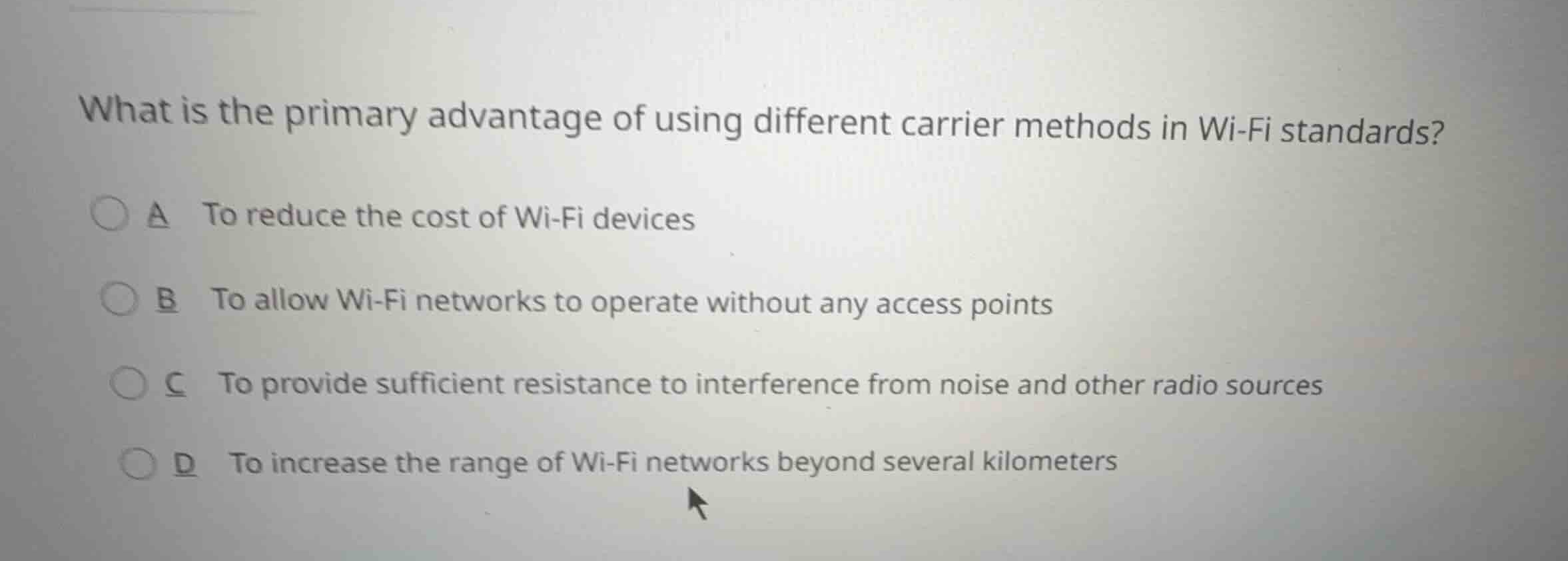
what is the primary advantage of using different carrier methods in wi-fi standards?
a to reduce the cost of wi-fi devices
b to allow wi-fi networks to operate without any access points
c to provide sufficient resistance to interference from noise and other radio sources
d to increase the range of wi-fi networks beyond several kilometers
Analyze the purpose of carrier methods in Wi-Fi
Wi-Fi standards use various carrier and modulation methods (such as DSSS, OFDM, and OFDMA) to encode data onto radio waves. The primary engineering challenge in wireless communication is transmitting data reliably through a shared, noisy medium (the air) where multiple devices and external radio sources cause signal degradation.
Evaluate the given options
- Option A: Using advanced carrier methods often increases the complexity and cost of hardware design rather than reducing it.
- Option B: Wi-Fi networks typically require access points (APs) for infrastructure mode, regardless of the carrier method used.
- Option C: Different carrier methods (like OFDM splitting a channel into multiple orthogonal subcarriers) are specifically designed to mitigate multi-path interference, noise, and fading, thereby providing robust resistance to interference.
- Option D: Standard Wi-Fi carrier methods are designed for local area networking (LAN) and do not extend the range to several kilometers without specialized high-power directional equipment.

Snap & solve any problem in the app
Get step-by-step solutions on Sovi AI
Photo-based solutions with guided steps
Explore more problems and detailed explanations
- (A) To reduce the cost of Wi-Fi devices
- (B) To allow Wi-Fi networks to operate without any access points
- (C) To provide sufficient resistance to interference from noise and other radio sources (Correct answer)
- (D) To increase the range of Wi-Fi networks beyond several kilometers