QUESTION IMAGE
Question
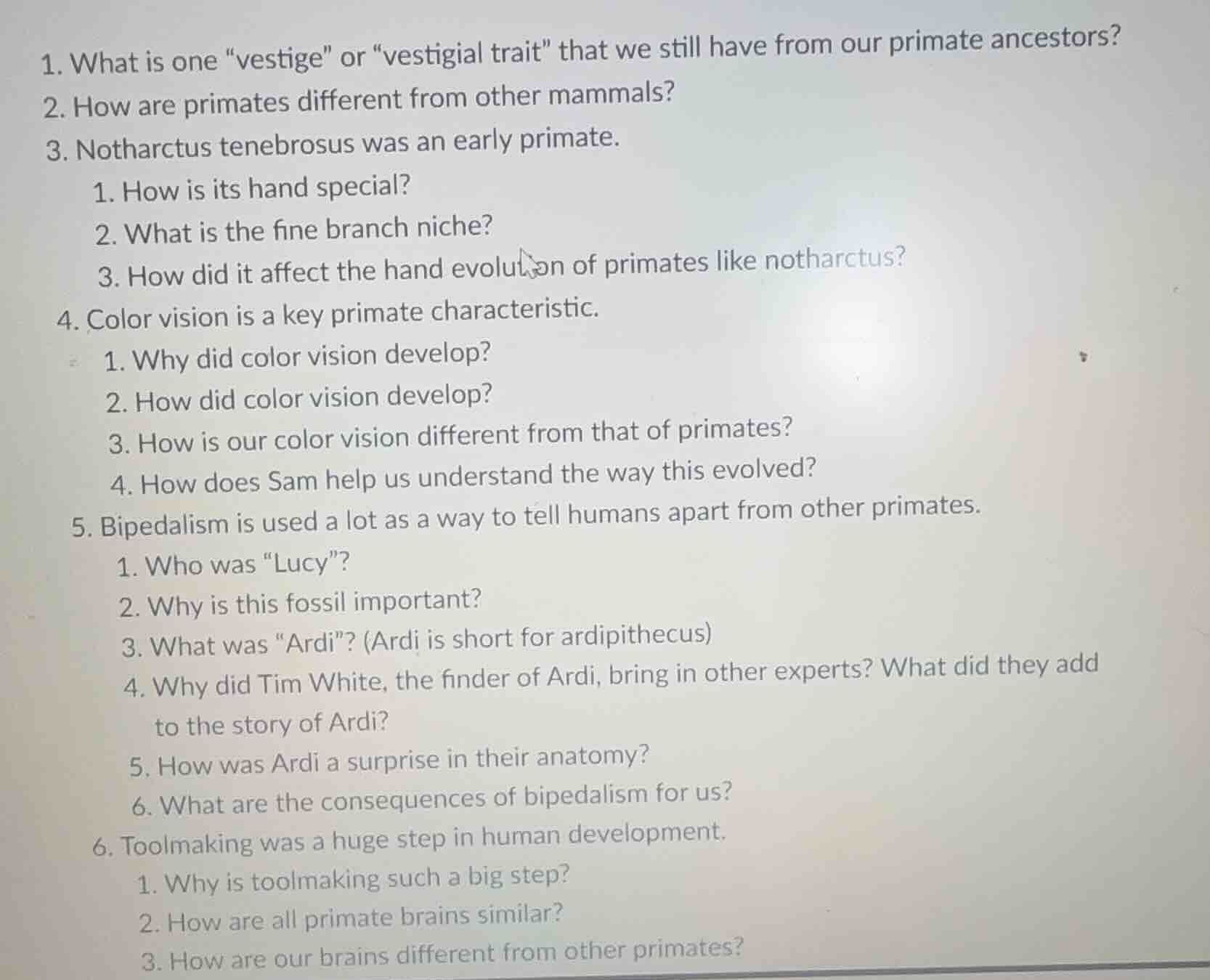
- what is one \vestige\ or \vestigial trait\ that we still have from our primate ancestors?
- how are primates different from other mammals?
- notharctus tenebrosus was an early primate.
- how is its hand special?
- what is the fine branch niche?
- how did it affect the hand evolution of primates like notharctus?
- color vision is a key primate characteristic.
- why did color vision develop?
- how did color vision develop?
- how is our color vision different from that of primates?
- how does sam help us understand the way this evolved?
- bipedalism is used a lot as a way to tell humans apart from other primates.
- who was \lucy\?
- why is this fossil important?
- what was \ardi\? (ardi is short for ardipithecus)
- why did tim white, the finder of ardi, bring in other experts? what did they add to the story of ardi?
- how was ardi a surprise in their anatomy?
- what are the consequences of bipedalism for us?
- toolmaking was a huge step in human development.
- why is toolmaking such a big step?
- how are all primate brains similar?
- how are our brains different from other primates?
Vestigial traits from primate ancestors
Using the Vestigial Traits knowledge point
Anatomical remnants from our evolutionary past include:
- Coccyx (tailbone): Remnant of a lost tail.
- Appendix: Once used for digesting cellulose.
- Arrector pili muscles: Cause goosebumps, formerly used to loft fur for warmth or defense.
- Wisdom teeth: Remnants of larger jaws used for grinding tough vegetation.
Primate characteristics vs other mammals
Using the Primate Evolution knowledge point
Primates are distinguished from other mammals by:
- Grasping hands and feet: Opposable thumbs/big toes, tactile pads, and flat nails instead of claws.
- Vision-dominant sensory system: Forward-facing eyes providing stereoscopic (3D) depth perception, often with color vision, at the expense of olfactory (smell) structures.
- Enlarged brains: High brain-to-body mass ratio, particularly in the neocortex.
- Life history: Longer gestation, prolonged juvenile dependency, and complex social structures.
Notharctus tenebrosus hand and niche
Using the Primate Evolution knowledge point
- Hand specialization: Notharctus possessed elongated fingers and an opposable thumb with flat nails instead of claws, allowing a precise power grip on branches.
- Fine branch niche: The terminal ends of tree branches where nutritious flowers, fruits, and insects are abundant but structurally weak.
- Evolutionary effect: Navigating this niche selected for grasping hands and feet to distribute weight and secure holds, driving the transition from clawed climbers to grasping primates.
Primate color vision development
Using the Primate Evolution knowledge point
- Why it developed: To locate ripe fruits and nutritious young red leaves against green forest canopies.
- How it developed: Gene duplication of opsin genes on the X chromosome led to trichromatic vision.
- Human vs primate vision: Most humans and Old World primates are trichromats (three color receptors). Many New World monkeys are dichromats or show polymorphic color vision.
- Sam's role: "Sam" (a research monkey) demonstrated how introducing a third opsin gene via gene therapy can instantly enable trichromatic color vision, showing that the brain has the plasticity to process new sensory inputs without immediate rewiring.
Bipedalism and hominin fossils
Using the Hominin Bipedalism knowledge point
- Lucy: A 3.2-million-year-old Australopithecus afarensis fossil discovered in Ethiopia.
- Importance: Proved that bipedalism evolved long before large brain size in hominins.
- Ardi: Ardipithecus ramidus, a 4.4-million-year-old hominin fossil.
- Tim White's collaboration: White brought in geologists, paleontologists, and botanists to reconstruct the ancient woodland habitat, proving bipedalism evolved in forests, not open savannas.
- Ardi's anatomical surprise: She possessed a fully opposable big toe…

Snap & solve any problem in the app
Get step-by-step solutions on Sovi AI
Photo-based solutions with guided steps
Explore more problems and detailed explanations
Question 1
One vestigial trait we still have from our primate ancestors is the coccyx (tailbone), which is the remnant of an ancestral tail.
Question 2
Primates differ from other mammals by having grasping hands and feet with opposable digits and flat nails instead of claws, forward-facing eyes providing stereoscopic 3D vision, and larger brains relative to their body size.
Question 3
- Notharctus had an opposable thumb and long, slender fingers with flat nails, allowing it to grasp branches securely.
- The fine branch niche refers to the thin, terminal ends of tree branches where high-energy food resources like fruits, flowers, and insects are located.
- It forced the evolution of grasping hands and feet to safely navigate and forage on unstable, thin branches.
Question 4
- Color vision developed to help primates distinguish ripe fruits and tender young leaves from green foliage.
- It developed through gene duplication of the opsin pigment genes, expanding vision from dichromatic (two-color) to trichromatic (three-color).
- Most humans and Old World monkeys are trichromats, whereas many New World monkeys are dichromats (or have variable color vision where only some females are trichromats).
- Sam (the squirrel monkey) showed that adding a third opsin gene via gene therapy allowed him to see red and green, proving that the primate brain is highly plastic and can immediately process new visual signals.
Question 5
- "Lucy" is a highly complete, 3.2-million-year-old fossil of \(Australopithecus\ afarensis\) found in Ethiopia in 1974.
- She proved that bipedalism (walking on two legs) evolved before large brains in human ancestors.
- "Ardi" is a 4.4-million-year-old fossil of \(Ardipithecus\ ramidus\), representing a critical early hominin species.
- White brought in multi-disciplinary experts to reconstruct the ancient environment. They proved that Ardi lived in a woodland habitat, overturning the classic theory that bipedalism evolved on open savannas.
- Ardi was a surprise because she had a grasping, opposable big toe like an ape, yet her pelvis and foot structure showed she was already a facultative biped on the ground.
- Consequences include freed hands for carrying food and tools, but also physical costs like lower back pain, knee strain, and more difficult childbirth.
Question 6
- Toolmaking is a huge step because it requires complex planning, abstract thought, and manual dexterity, which drove the evolutionary expansion of the brain.
- All primate brains share a similar anatomical blueprint, featuring a large visual cortex and complex social processing networks.
- Human brains are much larger relative to body size and have a highly expanded prefrontal cortex, which enables complex language, symbolic thought, and advanced reasoning.