QUESTION IMAGE
Question
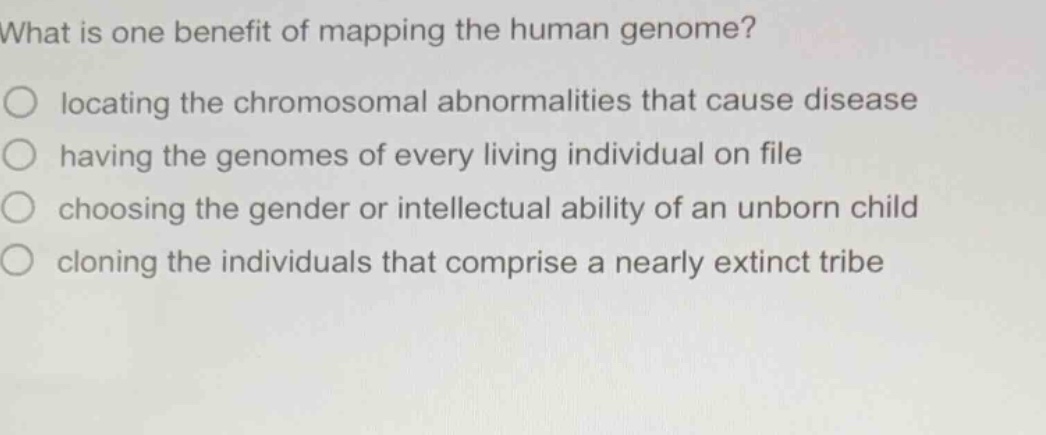
what is one benefit of mapping the human genome?
locating the chromosomal abnormalities that cause disease
having the genomes of every living individual on file
choosing the gender or intellectual ability of an unborn child
cloning the individuals that comprise a nearly extinct tribe
<pre_analysis>
{
"quality": "clear",
"question_count": 1,
"skills_matched": [
"direct_cot",
"multiple_choice_formatter",
"explain_then_answer",
"tutor"
],
"needs_drawing": false,
"concepts_used": [
"History of Genetics"
],
"new_concepts": [
"Human Genome Project",
"Genome Mapping Benefits"
],
"current_concepts": [
"History of Genetics",
"Human Genome Project",
"Genome Mapping Benefits"
]
}
</pre_analysis>
<reasoning>
Understand genome mapping
Mapping the human genome involves identifying and sequencing all the chemical base pairs that make up human DNA. This helps scientists locate specific genes and understand their functions.
Evaluate the first option
Using the History of Genetics knowledge point, mapping the genome allows researchers to pinpoint the exact locations of genes on chromosomes. This is crucial for identifying genetic mutations and chromosomal abnormalities that lead to hereditary diseases.
Evaluate the remaining options
- Having the genomes of every living individual on file is logistically impossible and raises severe privacy concerns.
- Choosing the gender or intellectual ability of an unborn child is an ethical issue and not a direct scientific benefit of mapping the reference genome.
- Cloning individuals of an extinct tribe is scientifically unrealistic and highly unethical.
Select the correct choice
The only scientifically valid, ethical, and practical benefit listed is locating the chromosomal abnormalities that cause disease.
</reasoning>
<answer>
<mcq-correct>locating the chromosomal abnormalities that cause disease</mcq-correct>
<mcq-option>having the genomes of every living individual on file</mcq-option>
<mcq-option>choosing the gender or intellectual ability of an unborn child</mcq-option>
<mcq-option>cloning the individuals that comprise a nearly extinct tribe</mcq-option>
</answer>
<post_analysis>
{
"subject": "Natural Science",
"question_type": "Multiple Choice",
"knowledge_point": [
"Natural Science",
"Biology",
"Human Genome Project"
]
}
</post_analysis>
Snap & solve any problem in the app
Get step-by-step solutions on Sovi AI
Photo-based solutions with guided steps
Explore more problems and detailed explanations
<pre_analysis>
{
"quality": "clear",
"question_count": 1,
"skills_matched": [
"direct_cot",
"multiple_choice_formatter",
"explain_then_answer",
"tutor"
],
"needs_drawing": false,
"concepts_used": [
"History of Genetics"
],
"new_concepts": [
"Human Genome Project",
"Genome Mapping Benefits"
],
"current_concepts": [
"History of Genetics",
"Human Genome Project",
"Genome Mapping Benefits"
]
}
</pre_analysis>
<reasoning>
Understand genome mapping
Mapping the human genome involves identifying and sequencing all the chemical base pairs that make up human DNA. This helps scientists locate specific genes and understand their functions.
Evaluate the first option
Using the History of Genetics knowledge point, mapping the genome allows researchers to pinpoint the exact locations of genes on chromosomes. This is crucial for identifying genetic mutations and chromosomal abnormalities that lead to hereditary diseases.
Evaluate the remaining options
- Having the genomes of every living individual on file is logistically impossible and raises severe privacy concerns.
- Choosing the gender or intellectual ability of an unborn child is an ethical issue and not a direct scientific benefit of mapping the reference genome.
- Cloning individuals of an extinct tribe is scientifically unrealistic and highly unethical.
Select the correct choice
The only scientifically valid, ethical, and practical benefit listed is locating the chromosomal abnormalities that cause disease.
</reasoning>
<answer>
<mcq-correct>locating the chromosomal abnormalities that cause disease</mcq-correct>
<mcq-option>having the genomes of every living individual on file</mcq-option>
<mcq-option>choosing the gender or intellectual ability of an unborn child</mcq-option>
<mcq-option>cloning the individuals that comprise a nearly extinct tribe</mcq-option>
</answer>
<post_analysis>
{
"subject": "Natural Science",
"question_type": "Multiple Choice",
"knowledge_point": [
"Natural Science",
"Biology",
"Human Genome Project"
]
}
</post_analysis>