QUESTION IMAGE
Question
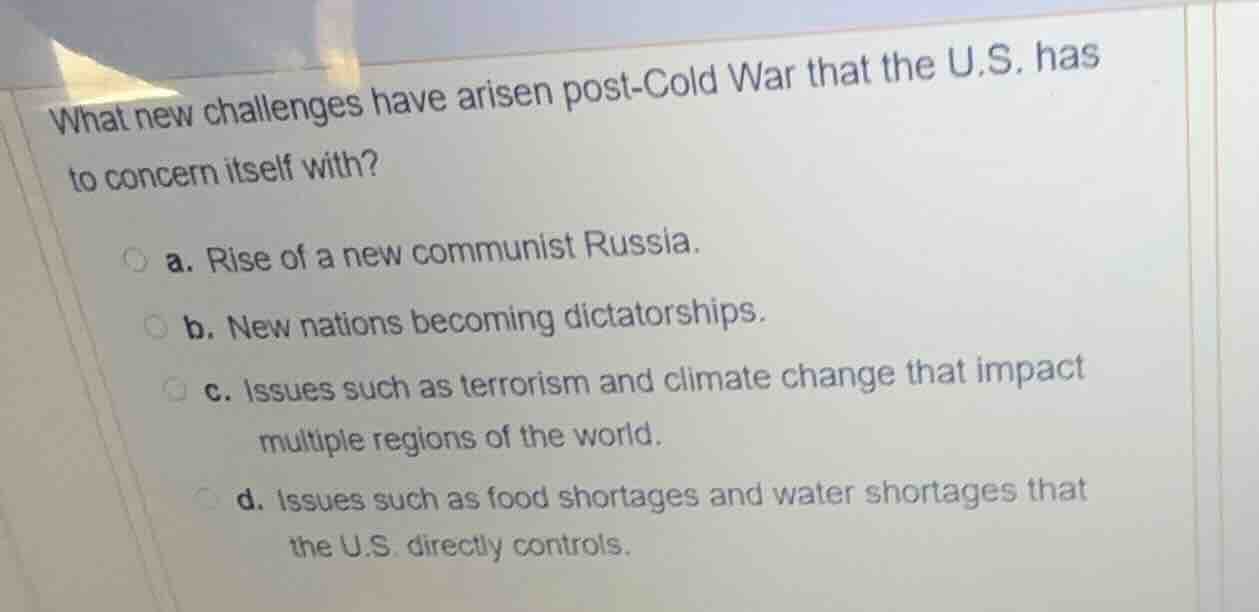
what new challenges have arisen post-cold war that the u.s. has to concern itself with?
a. rise of a new communist russia.
b. new nations becoming dictatorships.
c. issues such as terrorism and climate change that impact multiple regions of the world.
d. issues such as food shortages and water shortages that the u.s. directly controls.
Analyze the historical context
The question asks about the new challenges that have arisen in the post-Cold War era (after 1991) that the United States has to concern itself with. During the Cold War, U.S. foreign policy was primarily focused on containment of communism and bilateral relations with the Soviet Union. The collapse of the Soviet Union shifted the global landscape from a bipolar system to one with diverse, transnational challenges.
Evaluate option A
Option A suggests the "Rise of a new communist Russia." Following the dissolution of the Soviet Union in 1991, Russia transitioned to a federation with a market economy, not a new communist state. Therefore, this option is historically inaccurate.
Evaluate option B
Option B suggests "New nations becoming dictatorships." While democratic backsliding and authoritarianism occur, this is not the defining, novel global challenge of the post-Cold War era that uniquely characterizes modern globalized threats.
Evaluate option C
Option C mentions "Issues such as terrorism and climate change that impact multiple regions of the world." The post-Cold War era is highly globalized, characterized by non-state actors and transnational issues. Global terrorism (especially prominent after September 11, 2001) and climate change are prime examples of modern, borderless challenges that require international cooperation and directly impact U.S. national security and foreign policy.
Evaluate option D
Option D mentions "Issues such as food shortages and water shortages that the U.S. directly controls." While resource scarcity is a major global issue, the U.S. does not "directly control" global food and water shortages, making this statement incorrect.

Snap & solve any problem in the app
Get step-by-step solutions on Sovi AI
Photo-based solutions with guided steps
Explore more problems and detailed explanations
- a. Rise of a new communist Russia.
- b. New nations becoming dictatorships.
- c. Issues such as terrorism and climate change that impact multiple regions of the world. (Correct answer)
- d. Issues such as food shortages and water shortages that the U.S. directly controls.