QUESTION IMAGE
Question
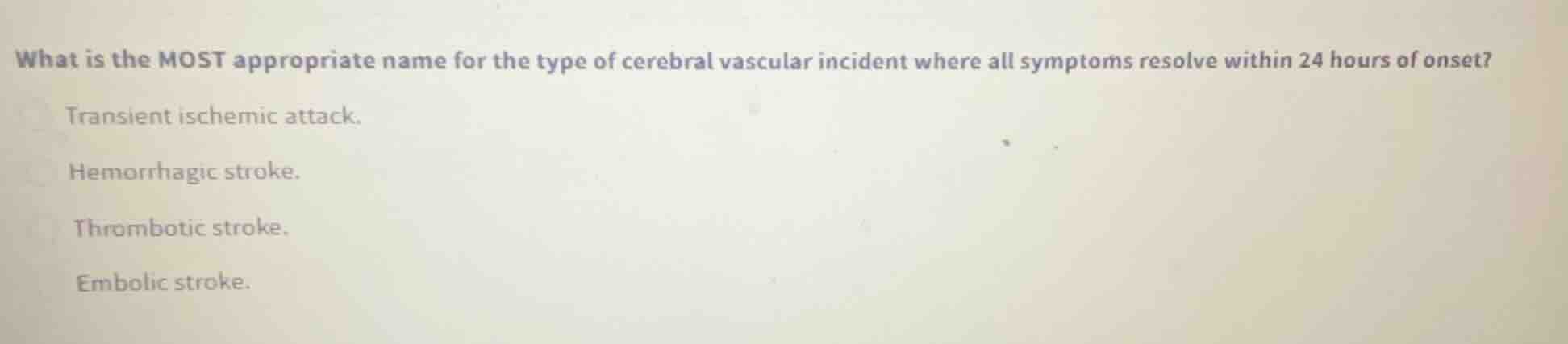
what is the most appropriate name for the type of cerebral vascular incident where all symptoms resolve within 24 hours of onset?
transient ischemic attack.
hemorrhagic stroke.
thrombotic stroke.
embolic stroke.
<pre_analysis>
{
"quality": "clear",
"question_count": 1,
"skills_matched": [
"direct_cot",
"multiple_choice_formatter",
"explain_then_answer",
"tutor",
"mastery_adaptive_brevity"
],
"needs_drawing": false,
"concepts_used": [
"Stroke Pathophysiology"
],
"new_concepts": [
"Transient Ischemic Attack"
],
"current_concepts": [
"Stroke Pathophysiology",
"Transient Ischemic Attack"
]
}
</pre_analysis>
<reasoning>
Analyze the clinical presentation
Using the Stroke Pathophysiology knowledge point
- A cerebrovascular incident with focal neurological deficits that completely resolve within 24 hours is defined as a transient ischemic attack (TIA).
- Unlike ischemic strokes (thrombotic or embolic) or hemorrhagic strokes, a TIA involves temporary blockage of blood flow without permanent tissue infarction.
Evaluate the options
- Transient ischemic attack: Correct. Symptoms typically resolve within minutes to hours, and by definition, within 24 hours.
- Hemorrhagic stroke: Incorrect. Caused by bleeding into the brain, leading to prolonged or permanent deficits.
- Thrombotic stroke: Incorrect. An ischemic stroke caused by a localized clot, resulting in permanent brain tissue damage.
- Embolic stroke: Incorrect. An ischemic stroke caused by a traveling embolus, resulting in permanent brain tissue damage.
</reasoning>
<answer>
<mcq-correct>Transient ischemic attack.</mcq-correct>
<mcq-option>Hemorrhagic stroke.</mcq-option>
<mcq-option>Thrombotic stroke.</mcq-option>
<mcq-option>Embolic stroke.</mcq-option>
</answer>
<post_analysis>
{
"subject": "Natural Science",
"question_type": "Multiple Choice",
"knowledge_point": [
"Natural Science",
"Medicine",
"Transient Ischemic Attack"
]
}
</post_analysis>
Snap & solve any problem in the app
Get step-by-step solutions on Sovi AI
Photo-based solutions with guided steps
Explore more problems and detailed explanations
<pre_analysis>
{
"quality": "clear",
"question_count": 1,
"skills_matched": [
"direct_cot",
"multiple_choice_formatter",
"explain_then_answer",
"tutor",
"mastery_adaptive_brevity"
],
"needs_drawing": false,
"concepts_used": [
"Stroke Pathophysiology"
],
"new_concepts": [
"Transient Ischemic Attack"
],
"current_concepts": [
"Stroke Pathophysiology",
"Transient Ischemic Attack"
]
}
</pre_analysis>
<reasoning>
Analyze the clinical presentation
Using the Stroke Pathophysiology knowledge point
- A cerebrovascular incident with focal neurological deficits that completely resolve within 24 hours is defined as a transient ischemic attack (TIA).
- Unlike ischemic strokes (thrombotic or embolic) or hemorrhagic strokes, a TIA involves temporary blockage of blood flow without permanent tissue infarction.
Evaluate the options
- Transient ischemic attack: Correct. Symptoms typically resolve within minutes to hours, and by definition, within 24 hours.
- Hemorrhagic stroke: Incorrect. Caused by bleeding into the brain, leading to prolonged or permanent deficits.
- Thrombotic stroke: Incorrect. An ischemic stroke caused by a localized clot, resulting in permanent brain tissue damage.
- Embolic stroke: Incorrect. An ischemic stroke caused by a traveling embolus, resulting in permanent brain tissue damage.
</reasoning>
<answer>
<mcq-correct>Transient ischemic attack.</mcq-correct>
<mcq-option>Hemorrhagic stroke.</mcq-option>
<mcq-option>Thrombotic stroke.</mcq-option>
<mcq-option>Embolic stroke.</mcq-option>
</answer>
<post_analysis>
{
"subject": "Natural Science",
"question_type": "Multiple Choice",
"knowledge_point": [
"Natural Science",
"Medicine",
"Transient Ischemic Attack"
]
}
</post_analysis>