QUESTION IMAGE
Question
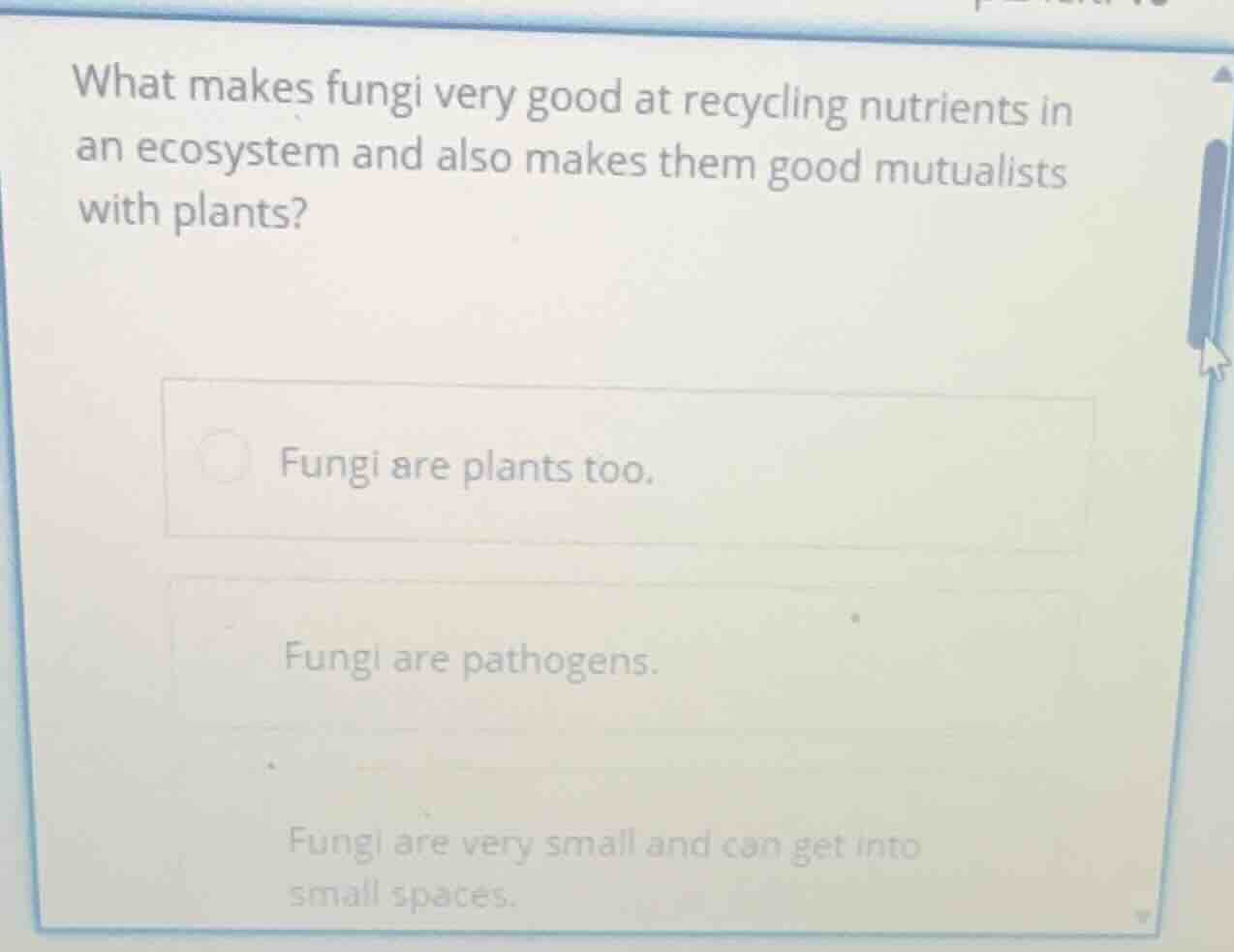
what makes fungi very good at recycling nutrients in an ecosystem and also makes them good mutualists with plants?
fungi are plants too.
fungi are pathogens.
fungi are very small and can get into small spaces.
Analyze the question requirements
The question asks what physical or biological characteristic makes fungi highly efficient at recycling nutrients (acting as decomposers) and excellent mutualistic partners with plants (such as in mycorrhizal associations).
Evaluate the visible options
Let's look at the options visible in the image:
- "Fungi are plants too." This is biologically incorrect. Fungi belong to their own distinct kingdom (Kingdom Fungi) and are more closely related to animals than plants.
- "Fungi are pathogens." While some fungi are pathogenic, being a pathogen does not explain why they are beneficial nutrient recyclers or good mutualists with plants.
- "Fungi are very small and can get into small spaces." This option points toward their filamentous structure (hyphae). Fungal hyphae are extremely thin, microscopic threads that form a vast network (mycelium). This gives them an incredibly high surface-area-to-volume ratio, allowing them to penetrate tiny soil pores, absorb nutrients efficiently, and interface closely with plant roots.
Connect structure to function
The high surface-area-to-volume ratio of the mycelium is the key feature. It allows fungi to secrete enzymes into tiny spaces to break down organic matter (recycling nutrients) and to absorb water and minerals to share with plant roots in exchange for carbohydrates (mutualism). Thus, their small, filamentous structure that can access tiny spaces is the correct explanation among the choices.

Snap & solve any problem in the app
Get step-by-step solutions on Sovi AI
Photo-based solutions with guided steps
Explore more problems and detailed explanations
- (A) Fungi are plants too.
- (B) Fungi are pathogens.
- (C) Fungi are very small and can get into small spaces. (Correct answer)