QUESTION IMAGE
Question
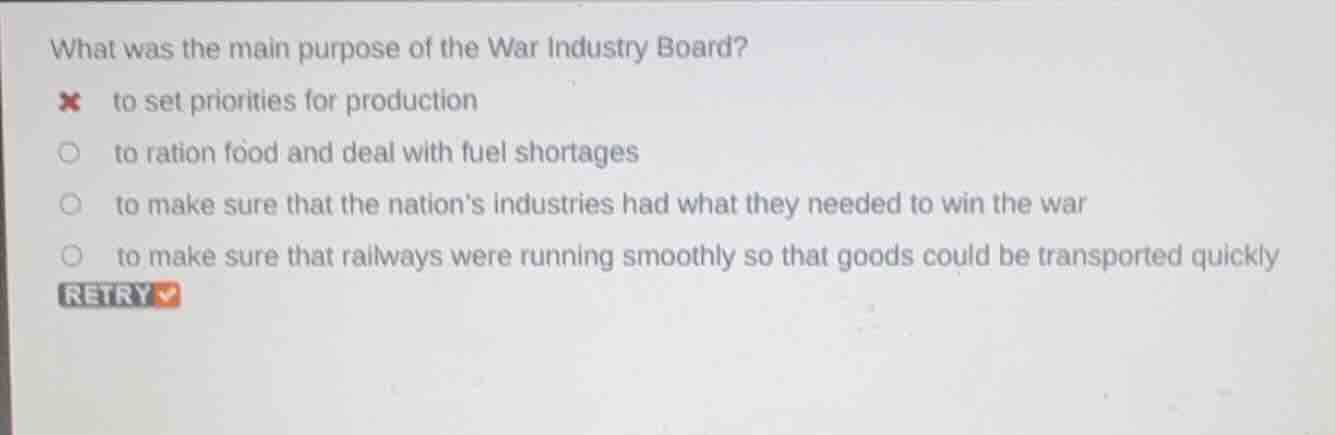
what was the main purpose of the war industry board?
to set priorities for production
to ration food and deal with fuel shortages
to make sure that the nations industries had what they needed to win the war
to make sure that railways were running smoothly so that goods could be transported quickly
🆕 New Concept Discovered: World War I Home Front Mobilization
Coordinating private industries to support military needs.
Step 1: Understand the role of the War Industries Board (WIB)
The War Industries Board (WIB) was a United States government agency established on July 28, 1917, during World War I. Its primary mission was to coordinate the purchase of war supplies between the War Department (Department of the Army) and the Navy Department.
Step 2: Identify the main objective
To win the war, the military required massive amounts of manufactured goods, raw materials, and equipment. The WIB was created to oversee and stimulate industrial production, eliminate waste, and ensure that American factories and industries had all the resources, raw materials, and support necessary to produce these vital war goods efficiently.
Step 3: Evaluate the options
- to set priorities for production: While the WIB did help set production priorities, this was a tool used to achieve its broader, main purpose of fully equipping the nation's industrial base for war.
- to ration food and deal with fuel shortages: This was the responsibility of the Food Administration (led by Herbert Hoover) and the Fuel Administration.
- to make sure that the nation's industries had what they needed to win the war: This directly describes the core purpose of the WIB—organizing and supplying the industrial sector to meet military demands.
- to make sure that railways were running smoothly so that goods could be transported quickly: This was the responsibility of the Railroad Administration.

Snap & solve any problem in the app
Get step-by-step solutions on Sovi AI
Photo-based solutions with guided steps
Explore more problems and detailed explanations
to make sure that the nation's industries had what they needed to win the war