QUESTION IMAGE
Question
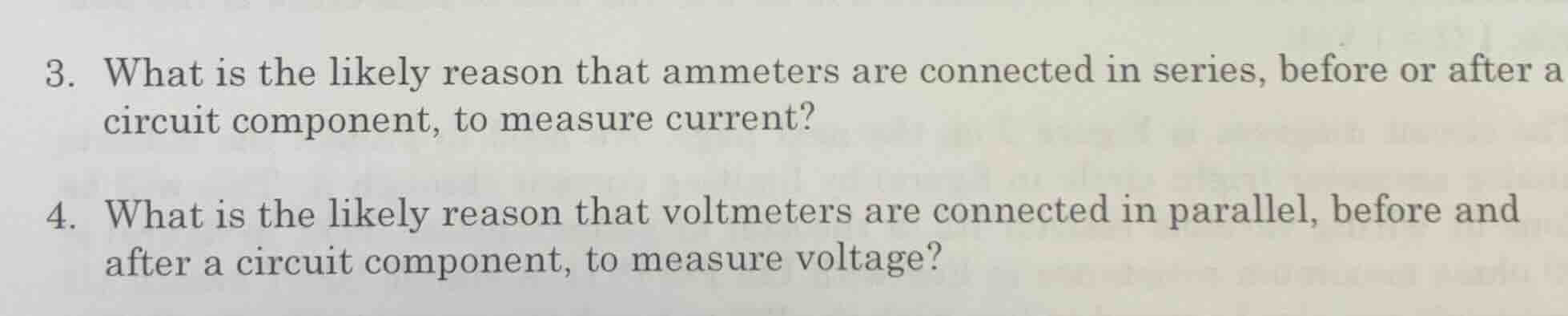
- what is the likely reason that ammeters are connected in series, before or after a circuit component, to measure current?
- what is the likely reason that voltmeters are connected in parallel, before and after a circuit component, to measure voltage?
Analyze current in series circuits
In a series circuit, the electric current flowing through components connected in a single path is identical at every point. To measure the exact current passing through a specific circuit component, an ammeter must experience that same flow. Therefore, it is connected in series so that all the charge carriers passing through the component also pass directly through the ammeter.
Consider ammeter resistance
An ideal ammeter has zero electrical resistance. This design ensures that when it is placed in series, it does not add significant resistance to the branch, which would otherwise decrease the overall current it is trying to measure.
Analyze voltage in parallel circuits
Voltage (electric potential difference) is measured between two distinct points in a circuit. To find the potential drop across a specific component, a measuring device must be connected to the circuit both before and after that component. This side-by-side configuration is a parallel connection.
Consider voltmeter resistance
An ideal voltmeter has infinite electrical resistance. This extremely high resistance ensures that when connected in parallel, virtually no current is diverted away from the main component through the voltmeter, preserving the original state of the circuit.

Snap & solve any problem in the app
Get step-by-step solutions on Sovi AI
Photo-based solutions with guided steps
Explore more problems and detailed explanations
Question 3
Ammeter connection in series ensures that the entire current flowing through the circuit component passes directly through the ammeter, as current is constant along a single series path.
Question 4
Voltmeter connection in parallel allows the device to measure the difference in electrical potential between two distinct points (before and after the component) without diverting significant current from the component.