QUESTION IMAGE
Question
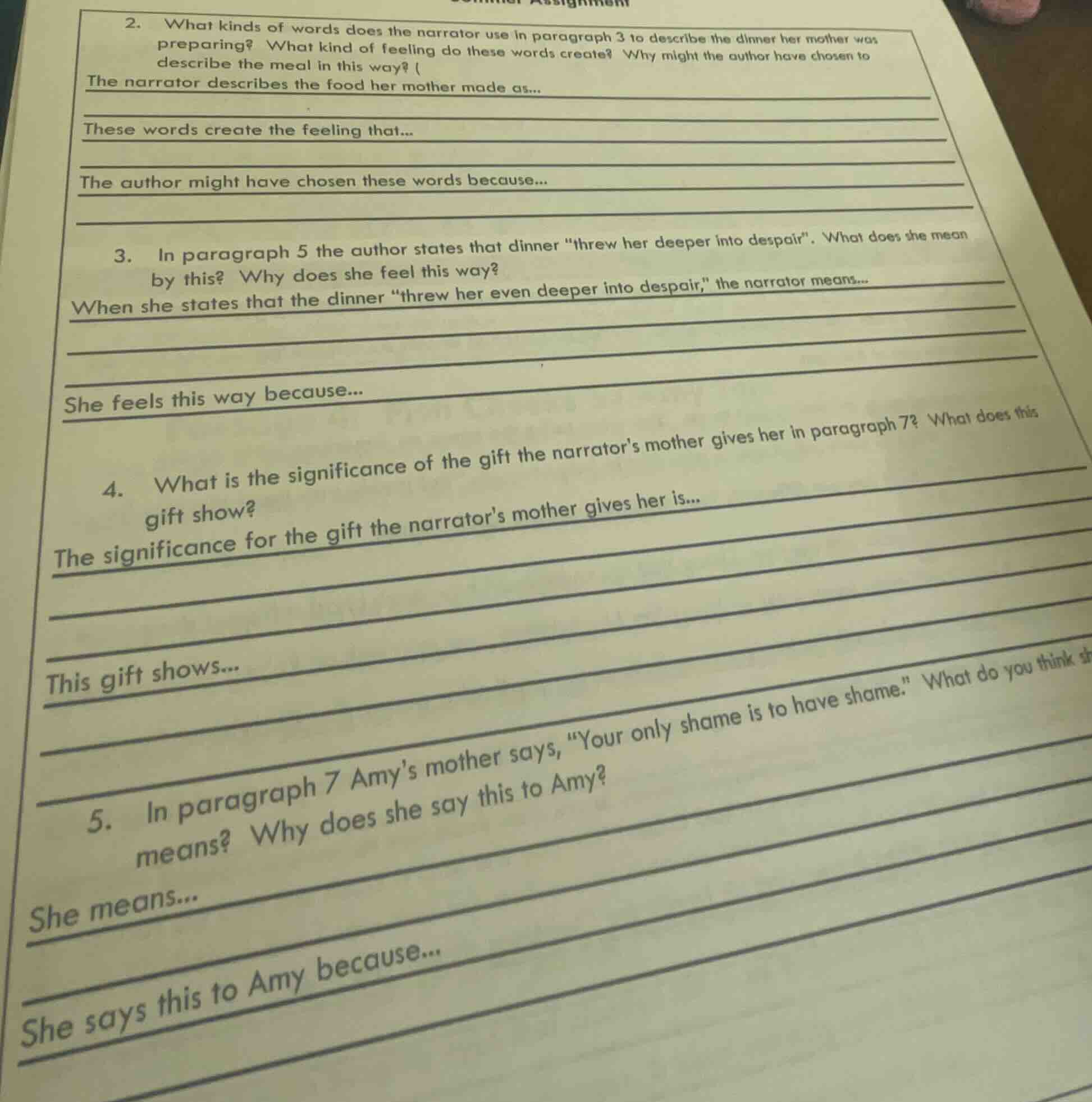
- what kinds of words does the narrator use in paragraph 3 to describe the dinner her mother was preparing? what kind of feeling do these words create? why might the author have chosen to describe the meal in this way?
the narrator describes the food her mother made as...
these words create the feeling that...
the author might have chosen these words because...
- in paragraph 5 the author states that dinner \threw her deeper into despair\. what does she mean by this? why does she feel this way?
when she states that the dinner \threw her even deeper into despair,\ the narrator means...
she feels this way because...
- what is the significance of the gift the narrators mother gives her in paragraph 7? what does this gift show?
the significance for the gift the narrators mother gives her is...
this gift shows...
- in paragraph 7 amys mother says, \your only shame is to have shame.\ what do you think she means? why does she say this to amy?
she means...
she says this to amy because...
Analyze the literary context
The questions refer to Amy Tan's short story "Fish Cheeks." We must analyze the narrator's feelings, the mother's actions, and the central themes of cultural identity and self-acceptance.
Examine paragraph 3 descriptions
In paragraph 3, the narrator uses sensory, raw, and unappealing words to describe the traditional Chinese food (e.g., "slimy rock cod," "rubbery white sponges"). This creates a feeling of disgust and embarrassment, highlighting her desire to fit into American culture.
Interpret paragraph 5 despair
The phrase "threw her deeper into despair" reflects Amy's intense teenage mortification. She feels this way because she is deeply self-conscious about her family's Chinese customs in front of her white, American crush, Robert, and his family.
Evaluate the gift in paragraph 7
The mother gives Amy a beige tweed miniskirt, which represents an acknowledgment of Amy's desire to look like an American girl. However, it is given alongside the reminder of her true identity, showing that her mother understands her struggle but wants her to remain proud of her heritage.
Analyze the mother's quote
Using Thematic Analysis, we interpret "Your only shame is to have shame." The mother means that being different or Chinese is not shameful; the only true disgrace is being embarrassed by one's own identity. She says this to help Amy realize that she should embrace her heritage rather than hide it.

Snap & solve any problem in the app
Get step-by-step solutions on Sovi AI
Photo-based solutions with guided steps
Explore more problems and detailed explanations
Question 2
The narrator describes the food her mother made as... strange, unappealing, and foreign, using vivid sensory descriptions such as "slimy rock cod" and "rubbery white sponges."
These words create the feeling that... the meal is bizarre, unappetizing, and deeply embarrassing to the young narrator.
The author might have chosen these words because... she wanted to emphasize her teenage perspective of dread and her intense desire to fit into mainstream American culture.
Question 3
When she states that the dinner "threw her even deeper into despair," the narrator means... she felt an overwhelming sense of shame and hopelessness as the cultural differences between her family and her guests became painfully obvious.
She feels this way because... she is deeply self-conscious about her family's loud Chinese manners and traditional food in front of Robert, the white minister's son whom she admires.
Question 4
The significance for the gift the narrator's mother gives her is... it represents a bridge between her Chinese heritage and her desire to fit into American society.
This gift shows... that her mother understands her daughter's inner conflict and wish to be a typical American teenage girl, while still loving her unconditionally.
Question 5
She means... that there is no inherent shame in her cultural background or who she is; the only real shame is being embarrassed by her own identity and family.
She says this to Amy because... she wants to teach her daughter to value her heritage and understand that she can adopt American styles on the outside while remaining proud of her Chinese identity on the inside.