QUESTION IMAGE
Question
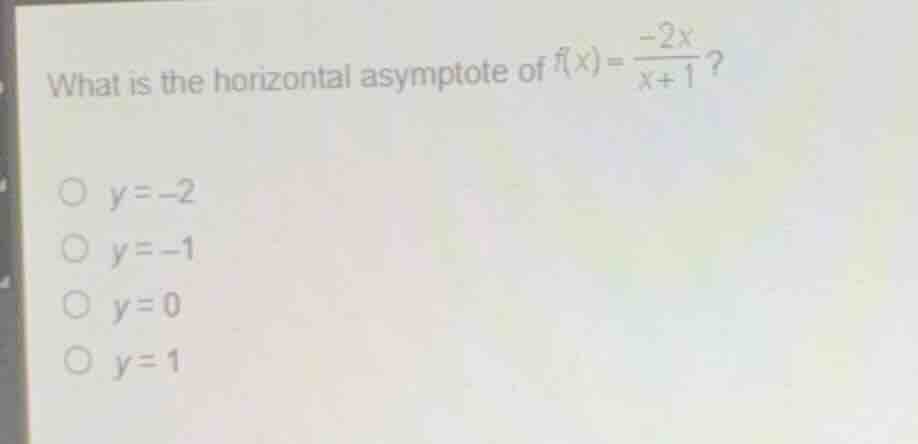
what is the horizontal asymptote of \\(f(x) = \frac{-2x}{x+1}\\)?
\\(y = -2\\)
\\(y = -1\\)
\\(y = 0\\)
\\(y = 1\\)
Identify the degrees of the numerator and denominator
The given rational function is:
$$f(x) = \frac{-2x}{x + 1}$$
The numerator is \(p(x) = -2x\), which has degree \(n = 1\).
The denominator is \(q(x) = x + 1\), which has degree \(m = 1\).
Compare degrees and find the ratio of leading coefficients
Since the degrees of the numerator and denominator are equal (\(n = m = 1\)), the horizontal asymptote is determined by the ratio of their leading coefficients:
$$y = \frac{\text{leading coefficient of } p(x)}{\text{leading coefficient of } q(x)}$$
The leading coefficient of the numerator is \(-2\), and the leading coefficient of the denominator is \(1\).
Calculate the horizontal asymptote
$$y = \frac{-2}{1} = -2$$
Thus, the horizontal asymptote is \(y = -2\).

Snap & solve any problem in the app
Get step-by-step solutions on Sovi AI
Photo-based solutions with guided steps
Explore more problems and detailed explanations
- (A) \(y = -2\) (Correct answer)
- (B) \(y = -1\)
- (C) \(y = 0\)
- (D) \(y = 1\)