Sovi.AI - AI Math Tutor

Scan to solve math questions

QUESTION IMAGE

what happened after british soldiers killed five colonists in the bosto…

Question

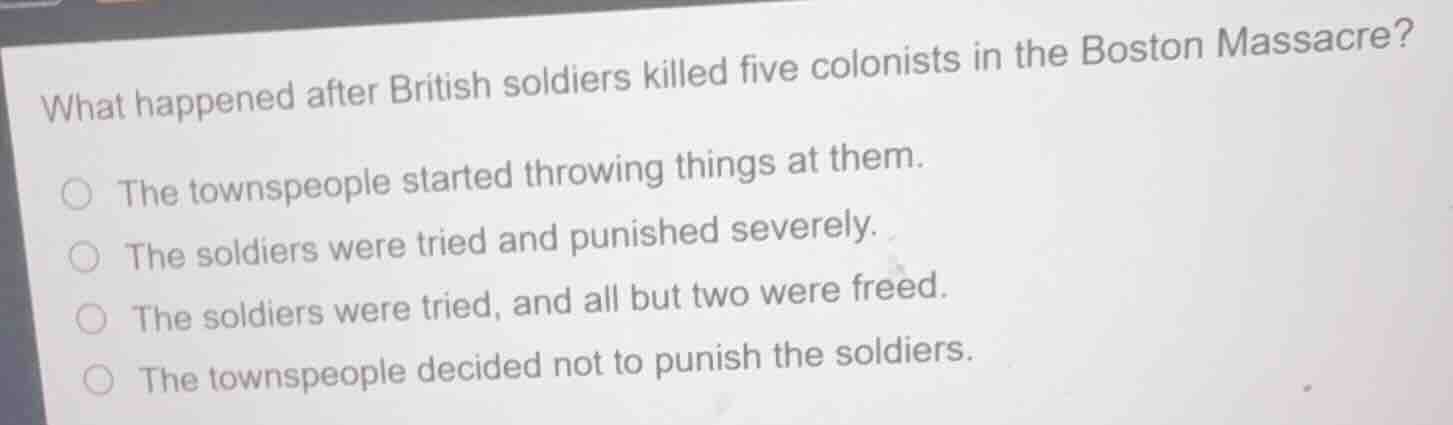
what happened after british soldiers killed five colonists in the boston massacre?

the townspeople started throwing things at them.
the soldiers were tried and punished severely.
the soldiers were tried, and all but two were freed.
the townspeople decided not to punish the soldiers.

Explanation:

Response

<pre_analysis>
{
"quality": "clear",
"question_count": 1,
"skills_matched": [
"direct_cot",
"multiple_choice_formatter",
"explain_then_answer",
"tutor"
],
"needs_drawing": false,
"concepts_used": [],
"new_concepts": [
"Boston Massacre",
"John Adams Trial",
"Colonial Justice"
],
"current_concepts": [
"Boston Massacre",
"John Adams Trial",
"Colonial Justice"
]
}
</pre_analysis>

<reasoning>

Analyze the historical context of the Boston Massacre

The Boston Massacre occurred on March 5, 1770, when British soldiers fired into an angry mob of colonists, killing five people. The throwing of objects by townspeople actually preceded and triggered the shooting, rather than happening after it.

Examine the legal aftermath and trials

Following the event, the British soldiers involved, including Captain Thomas Preston, were arrested and put on trial in Boston. They were defended by John Adams, a prominent colonial lawyer and future U.S. President, who wanted to ensure they received a fair trial to demonstrate the colonies' commitment to justice and the rule of law.

Evaluate the trial outcomes

During the trials in late 1770, Captain Preston and six of the soldiers were acquitted (freed). Two soldiers, Hugh Montgomery and Matthew Kilroy, were found guilty of manslaughter. They were punished by having their thumbs branded before being released. Therefore, the soldiers were tried, and all but two were freed.
</reasoning>

<answer>
<mcq-option>The townspeople started throwing things at them.</mcq-option>
<mcq-option>The soldiers were tried and punished severely.</mcq-option>
<mcq-correct>The soldiers were tried, and all but two were freed.</mcq-correct>
<mcq-option>The townspeople decided not to punish the soldiers.</mcq-option>
</answer>

<post_analysis>
{
"subject": "Social Science",
"question_type": "Multiple Choice",
"knowledge_point": [
"Social Science",
"U.S. History",
"Boston Massacre"
]
}
</post_analysis>

Answer:

<pre_analysis>
{
"quality": "clear",
"question_count": 1,
"skills_matched": [
"direct_cot",
"multiple_choice_formatter",
"explain_then_answer",
"tutor"
],
"needs_drawing": false,
"concepts_used": [],
"new_concepts": [
"Boston Massacre",
"John Adams Trial",
"Colonial Justice"
],
"current_concepts": [
"Boston Massacre",
"John Adams Trial",
"Colonial Justice"
]
}
</pre_analysis>

<reasoning>

Analyze the historical context of the Boston Massacre

The Boston Massacre occurred on March 5, 1770, when British soldiers fired into an angry mob of colonists, killing five people. The throwing of objects by townspeople actually preceded and triggered the shooting, rather than happening after it.

Examine the legal aftermath and trials

Following the event, the British soldiers involved, including Captain Thomas Preston, were arrested and put on trial in Boston. They were defended by John Adams, a prominent colonial lawyer and future U.S. President, who wanted to ensure they received a fair trial to demonstrate the colonies' commitment to justice and the rule of law.

Evaluate the trial outcomes

During the trials in late 1770, Captain Preston and six of the soldiers were acquitted (freed). Two soldiers, Hugh Montgomery and Matthew Kilroy, were found guilty of manslaughter. They were punished by having their thumbs branded before being released. Therefore, the soldiers were tried, and all but two were freed.
</reasoning>

<answer>
<mcq-option>The townspeople started throwing things at them.</mcq-option>
<mcq-option>The soldiers were tried and punished severely.</mcq-option>
<mcq-correct>The soldiers were tried, and all but two were freed.</mcq-correct>
<mcq-option>The townspeople decided not to punish the soldiers.</mcq-option>
</answer>

<post_analysis>
{
"subject": "Social Science",
"question_type": "Multiple Choice",
"knowledge_point": [
"Social Science",
"U.S. History",
"Boston Massacre"
]
}
</post_analysis>