Sovi.AI - AI Math Tutor

Scan to solve math questions

QUESTION IMAGE

what is the domain of this quadratic function? \\(-\\infty < x < \\inft…

Question

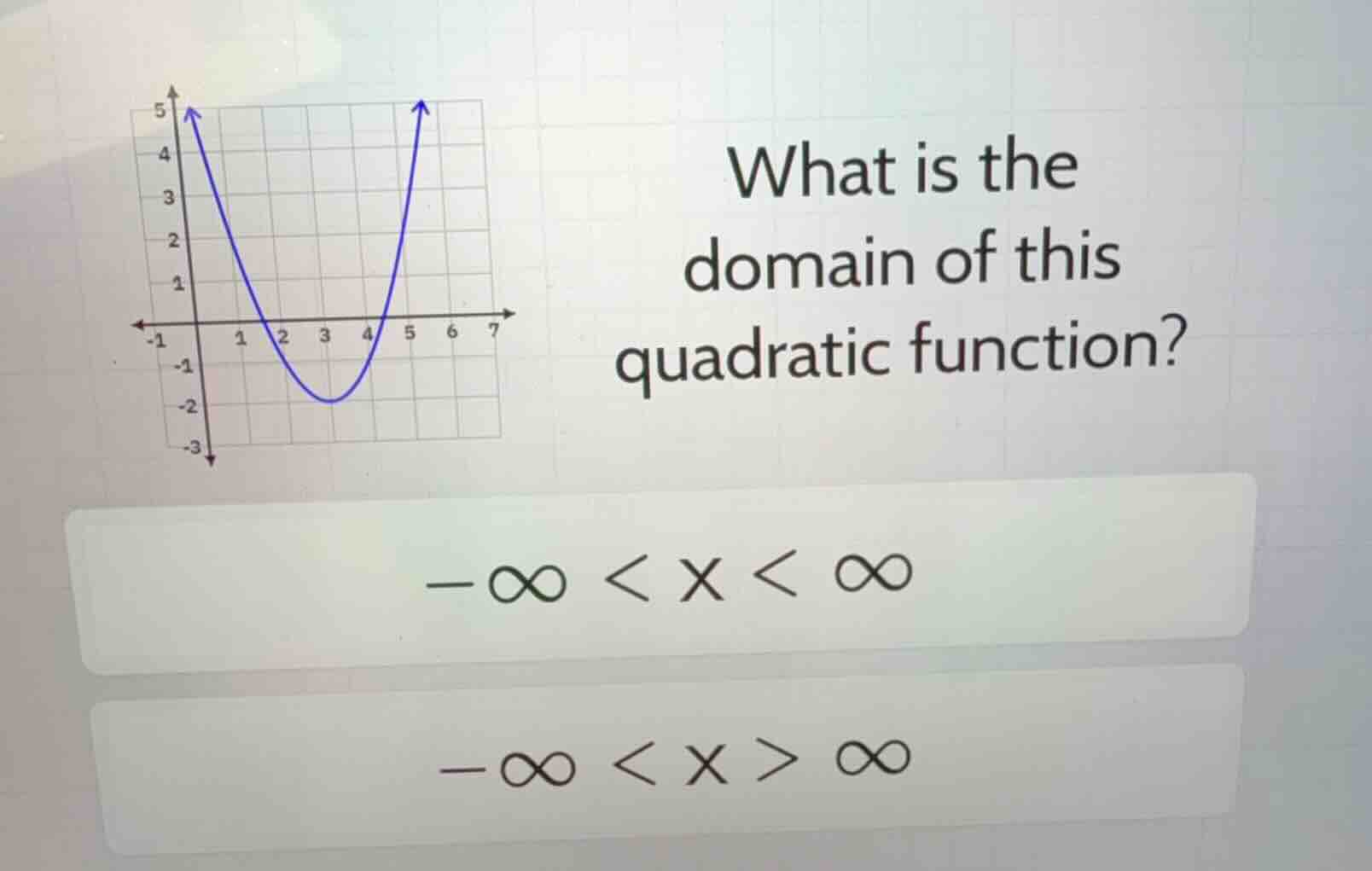
what is the domain of this quadratic function?

\\(-\infty < x < \infty\\)

\\(-\infty < x > \infty\\)

Explanation:

Response

<pre_analysis>
{
"quality": "clear",
"question_count": 1,
"skills_matched": [
"step_cot",
"multiple_choice_formatter",
"explain_then_answer",
"tutor"
],
"needs_drawing": false,
"concepts_used": [],
"new_concepts": [
"Domain of Quadratic Functions",
"Interval Notation"
],
"current_concepts": [
"Domain of Quadratic Functions",
"Interval Notation",
"Quadratic Graphs"
]
}
</pre_analysis>

<reasoning>

Identify the definition of domain

The domain of a function represents all possible input values, typically represented by the variable \(x\), for which the function is defined. On a graph, we determine the domain by looking at the horizontal span of the curve from left to right.

Analyze the graph of the quadratic function

The graph is a parabola that opens upwards. The arrows on both ends of the curve indicate that the graph continues infinitely upwards and outwards to both the left and the right.

Determine the horizontal span

Because the parabola extends infinitely to the left and to the right, there are no restrictions on the \(x\)-values. The function is defined for all real numbers.

Express the domain in inequality notation

To represent "all real numbers" using inequalities, we write that \(x\) is strictly greater than negative infinity and strictly less than positive infinity:
\[-\infty < x < \infty\]

Compare with the given options

We compare this result with the two choices shown in the image:

  1. \(-\infty < x < \infty\)
  2. \(-\infty < x > \infty\)

The first option correctly represents the interval of all real numbers.
</reasoning>

<answer>
<mcq-correct>(A) \(-\infty < x < \infty\)</mcq-correct>
<mcq-option>(B) \(-\infty < x > \infty\)</mcq-option>
</answer>

<post_analysis>
{
"subject": "Mathematics",
"question_type": "Multiple Choice",
"knowledge_point": [
"Mathematics",
"Algebra",
"Domain of Quadratic Functions"
]
}
</post_analysis>

Answer:

<pre_analysis>
{
"quality": "clear",
"question_count": 1,
"skills_matched": [
"step_cot",
"multiple_choice_formatter",
"explain_then_answer",
"tutor"
],
"needs_drawing": false,
"concepts_used": [],
"new_concepts": [
"Domain of Quadratic Functions",
"Interval Notation"
],
"current_concepts": [
"Domain of Quadratic Functions",
"Interval Notation",
"Quadratic Graphs"
]
}
</pre_analysis>

<reasoning>

Identify the definition of domain

The domain of a function represents all possible input values, typically represented by the variable \(x\), for which the function is defined. On a graph, we determine the domain by looking at the horizontal span of the curve from left to right.

Analyze the graph of the quadratic function

The graph is a parabola that opens upwards. The arrows on both ends of the curve indicate that the graph continues infinitely upwards and outwards to both the left and the right.

Determine the horizontal span

Because the parabola extends infinitely to the left and to the right, there are no restrictions on the \(x\)-values. The function is defined for all real numbers.

Express the domain in inequality notation

To represent "all real numbers" using inequalities, we write that \(x\) is strictly greater than negative infinity and strictly less than positive infinity:
\[-\infty < x < \infty\]

Compare with the given options

We compare this result with the two choices shown in the image:

  1. \(-\infty < x < \infty\)
  2. \(-\infty < x > \infty\)

The first option correctly represents the interval of all real numbers.
</reasoning>

<answer>
<mcq-correct>(A) \(-\infty < x < \infty\)</mcq-correct>
<mcq-option>(B) \(-\infty < x > \infty\)</mcq-option>
</answer>

<post_analysis>
{
"subject": "Mathematics",
"question_type": "Multiple Choice",
"knowledge_point": [
"Mathematics",
"Algebra",
"Domain of Quadratic Functions"
]
}
</post_analysis>