QUESTION IMAGE
Question
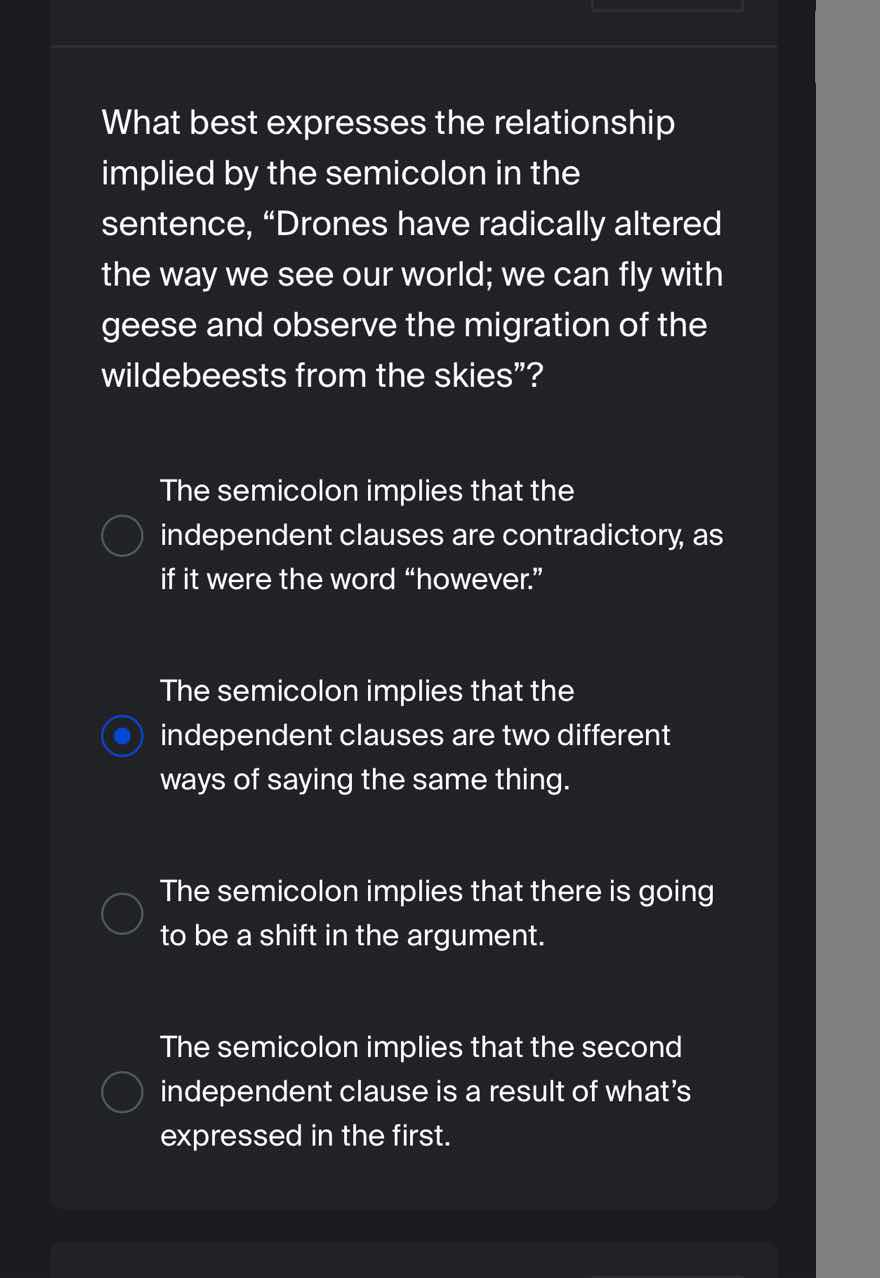
what best expresses the relationship implied by the semicolon in the sentence, \drones have radically altered the way we see our world; we can fly with geese and observe the migration of the wildebeests from the skies\?
- the semicolon implies that the independent clauses are contradictory, as if it were the word \however.\
- the semicolon implies that the independent clauses are two different ways of saying the same thing.
- the semicolon implies that there is going to be a shift in the argument.
- the semicolon implies that the second independent clause is a result of whats expressed in the first.
Analyze the relationship between the clauses
The first independent clause states: "Drones have radically altered the way we see our world."
The second independent clause states: "we can fly with geese and observe the migration of the wildebeests from the skies."
The second clause provides concrete examples of how drones have altered our view of the world, demonstrating a cause-and-effect or result relationship where the second clause is a direct consequence or illustration of the first.
Evaluate the options
- Option 1 suggests contradiction ("however"), which is incorrect because the clauses support each other.
- Option 2 suggests they say the same thing, which is incorrect because the first is a general statement and the second is a specific set of examples/consequences.
- Option 3 suggests a shift in the argument, which is incorrect because the argument continues in the same direction.
- Option 4 suggests the second clause is a result of the first, which is correct because being able to fly with geese and observe migrations is a direct result of drones altering how we see the world.

Snap & solve any problem in the app
Get step-by-step solutions on Sovi AI
Photo-based solutions with guided steps
Explore more problems and detailed explanations
- The semicolon implies that the independent clauses are contradictory, as if it were the word "however."
- The semicolon implies that the independent clauses are two different ways of saying the same thing.
- The semicolon implies that there is going to be a shift in the argument.
- The semicolon implies that the second independent clause is a result of what's expressed in the first. (Correct answer)