QUESTION IMAGE
Question
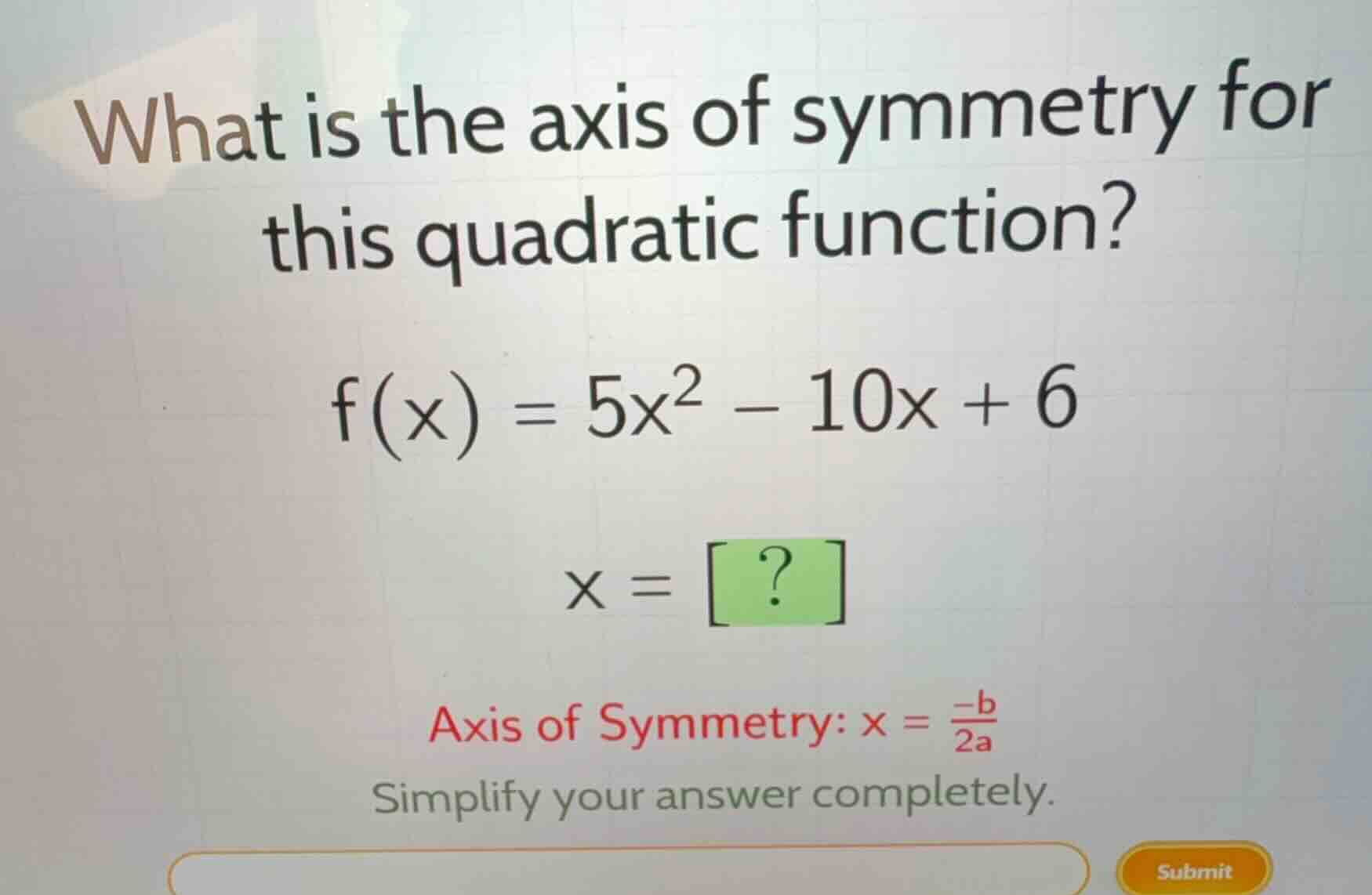
what is the axis of symmetry for this quadratic function?
(f(x) = 5x^2 - 10x + 6)
(x = ?)
axis of symmetry: (x = \frac{-b}{2a})
simplify your answer completely.
<pre_analysis>
{
"quality": "clear",
"question_count": 1,
"skills_matched": [
"step_cot",
"blank_filling_formatter",
"explain_then_answer",
"tutor"
],
"needs_drawing": false,
"concepts_used": [],
"new_concepts": [
"Axis of Symmetry",
"Quadratic Standard Form"
],
"current_concepts": [
"Axis of Symmetry",
"Quadratic Standard Form"
]
}
</pre_analysis>
<reasoning>
Identify the coefficients of the quadratic function
To find the axis of symmetry, we first identify the coefficients \(a\), \(b\), and \(c\) from the standard form of the quadratic function \(f(x) = ax^2 + bx + c\).
Given:
\[f(x) = 5x^2 - 10x + 6\]
Comparing this to the standard form:
\[a = 5\]
\[b = -10\]
\[c = 6\]
Apply the axis of symmetry formula
The formula for the axis of symmetry of a parabola in standard form is:
\[x = \frac{-b}{2a}\]
Substituting our identified values \(a = 5\) and \(b = -10\) into the formula:
\[x = \frac{-(-10)}{2(5)}\]
Simplify the expression
Now we simplify the numerator and the denominator to find the final value of \(x\):
\[x = \frac{10}{10}\]
\[x = 1\]
This vertical line \(x = 1\) represents the axis of symmetry.
</reasoning>
<answer>
What is the axis of symmetry for this quadratic function?
\(f(x) = 5x^2 - 10x + 6\)
\(x =\) <blank>1</blank>
</answer>
<post_analysis>
{
"subject": "Mathematics",
"question_type": "Fill-in-the-blank",
"knowledge_point": [
"Mathematics",
"Algebra",
"Axis of Symmetry"
]
}
</post_analysis>
Snap & solve any problem in the app
Get step-by-step solutions on Sovi AI
Photo-based solutions with guided steps
Explore more problems and detailed explanations
<pre_analysis>
{
"quality": "clear",
"question_count": 1,
"skills_matched": [
"step_cot",
"blank_filling_formatter",
"explain_then_answer",
"tutor"
],
"needs_drawing": false,
"concepts_used": [],
"new_concepts": [
"Axis of Symmetry",
"Quadratic Standard Form"
],
"current_concepts": [
"Axis of Symmetry",
"Quadratic Standard Form"
]
}
</pre_analysis>
<reasoning>
Identify the coefficients of the quadratic function
To find the axis of symmetry, we first identify the coefficients \(a\), \(b\), and \(c\) from the standard form of the quadratic function \(f(x) = ax^2 + bx + c\).
Given:
\[f(x) = 5x^2 - 10x + 6\]
Comparing this to the standard form:
\[a = 5\]
\[b = -10\]
\[c = 6\]
Apply the axis of symmetry formula
The formula for the axis of symmetry of a parabola in standard form is:
\[x = \frac{-b}{2a}\]
Substituting our identified values \(a = 5\) and \(b = -10\) into the formula:
\[x = \frac{-(-10)}{2(5)}\]
Simplify the expression
Now we simplify the numerator and the denominator to find the final value of \(x\):
\[x = \frac{10}{10}\]
\[x = 1\]
This vertical line \(x = 1\) represents the axis of symmetry.
</reasoning>
<answer>
What is the axis of symmetry for this quadratic function?
\(f(x) = 5x^2 - 10x + 6\)
\(x =\) <blank>1</blank>
</answer>
<post_analysis>
{
"subject": "Mathematics",
"question_type": "Fill-in-the-blank",
"knowledge_point": [
"Mathematics",
"Algebra",
"Axis of Symmetry"
]
}
</post_analysis>