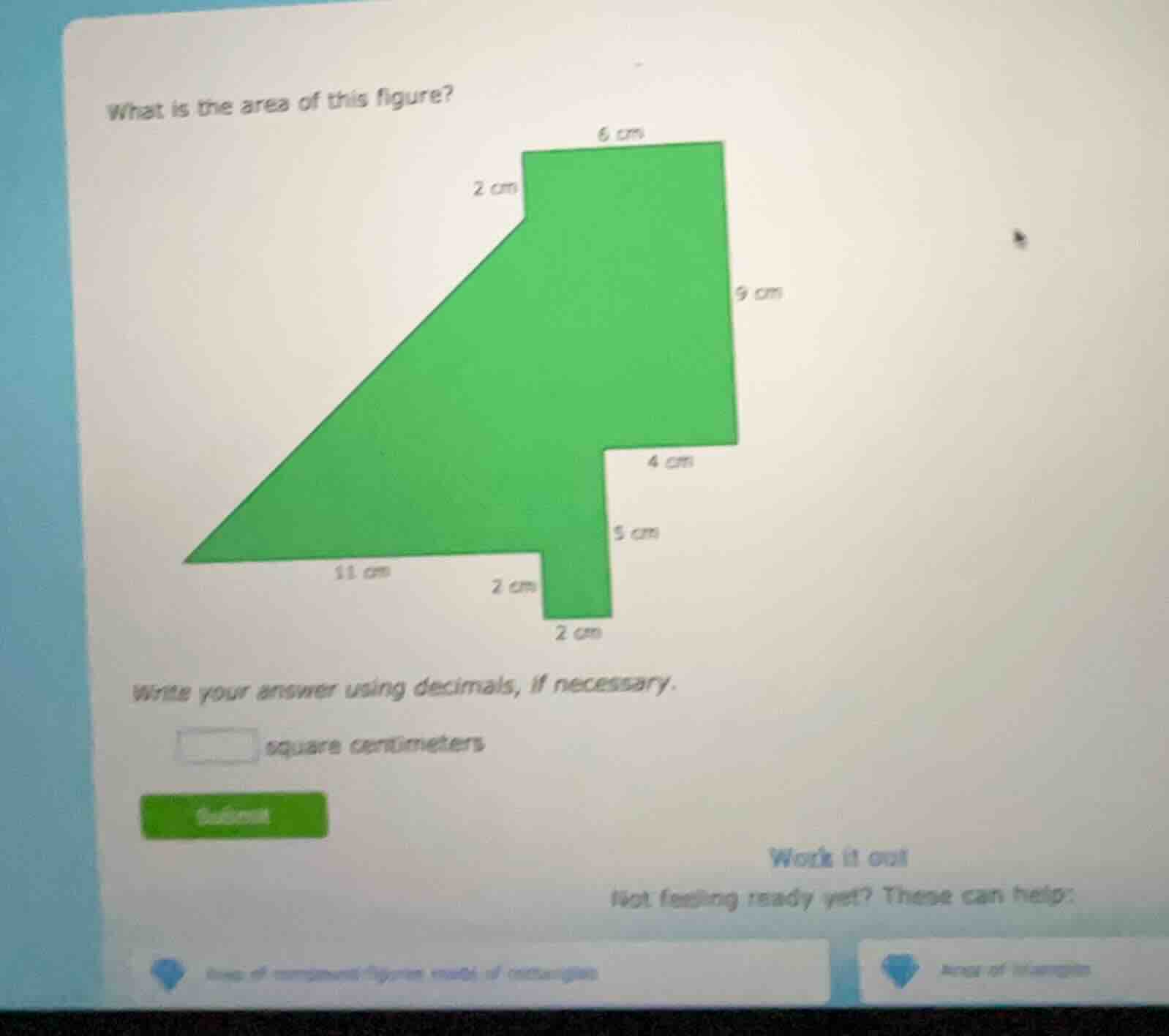
QUESTION IMAGE
Question
what is the area of this figure?
write your answer using decimals, if necessary.
square centimeters
<pre_analysis>
{
"quality": "clear",
"question_count": 1,
"skills_matched": [
"step_cot",
"blank_filling_formatter",
"explain_then_answer",
"tutor"
],
"needs_drawing": true,
"concepts_used": [
"Area of Composite Figures"
],
"new_concepts": [
"Area of Triangles",
"Area of Rectangles"
],
"current_concepts": [
"Area of Composite Figures",
"Area of Triangles",
"Area of Rectangles"
]
}
</pre_analysis>
<reasoning>
Decompose the composite figure
We decompose the shape into three simpler, non-overlapping regions:
- A bottom-right small rectangle of dimensions \(2\text{ cm} \times 2\text{ cm}\).
- A central rectangle. The top edge of this section is \(6\text{ cm}\). The right vertical edge is \(9\text{ cm}\). The bottom-right horizontal cutout has length \(4\text{ cm}\), meaning the width of the lower part of this central column is \(6 - 4 = 2\text{ cm}\). The vertical drop of this lower part is \(5\text{ cm}\). Thus, the total height of this central column is \(9 + 5 = 14\text{ cm}\). We can split this central column into:
- A top rectangle of \(6\text{ cm} \times 9\text{ cm}\).
- A middle-lower vertical strip of \(2\text{ cm} \times 5\text{ cm}\) extending downwards.
- A left triangular region. The vertical side of this triangle is adjacent to the central column. The top vertical segment of the central column's left side is \(2\text{ cm}\). The total height of the central column is \(14\text{ cm}\). The bottom of the triangle aligns with the horizontal line of length \(11\text{ cm}\). The vertical height of the triangle is \(14 - 2 = 12\text{ cm}\). The base of the triangle is \(11\text{ cm}\).
Calculate the area of each region
Using the Area of Composite Figures concept, we calculate the area of each decomposed part:
- Part 1 (Triangle on the left):
\[
\text{Area}_1 = \frac{1}{2} \times \text{base} \times \text{height} = \frac{1}{2} \times 11 \times 12 = 66\text{ cm}^2
\]
- Part 2 (Top-right rectangle):
\[
\text{Area}_2 = \text{width} \times \text{height} = 6 \times 9 = 54\text{ cm}^2
\]
- Part 3 (Middle-lower vertical strip):
\[
\text{Area}_3 = \text{width} \times \text{height} = 2 \times 5 = 10\text{ cm}^2
\]
- Part 4 (Bottom-right small rectangle):
\[
\text{Area}_4 = \text{width} \times \text{height} = 2 \times 2 = 4\text{ cm}^2
\]
Sum the areas
We add the areas of all four parts to find the total area:
\[
\text{Total Area} = \text{Area}_1 + \text{Area}_2 + \text{Area}_3 + \text{Area}_4
\]
\[
\text{Total Area} = 66 + 54 + 10 + 4 = 134\text{ cm}^2
\]
</reasoning>
<answer>
What is the area of this figure?
Write your answer using decimals, if necessary.
<blank>134</blank> square centimeters
</answer>
<plot>
{
"elements": [
{
"type": "polygon",
"params": [
[-11, 0],
[0, 0],
[0, -2],
[2, -2],
[2, 0],
[2, 5],
[6, 5],
[6, 14],
[0, 14],
[0, 12]
],
"properties": {
"fillColor": "rgba(140, 85, 242, 0.3)",
"strokeColor": "#8C55F2",
"strokeWidth": 2,
"name": "Composite Figure"
}
},
{
"type": "segment",
"params": [[0, 0], [0, 12]],
"properties": {
"strokeColor": "#5583F2",
"strokeWidth": 1,
"dash": 2
}
},
{
"type": "segment",
"params": [[0, 5], [2, 5]],
"properties": {
"strokeColor": "#5583F2",
"strokeWidth": 1,
"dash": 2
}
},
{
"type": "text",
"params…
Snap & solve any problem in the app
Get step-by-step solutions on Sovi AI
Photo-based solutions with guided steps
Explore more problems and detailed explanations
<pre_analysis>
{
"quality": "clear",
"question_count": 1,
"skills_matched": [
"step_cot",
"blank_filling_formatter",
"explain_then_answer",
"tutor"
],
"needs_drawing": true,
"concepts_used": [
"Area of Composite Figures"
],
"new_concepts": [
"Area of Triangles",
"Area of Rectangles"
],
"current_concepts": [
"Area of Composite Figures",
"Area of Triangles",
"Area of Rectangles"
]
}
</pre_analysis>
<reasoning>
Decompose the composite figure
We decompose the shape into three simpler, non-overlapping regions:
- A bottom-right small rectangle of dimensions \(2\text{ cm} \times 2\text{ cm}\).
- A central rectangle. The top edge of this section is \(6\text{ cm}\). The right vertical edge is \(9\text{ cm}\). The bottom-right horizontal cutout has length \(4\text{ cm}\), meaning the width of the lower part of this central column is \(6 - 4 = 2\text{ cm}\). The vertical drop of this lower part is \(5\text{ cm}\). Thus, the total height of this central column is \(9 + 5 = 14\text{ cm}\). We can split this central column into:
- A top rectangle of \(6\text{ cm} \times 9\text{ cm}\).
- A middle-lower vertical strip of \(2\text{ cm} \times 5\text{ cm}\) extending downwards.
- A left triangular region. The vertical side of this triangle is adjacent to the central column. The top vertical segment of the central column's left side is \(2\text{ cm}\). The total height of the central column is \(14\text{ cm}\). The bottom of the triangle aligns with the horizontal line of length \(11\text{ cm}\). The vertical height of the triangle is \(14 - 2 = 12\text{ cm}\). The base of the triangle is \(11\text{ cm}\).
Calculate the area of each region
Using the Area of Composite Figures concept, we calculate the area of each decomposed part:
- Part 1 (Triangle on the left):
\[
\text{Area}_1 = \frac{1}{2} \times \text{base} \times \text{height} = \frac{1}{2} \times 11 \times 12 = 66\text{ cm}^2
\]
- Part 2 (Top-right rectangle):
\[
\text{Area}_2 = \text{width} \times \text{height} = 6 \times 9 = 54\text{ cm}^2
\]
- Part 3 (Middle-lower vertical strip):
\[
\text{Area}_3 = \text{width} \times \text{height} = 2 \times 5 = 10\text{ cm}^2
\]
- Part 4 (Bottom-right small rectangle):
\[
\text{Area}_4 = \text{width} \times \text{height} = 2 \times 2 = 4\text{ cm}^2
\]
Sum the areas
We add the areas of all four parts to find the total area:
\[
\text{Total Area} = \text{Area}_1 + \text{Area}_2 + \text{Area}_3 + \text{Area}_4
\]
\[
\text{Total Area} = 66 + 54 + 10 + 4 = 134\text{ cm}^2
\]
</reasoning>
<answer>
What is the area of this figure?
Write your answer using decimals, if necessary.
<blank>134</blank> square centimeters
</answer>
<plot>
{
"elements": [
{
"type": "polygon",
"params": [
[-11, 0],
[0, 0],
[0, -2],
[2, -2],
[2, 0],
[2, 5],
[6, 5],
[6, 14],
[0, 14],
[0, 12]
],
"properties": {
"fillColor": "rgba(140, 85, 242, 0.3)",
"strokeColor": "#8C55F2",
"strokeWidth": 2,
"name": "Composite Figure"
}
},
{
"type": "segment",
"params": [[0, 0], [0, 12]],
"properties": {
"strokeColor": "#5583F2",
"strokeWidth": 1,
"dash": 2
}
},
{
"type": "segment",
"params": [[0, 5], [2, 5]],
"properties": {
"strokeColor": "#5583F2",
"strokeWidth": 1,
"dash": 2
}
},
{
"type": "text",
"params": [3, 14.5, "6 cm"],
"properties": {
"color": "#583C87"
}
},
{
"type": "text",
"params": [6.5, 9.5, "9 cm"],
"properties": {
"color": "#583C87"
}
},
{
"type": "text",
"params": [4, 4.5, "4 cm"],
"properties": {
"color": "#583C87"
}
},
{
"type": "text",
"params": [2.5, 2.5, "5 cm"],
"properties": {
"color": "#583C87"
}
},
{
"type": "text",
"params": [1, -2.5, "2 cm"],
"properties": {
"color": "#583C87"
}
},
{
"type": "text",
"params": [-0.8, -1, "2 cm"],
"properties": {
"color": "#583C87"
}
},
{
"type": "text",
"params": [-5.5, -0.5, "11 cm"],
"properties": {
"color": "#583C87"
}
},
{
"type": "text",
"params": [-0.8, 13, "2 cm"],
"properties": {
"color": "#583C87"
}
}
]
}
</plot>
<post_analysis>
{
"subject": "Mathematics",
"question_type": "Fill-in-the-blank",
"knowledge_point": [
"Mathematics",
"Geometry",
"Area of Composite Figures"
]
}
</post_analysis>