QUESTION IMAGE
Question
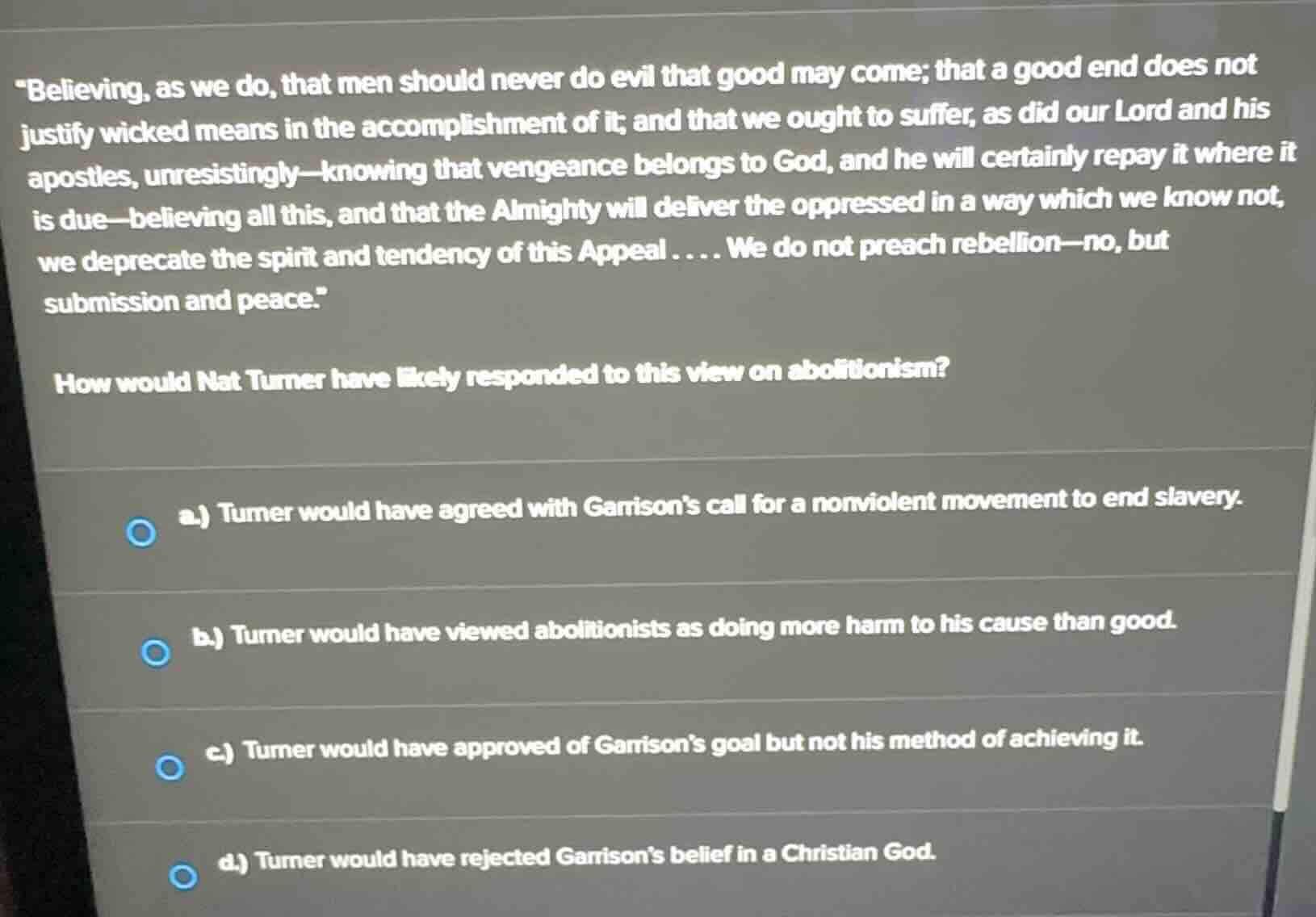
\believing, as we do, that men should never do evil that good may come; that a good end does not justify wicked means in the accomplishment of it; and that we ought to suffer, as did our lord and his apostles, unresistingly—knowing that vengeance belongs to god, and he will certainly repay it where it is due—believing all this, and that the almighty will deliver the oppressed in a way which we know not, we deprecate the spirit and tendency of this appeal.... we do not preach rebellion—no, but submission and peace.\
how would nat turner have likely responded to this view on abolitionism?
a.) turner would have agreed with garrisons call for a nonviolent movement to end slavery.
b.) turner would have viewed abolitionists as doing more harm to his cause than good.
c.) turner would have approved of garrisons goal but not his method of achieving it.
d.) turner would have rejected garrisons belief in a christian god.
Analyze the provided text
The quote advocates for nonresistance, submission, and peace, stating that "men should never do evil that good may come" and "we do not preach rebellion—no, but submission and peace." This represents the pacifist, moral suasion approach of William Lloyd Garrison and his followers, who rejected physical violence or armed rebellion to end slavery.
Analyze Nat Turner's perspective
Nat Turner was an enslaved preacher who led a major, violent armed rebellion in Virginia in 1831. He believed he was chosen by God to lead his people out of bondage through direct, armed struggle. Therefore, Turner shared the ultimate goal of ending slavery (abolitionism) but strongly disagreed with the pacifist method of submission and nonresistance.
Evaluate the options
- a.) Incorrect. Turner did not support nonviolence; he led an armed uprising.
- b.) Incorrect. Turner did not view abolitionists as doing more harm than good; he shared their goal of ending slavery.
- c.) Correct. Turner would have approved of the goal (abolishing slavery) but rejected the nonviolent, submissive method.
- d.) Incorrect. Turner was a deeply religious Christian preacher who acted on what he believed were divine signs, so he would not reject a belief in a Christian God.
Connect to historical concepts
Using the Resistance to Enslavement and Antebellum Slavery Debates knowledge points, we see the contrast between Garrison's moral suasion and Turner's armed resistance.

Snap & solve any problem in the app
Get step-by-step solutions on Sovi AI
Photo-based solutions with guided steps
Explore more problems and detailed explanations
- a.) Turner would have agreed with Garrison's call for a nonviolent movement to end slavery.
- b.) Turner would have viewed abolitionists as doing more harm to his cause than good.
- c.) Turner would have approved of Garrison's goal but not his method of achieving it. (Correct answer)
- d.) Turner would have rejected Garrison's belief in a Christian God.