QUESTION IMAGE
Question
warm-up
type your response in the box.
consider two situations:
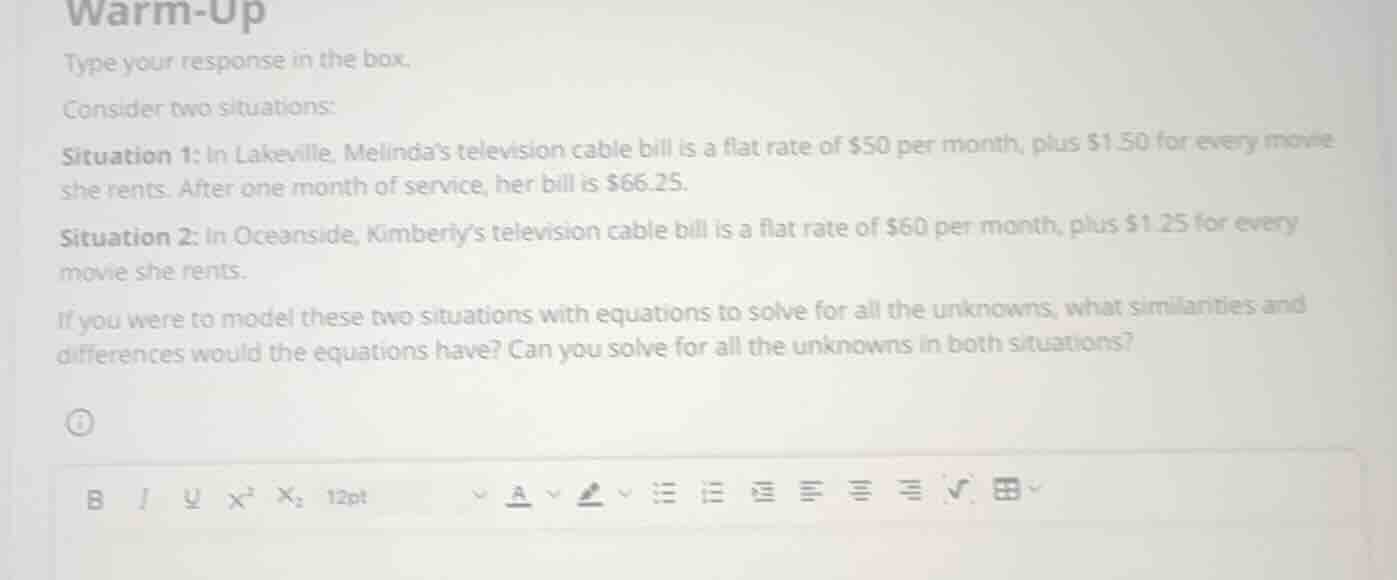
situation 1: in lakeville, melindas television cable bill is a flat rate of $50 per month, plus $1.50 for every movie she rents. after one month of service, her bill is $66.25.
situation 2: in oceanside, kimberlys television cable bill is a flat rate of $60 per month, plus $1.25 for every movie she rents.
if you were to model these two situations with equations to solve for all the unknowns, what similarities and differences would the equations have? can you solve for all the unknowns in both situations?
Formulate equations for both situations
Using the Linear Functions and Formulating Systems of Equations knowledge points
Compare similarities and differences
Both models represent linear relationships with a flat monthly fee (y-intercept) and a constant rate per movie (slope).
Situation 1 provides the total bill value \(B = 66.25\), leaving only one unknown variable \(m\).
Situation 2 does not provide a total bill value, leaving two unknown variables (\(m\) and \(B\)).
Determine solvability of the unknowns
For Situation 1, we have one equation with one unknown:
Since the number of movies \(m\) must be an integer, this situation contains a practical inconsistency, but mathematically it yields a unique solution.
For Situation 2, we have one equation with two unknowns (\(m\) and \(B\)), which has infinitely many solutions and cannot be solved uniquely.

Snap & solve any problem in the app
Get step-by-step solutions on Sovi AI
Photo-based solutions with guided steps
Explore more problems and detailed explanations
Similarities and Differences:
- Similarities: Both situations can be modeled using linear equations of the form \(y = mx + b\), where there is a constant rate of change (cost per movie) and a starting value (flat monthly rate).
- Differences: In Situation 1, the total bill is known (\(66.25\)), resulting in a single equation with one variable. In Situation 2, the total bill is unknown, resulting in a single equation with two variables.
Solvability:
- Situation 1: Can be solved because there is only one unknown variable. Solving \(50 + 1.50m = 66.25\) gives \(m \approx 10.83\) movies.
- Situation 2: Cannot be solved because there is only one equation for two unknown variables (the number of movies and the total bill), which yields infinitely many solutions.