Sovi.AI - AI Math Tutor

Scan to solve math questions

QUESTION IMAGE

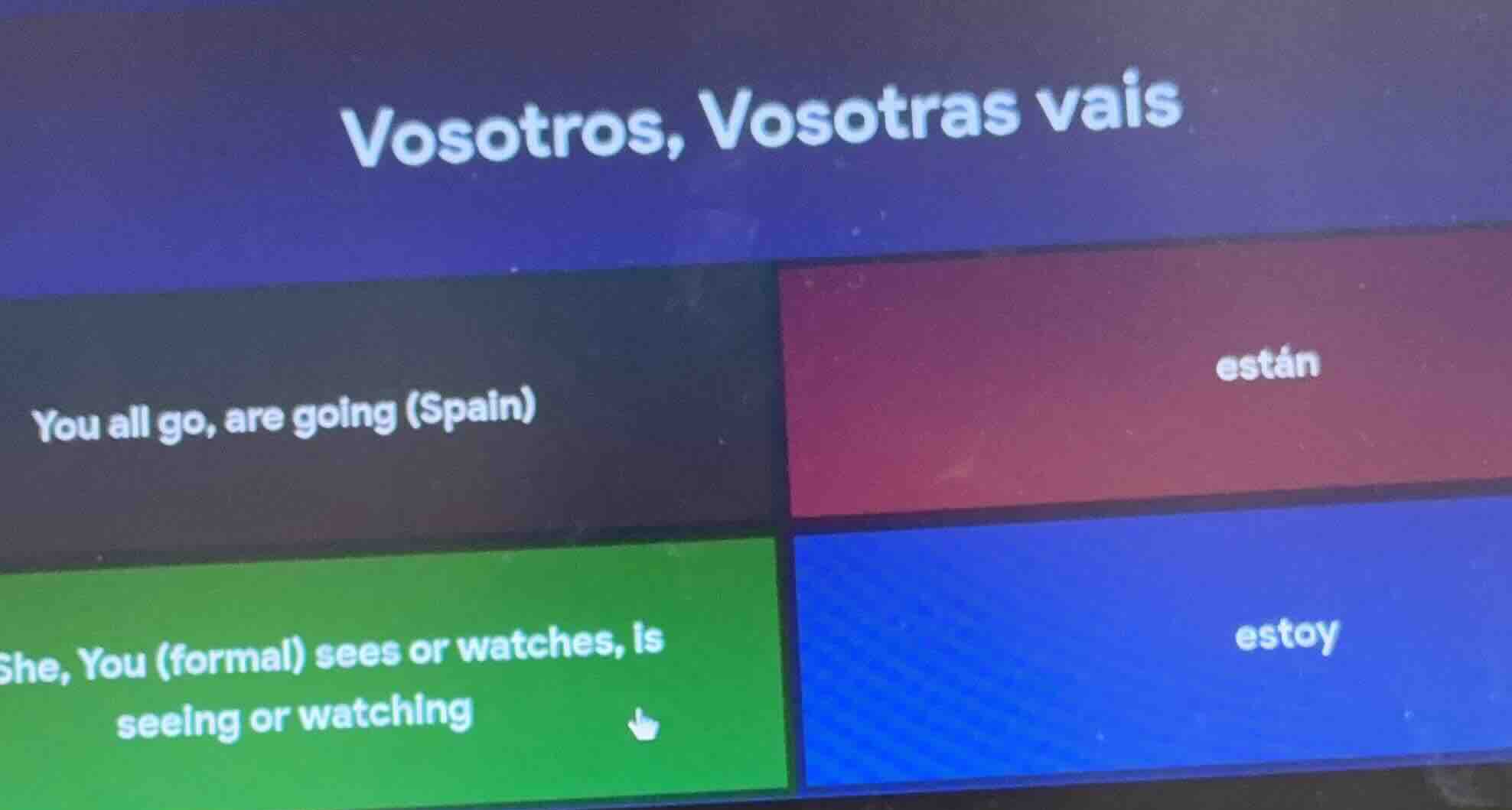
vosotros, vosotras vais you all go, are going (spain) están she, you (f…

Question

vosotros, vosotras vais

you all go, are going (spain)
están
she, you (formal) sees or watches, is seeing or watching
estoy

Explanation:

Response

<pre_analysis>
{
"quality": "clear",
"question_count": 1,
"skills_matched": [
"direct_cot",
"multiple_choice_formatter",
"explain_then_answer",
"quick"
],
"needs_drawing": false,
"concepts_used": [],
"new_concepts": [
"Spanish Verb Conjugation",
"Spanish Pronouns",
"Spanish Verb Translation"
],
"current_concepts": [
"Spanish Verb Conjugation",
"Spanish Pronouns",
"Spanish Verb Translation"
]
}
</pre_analysis>

<reasoning>

Identify the subject pronoun and verb form

The prompt displays "Vosotros, Vosotras vais".

  • "Vosotros" and "Vosotras" are the second-person plural pronouns ("you all") used primarily in Spain.
  • "Vais" is the present tense conjugation of the irregular verb "ir" (to go) corresponding to "vosotros/vosotras".

Translate the phrase to English

  • "Ir" means "to go".
  • "Vosotros, Vosotras vais" translates to "You all go" or "You all are going" (specifically used in Spain).

Evaluate the given options

  • Option 1 (Top-Left, Black): "You all go, are going (Spain)" matches the translation.
  • Option 2 (Top-Right, Red): "están" is a conjugated form of "estar" (to be).
  • Option 3 (Bottom-Left, Green): "She, You (formal) sees or watches, is seeing or watching" corresponds to "ve".
  • Option 4 (Bottom-Right, Blue): "estoy" is the first-person singular form of "estar" (I am).

</reasoning>

<answer>
<mcq-correct>(A) You all go, are going (Spain)</mcq-correct>
<mcq-option>(B) están</mcq-option>
<mcq-option>(C) She, You (formal) sees or watches, is seeing or watching</mcq-option>
<mcq-option>(D) estoy</mcq-option>
</answer>

<post_analysis>
{
"subject": "Others",
"question_type": "Multiple Choice",
"knowledge_point": [
"Others",
"Spanish",
"Spanish Verb Conjugation"
]
}
</post_analysis>

Answer:

<pre_analysis>
{
"quality": "clear",
"question_count": 1,
"skills_matched": [
"direct_cot",
"multiple_choice_formatter",
"explain_then_answer",
"quick"
],
"needs_drawing": false,
"concepts_used": [],
"new_concepts": [
"Spanish Verb Conjugation",
"Spanish Pronouns",
"Spanish Verb Translation"
],
"current_concepts": [
"Spanish Verb Conjugation",
"Spanish Pronouns",
"Spanish Verb Translation"
]
}
</pre_analysis>

<reasoning>

Identify the subject pronoun and verb form

The prompt displays "Vosotros, Vosotras vais".

  • "Vosotros" and "Vosotras" are the second-person plural pronouns ("you all") used primarily in Spain.
  • "Vais" is the present tense conjugation of the irregular verb "ir" (to go) corresponding to "vosotros/vosotras".

Translate the phrase to English

  • "Ir" means "to go".
  • "Vosotros, Vosotras vais" translates to "You all go" or "You all are going" (specifically used in Spain).

Evaluate the given options

  • Option 1 (Top-Left, Black): "You all go, are going (Spain)" matches the translation.
  • Option 2 (Top-Right, Red): "están" is a conjugated form of "estar" (to be).
  • Option 3 (Bottom-Left, Green): "She, You (formal) sees or watches, is seeing or watching" corresponds to "ve".
  • Option 4 (Bottom-Right, Blue): "estoy" is the first-person singular form of "estar" (I am).

</reasoning>

<answer>
<mcq-correct>(A) You all go, are going (Spain)</mcq-correct>
<mcq-option>(B) están</mcq-option>
<mcq-option>(C) She, You (formal) sees or watches, is seeing or watching</mcq-option>
<mcq-option>(D) estoy</mcq-option>
</answer>

<post_analysis>
{
"subject": "Others",
"question_type": "Multiple Choice",
"knowledge_point": [
"Others",
"Spanish",
"Spanish Verb Conjugation"
]
}
</post_analysis>