QUESTION IMAGE
Question
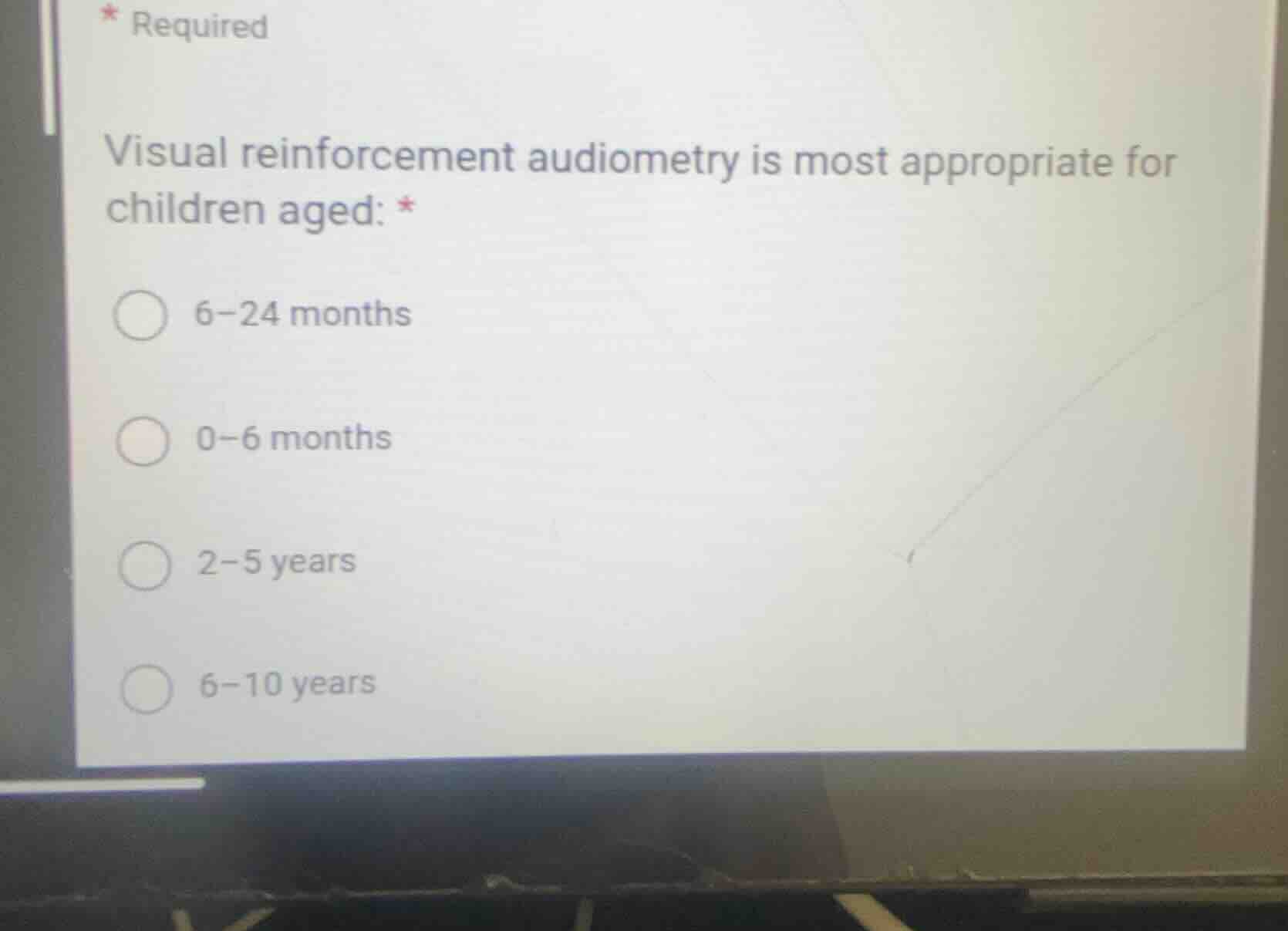
visual reinforcement audiometry is most appropriate for children aged: *
6-24 months
0-6 months
2-5 years
6-10 years
Define Visual Reinforcement Audiometry
Visual Reinforcement Audiometry (VRA) is a behavioral hearing test technique used for infants and young children. It relies on conditioning the child to turn their head toward a sound source in response to an auditory stimulus, reinforcing this head-turn behavior with an appealing visual reward (such as an animated toy or a flashing light).
Determine the developmental age range
To successfully perform VRA, a child must have the developmental capability to make a voluntary, coordinated head turn toward a sound source (localization) and be cognitively able to be conditioned.
- Infants under 6 months of age typically lack the motor control to perform reliable, independent head turns for localization.
- Children older than 24 months (2 years) usually become bored quickly with VRA or are developmentally ready for more active play-based testing methods, such as Conditioned Play Audiometry (CPA), which is typically used for children aged 2 to 5 years.
- Therefore, the developmental window where VRA is most reliable and appropriate is between 6 months and 24 months of age.
Evaluate the given options
- 6–24 months: This matches the standard developmental window for VRA.
- 0–6 months: Too young for reliable head-turn conditioning; physiological tests like ABR or OAE are preferred.
- 2–5 years: Conditioned Play Audiometry (CPA) is more appropriate for this age group.
- 6–10 years: Standard conventional audiometry is appropriate for this age group.

Snap & solve any problem in the app
Get step-by-step solutions on Sovi AI
Photo-based solutions with guided steps
Explore more problems and detailed explanations
- 6–24 months (Correct answer)
- 0–6 months
- 2–5 years
- 6–10 years