QUESTION IMAGE
Question
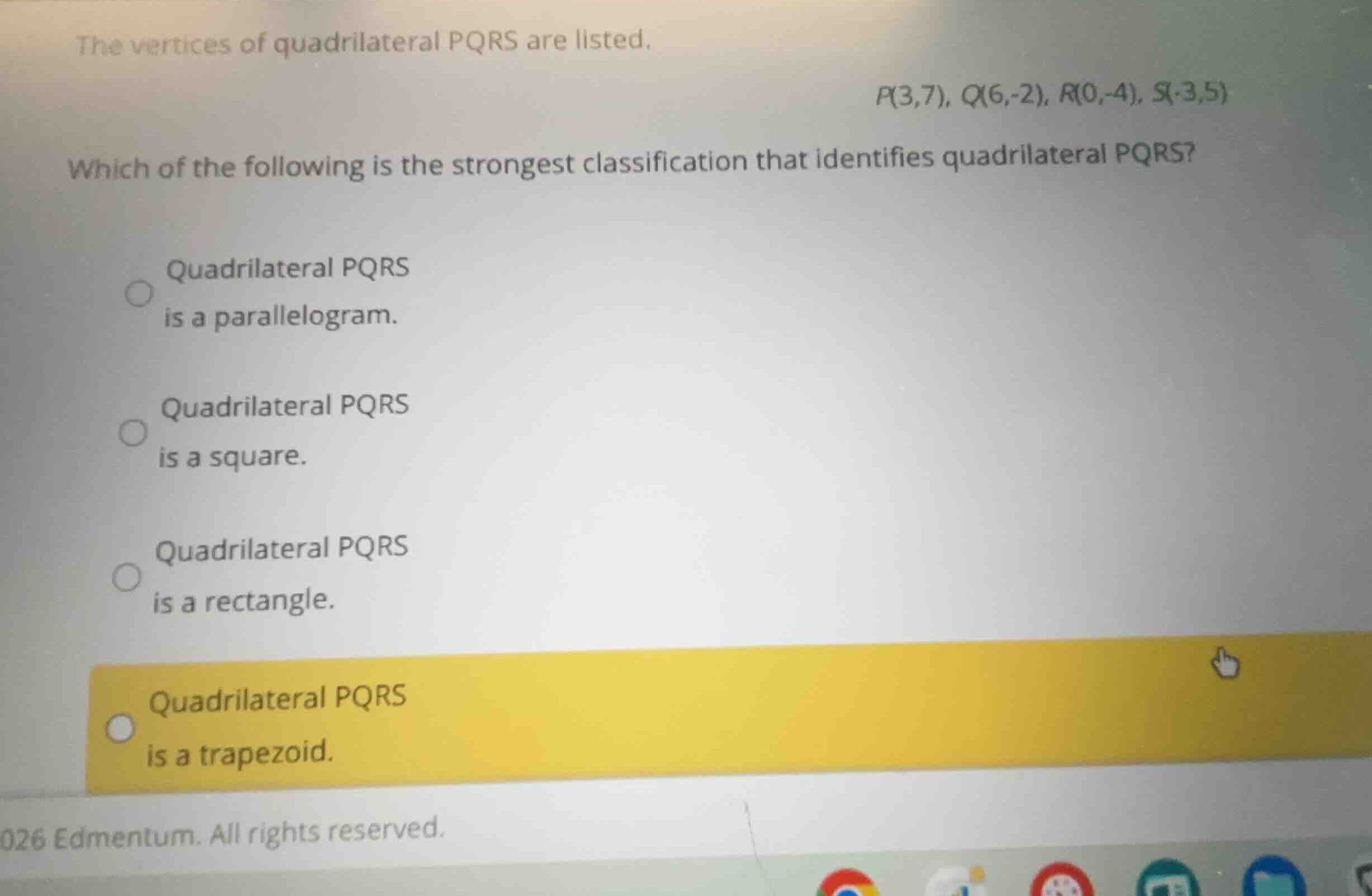
the vertices of quadrilateral pqrs are listed.
\\p(3,7), q(6,-2), r(0,-4), s(-3,5)\\
which of the following is the strongest classification that identifies quadrilateral pqrs?
- quadrilateral pqrs is a parallelogram.
- quadrilateral pqrs is a square.
- quadrilateral pqrs is a rectangle.
- quadrilateral pqrs is a trapezoid.
⚡ Using what you learned: properties of quadrilaterals · slope of a line
Step 1: Find the slopes of the sides
Calculate the slopes of the four sides of quadrilateral \( PQRS \) using the slope formula \( m = \frac{y_2 - y_1}{x_2 - x_1} \):
- Slope of \( PQ \) (from \( P(3,7) \) to \( Q(6,-2) \)):
- Slope of \( QR \) (from \( Q(6,-2) \) to \( R(0,-4) \)):
- Slope of \( RS \) (from \( R(0,-4) \) to \( S(-3,5) \)):
- Slope of \( SP \) (from \( S(-3,5) \) to \( P(3,7) \)):
Step 2: Analyze parallel and perpendicular sides
- Parallel sides:
Since \( m_{PQ} = m_{RS} = -3 \), the opposite sides \( PQ \) and \( RS \) are parallel.
Since \( m_{QR} = m_{SP} = \frac{1}{3} \), the opposite sides \( QR \) and \( SP \) are parallel.
This confirms \( PQRS \) is at least a parallelogram.
- Perpendicular sides:
Compare the slopes of adjacent sides, such as \( PQ \) and \( QR \):
Since the product of their slopes is \(-1\), the adjacent sides are perpendicular, meaning all four angles are \( 90^\circ \). This makes \( PQRS \) at least a rectangle.
Step 3: Check side lengths to distinguish between rectangle and square
Calculate the lengths of adjacent sides \( PQ \) and \( QR \) using the distance formula:
- Length of \( PQ \):
- Length of \( QR \):
Since the adjacent sides are not equal in length (\( \sqrt{90}
eq \sqrt{40} \)), the figure is not a square. The strongest classification is a rectangle.

Snap & solve any problem in the app
Get step-by-step solutions on Sovi AI
Photo-based solutions with guided steps
Explore more problems and detailed explanations
Quadrilateral PQRS is a rectangle.