QUESTION IMAGE
Question
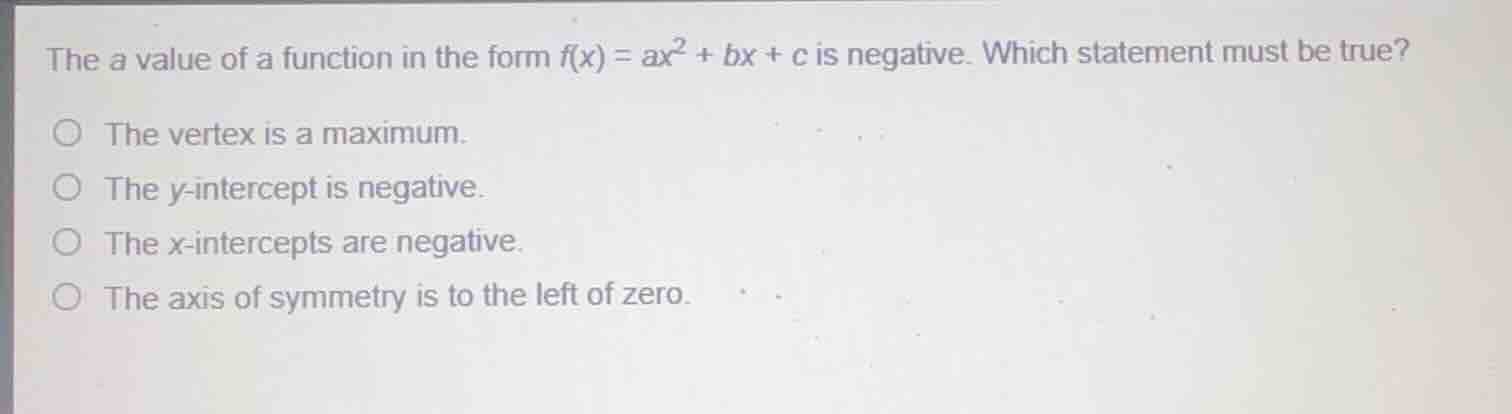
the a value of a function in the form \\(f(x) = ax^2 + bx + c\\) is negative. which statement must be true?
- the vertex is a maximum.
- the \\(y\\)-intercept is negative.
- the \\(x\\)-intercepts are negative.
- the axis of symmetry is to the left of zero.
Identify the given conditions
We are given a quadratic function:
$$f(x) = ax^2 + bx + c$$
The coefficient \(a\) is negative (\(a < 0\)). We need to determine which statement must be true.
Analyze the effect of the leading coefficient
Using the Quadratic Vertex knowledge point
$$
LATEXBLOCK0
$$
Evaluate the remaining options
We test if other options must be true by finding counterexamples:
- The \(y\)-intercept is negative: The \(y\)-intercept is \(f(0) = c\). If we choose \(f(x) = -x^2 + 5\), then \(c = 5 > 0\). This is not necessarily true.
- The \(x\)-intercepts are negative: If we choose \(f(x) = -(x-2)^2 + 1\), the vertex is at \((2,1)\) and it opens downward. The \(x\)-intercepts are at \(x = 1\) and \(x = 3\), which are positive. This is not necessarily true.
- The axis of symmetry is to the left of zero: The axis of symmetry is \(x = -\frac{b}{2a}\). If we choose \(b = 4\) and \(a = -1\), then \(x = -\frac{4}{2(-1)} = 2 > 0\), which is to the right of zero. This is not necessarily true.

Snap & solve any problem in the app
Get step-by-step solutions on Sovi AI
Photo-based solutions with guided steps
Explore more problems and detailed explanations
- (A) The vertex is a maximum. (Correct answer)
- (B) The y-intercept is negative.
- (C) The x-intercepts are negative.
- (D) The axis of symmetry is to the left of zero.