QUESTION IMAGE
Question
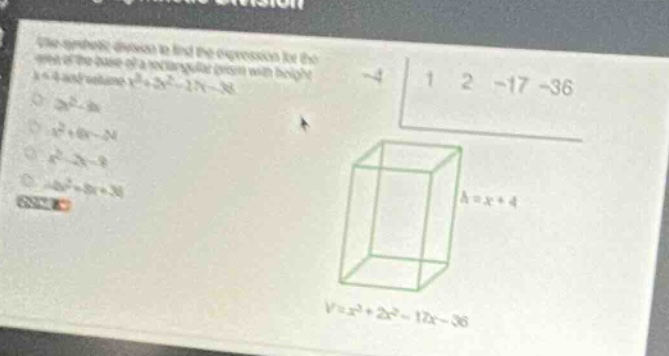
use synthetic division to find the expression for the area of the base of a rectangular prism with height \\(h = x + 4\\) and volume \\(v = x^3 + 2x^2 - 17x - 36\\).
\\(\bigcirc\\) \\(2x^2 - 3x\\)
\\(\bigcirc\\) \\(x^2 + 6x - 2\\)
\\(\bigcirc\\) \\(x^2 - 2x - 9\\)
\\(\bigcirc\\) \\(-4x^2 - 8x + 36\\)
🆕 New Concept Discovered: Polynomial Synthetic Division
Dividing polynomials using only their coefficients.
Step 1: Set up the division
The volume of a rectangular prism is given by:
where \( B \) is the area of the base and \( h \) is the height. To find the area of the base \( B \), we divide the volume by the height:
Using synthetic division with the divisor \( x + 4 \), we use the root \( -4 \) and the coefficients of the numerator: \( 1 \), \( 2 \), \( -17 \), and \( -36 \).
 -4 |  1   2  -17  -36
    |     -4    8   36
    ------------------
       1  -2   -9    0
Step 2: Perform the synthetic division steps
- Bring down the first coefficient: \( 1 \).
- Multiply \( 1 \) by \( -4 \) to get \( -4 \). Add this to the next coefficient: \( 2 + (-4) = -2 \).
- Multiply \( -2 \) by \( -4 \) to get \( 8 \). Add this to the next coefficient: \( -17 + 8 = -9 \).
- Multiply \( -9 \) by \( -4 \) to get \( 36 \). Add this to the final coefficient: \( -36 + 36 = 0 \).
Step 3: Write the resulting polynomial
The numbers at the bottom, \( 1 \), \( -2 \), and \( -9 \), represent the coefficients of the quotient polynomial, which is one degree lower than the original cubic polynomial:

Snap & solve any problem in the app
Get step-by-step solutions on Sovi AI
Photo-based solutions with guided steps
Explore more problems and detailed explanations
\( x^2 - 2x - 9 \)