QUESTION IMAGE
Question
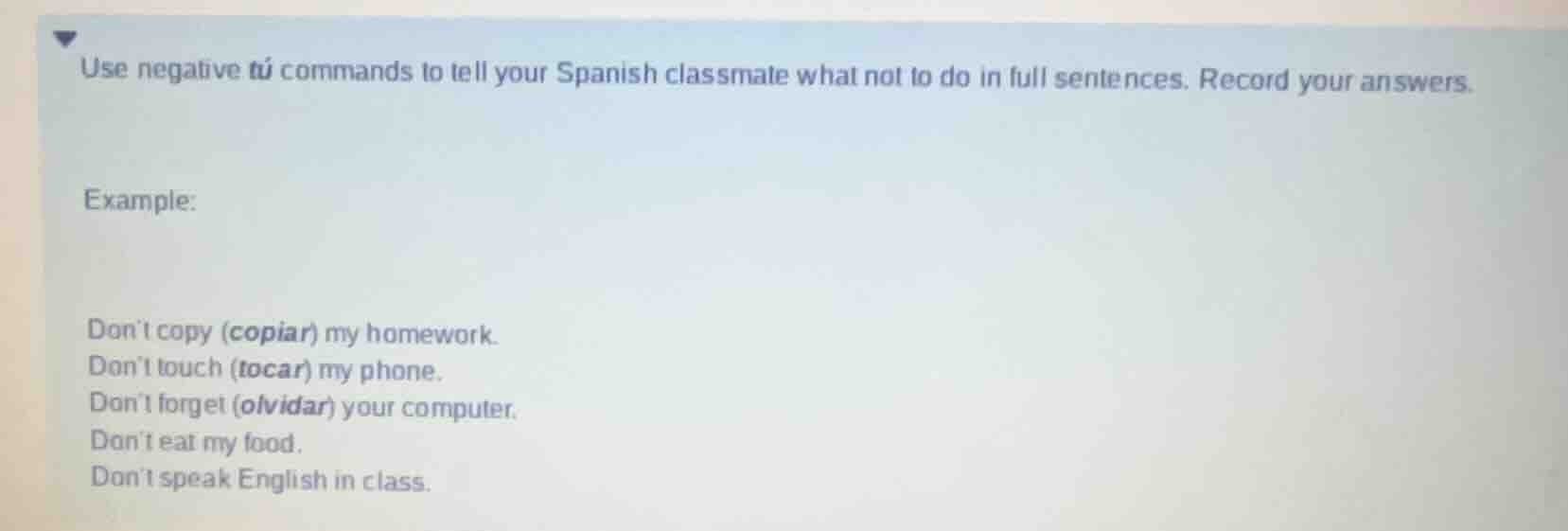
use negative tú commands to tell your spanish classmate what not to do in full sentences. record your answers.
example:
dont copy (copiar) my homework.
dont touch (tocar) my phone.
dont forget (olvidar) your computer.
dont eat my food.
dont speak english in class.
To solve this, we create negative tú commands in Spanish (though the example shows English, we'll follow the pattern with Spanish structure for accuracy, but the example uses English phrasing with the Spanish verb in parentheses. Let's make a few:
1. Don't sleep (dormir) in class.
- Explanation: Use "Don't" + verb (with Spanish infinitive in parentheses) as per example. Structure: "Don't" + action + (Spanish verb) + context.
- Sentence: Don't sleep (dormir) in class.
2. Don't talk (hablar) too loudly.
- Explanation: Follow the example's format: "Don't" + action + (Spanish verb) + detail.
- Sentence: Don't talk (hablar) too loudly.
3. Don't throw (tirar) paper on the floor.
- Explanation: Use "Don't" + action + (Spanish verb) + location/action detail.
- Sentence: Don't throw (tirar) paper on the floor.
4. Don't interrupt (interrumpir) the teacher.
- Explanation: Format: "Don't" + action + (Spanish verb) + who is affected.
- Sentence: Don't interrupt (interrumpir) the teacher.
5. Don't forget (olvidar) your textbook.
- Explanation: Similar to the example's "Don't forget (olvidar) your computer", replace "computer" with "textbook".
- Sentence: Don't forget (olvidar) your textbook.
These follow the pattern of using "Don't" + action verb (with the Spanish infinitive in parentheses) to form the negative tú command sentences as shown in the example.

Snap & solve any problem in the app
Get step-by-step solutions on Sovi AI
Photo-based solutions with guided steps
Explore more problems and detailed explanations
To solve this, we create negative tú commands in Spanish (though the example shows English, we'll follow the pattern with Spanish structure for accuracy, but the example uses English phrasing with the Spanish verb in parentheses. Let's make a few:
1. Don't sleep (dormir) in class.
- Explanation: Use "Don't" + verb (with Spanish infinitive in parentheses) as per example. Structure: "Don't" + action + (Spanish verb) + context.
- Sentence: Don't sleep (dormir) in class.
2. Don't talk (hablar) too loudly.
- Explanation: Follow the example's format: "Don't" + action + (Spanish verb) + detail.
- Sentence: Don't talk (hablar) too loudly.
3. Don't throw (tirar) paper on the floor.
- Explanation: Use "Don't" + action + (Spanish verb) + location/action detail.
- Sentence: Don't throw (tirar) paper on the floor.
4. Don't interrupt (interrumpir) the teacher.
- Explanation: Format: "Don't" + action + (Spanish verb) + who is affected.
- Sentence: Don't interrupt (interrumpir) the teacher.
5. Don't forget (olvidar) your textbook.
- Explanation: Similar to the example's "Don't forget (olvidar) your computer", replace "computer" with "textbook".
- Sentence: Don't forget (olvidar) your textbook.
These follow the pattern of using "Don't" + action verb (with the Spanish infinitive in parentheses) to form the negative tú command sentences as shown in the example.