QUESTION IMAGE
Question
use the following information to answer question 4.
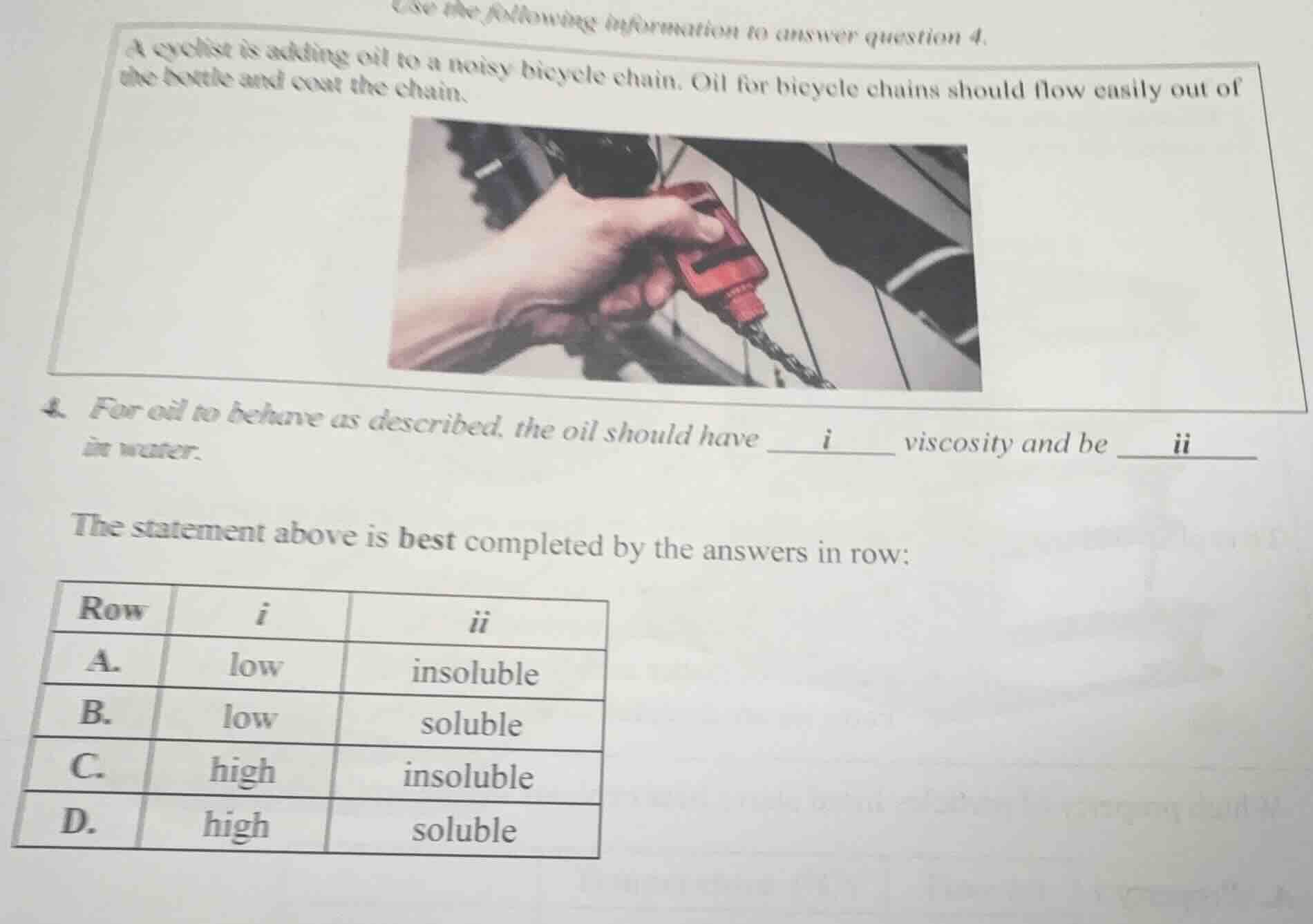
a cyclist is adding oil to a noisy bicycle chain. oil for bicycle chains should flow easily out of the bottle and coat the chain.
- for oil to behave as described, the oil should have i viscosity and be ii in water.
the statement above is best completed by the answers in row:
\
<pre_analysis>
{
"quality": "clear",
"question_count": 1,
"skills_matched": [
"direct_cot",
"multiple_choice_formatter",
"explain_then_answer",
"tutor"
],
"needs_drawing": false,
"concepts_used": [
"Factors Affecting Dissolving"
],
"new_concepts": [
"Viscosity",
"Solubility of Liquids"
],
"current_concepts": [
"Viscosity",
"Factors Affecting Dissolving",
"Solubility of Liquids"
]
}
</pre_analysis>
<reasoning>
Analyze the required viscosity
The text states that oil for bicycle chains should "flow easily out of the bottle and coat the chain." Viscosity is a fluid's resistance to flow. A fluid that flows easily has a low viscosity, while a thick fluid that flows slowly has a high viscosity. Therefore, to flow easily, the oil must have low viscosity.
Analyze the required solubility in water
Bicycles are often ridden outdoors where they may encounter rain, puddles, or wet conditions. If the chain oil were soluble in water, it would easily dissolve and wash away when exposed to water, leaving the chain unprotected. To remain on the chain and protect it in wet conditions, the oil must be insoluble in water.
Match with the options
Using the Factors Affecting Dissolving knowledge point, we evaluate the solubility behavior.
- Column (i) must be "low".
- Column (ii) must be "insoluble".
This combination corresponds to Row A.
</reasoning>
<answer>
<mcq-correct>(A) Row A: i = low, ii = insoluble</mcq-correct>
<mcq-option>(B) Row B: i = low, ii = soluble</mcq-option>
<mcq-option>(C) Row C: i = high, ii = insoluble</mcq-option>
<mcq-option>(D) Row D: i = high, ii = soluble</mcq-option>
</answer>
<post_analysis>
{
"subject": "Natural Science",
"question_type": "Multiple Choice",
"knowledge_point": [
"Natural Science",
"Physics",
"Viscosity and Solubility"
]
}
</post_analysis>
Snap & solve any problem in the app
Get step-by-step solutions on Sovi AI
Photo-based solutions with guided steps
Explore more problems and detailed explanations
<pre_analysis>
{
"quality": "clear",
"question_count": 1,
"skills_matched": [
"direct_cot",
"multiple_choice_formatter",
"explain_then_answer",
"tutor"
],
"needs_drawing": false,
"concepts_used": [
"Factors Affecting Dissolving"
],
"new_concepts": [
"Viscosity",
"Solubility of Liquids"
],
"current_concepts": [
"Viscosity",
"Factors Affecting Dissolving",
"Solubility of Liquids"
]
}
</pre_analysis>
<reasoning>
Analyze the required viscosity
The text states that oil for bicycle chains should "flow easily out of the bottle and coat the chain." Viscosity is a fluid's resistance to flow. A fluid that flows easily has a low viscosity, while a thick fluid that flows slowly has a high viscosity. Therefore, to flow easily, the oil must have low viscosity.
Analyze the required solubility in water
Bicycles are often ridden outdoors where they may encounter rain, puddles, or wet conditions. If the chain oil were soluble in water, it would easily dissolve and wash away when exposed to water, leaving the chain unprotected. To remain on the chain and protect it in wet conditions, the oil must be insoluble in water.
Match with the options
Using the Factors Affecting Dissolving knowledge point, we evaluate the solubility behavior.
- Column (i) must be "low".
- Column (ii) must be "insoluble".
This combination corresponds to Row A.
</reasoning>
<answer>
<mcq-correct>(A) Row A: i = low, ii = insoluble</mcq-correct>
<mcq-option>(B) Row B: i = low, ii = soluble</mcq-option>
<mcq-option>(C) Row C: i = high, ii = insoluble</mcq-option>
<mcq-option>(D) Row D: i = high, ii = soluble</mcq-option>
</answer>
<post_analysis>
{
"subject": "Natural Science",
"question_type": "Multiple Choice",
"knowledge_point": [
"Natural Science",
"Physics",
"Viscosity and Solubility"
]
}
</post_analysis>