QUESTION IMAGE
Question
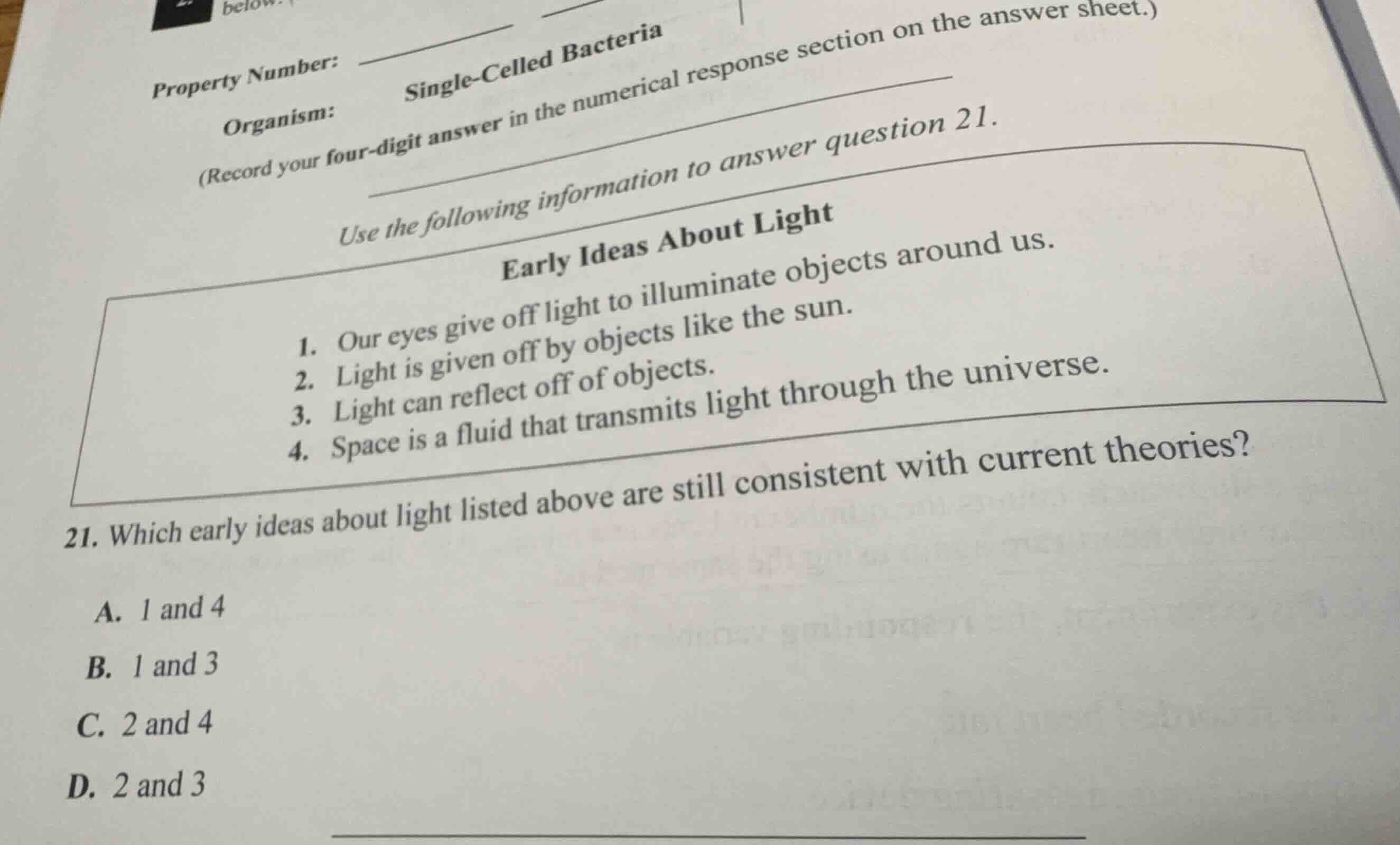
use the following information to answer question 21.
early ideas about light
- our eyes give off light to illuminate objects around us.
- light is given off by objects like the sun.
- light can reflect off of objects.
- space is a fluid that transmits light through the universe.
- which early ideas about light listed above are still consistent with current theories?
a. 1 and 4
b. 1 and 3
c. 2 and 4
d. 2 and 3
<pre_analysis>
{
"quality": "clear",
"question_count": 1,
"skills_matched": [
"direct_cot",
"multiple_choice_formatter",
"explain_then_answer",
"tutor"
],
"needs_drawing": false,
"concepts_used": [],
"new_concepts": [
"History of Light Theories",
"Properties of Light",
"Reflection and Emission"
],
"current_concepts": [
"History of Light Theories",
"Properties of Light",
"Reflection and Emission"
]
}
</pre_analysis>
<reasoning>
Analyze the early ideas about light
We evaluate each of the four statements to see if they align with modern scientific understanding:
- Our eyes give off light to illuminate objects around us. This is the ancient "emission theory" of vision. Today, we know eyes detect light entering them rather than emitting it. This is incorrect.
- Light is given off by objects like the sun. This describes luminous sources that emit their own light. This is correct.
- Light can reflect off of objects. This describes how we see non-luminous objects when light bounces off them into our eyes. This is correct.
- Space is a fluid that transmits light through the universe. This refers to the historical "luminiferous aether" hypothesis. Modern physics shows light is an electromagnetic wave that travels through a vacuum without needing a medium. This is incorrect.
Identify the consistent statements
Statements 2 and 3 are consistent with current scientific theories, while statements 1 and 4 are outdated.
Match with the options
Looking at the choices:
- A. 1 and 4
- B. 1 and 3
- C. 2 and 4
- D. 2 and 3
The correct option is D.
</reasoning>
<answer>
<mcq-option>(A) 1 and 4</mcq-option>
<mcq-option>(B) 1 and 3</mcq-option>
<mcq-option>(C) 2 and 4</mcq-option>
<mcq-correct>(D) 2 and 3</mcq-correct>
</answer>
<post_analysis>
{
"subject": "Natural Science",
"question_type": "Multiple Choice",
"knowledge_point": [
"Natural Science",
"Physics",
"Properties of Light"
]
}
</post_analysis>
Snap & solve any problem in the app
Get step-by-step solutions on Sovi AI
Photo-based solutions with guided steps
Explore more problems and detailed explanations
<pre_analysis>
{
"quality": "clear",
"question_count": 1,
"skills_matched": [
"direct_cot",
"multiple_choice_formatter",
"explain_then_answer",
"tutor"
],
"needs_drawing": false,
"concepts_used": [],
"new_concepts": [
"History of Light Theories",
"Properties of Light",
"Reflection and Emission"
],
"current_concepts": [
"History of Light Theories",
"Properties of Light",
"Reflection and Emission"
]
}
</pre_analysis>
<reasoning>
Analyze the early ideas about light
We evaluate each of the four statements to see if they align with modern scientific understanding:
- Our eyes give off light to illuminate objects around us. This is the ancient "emission theory" of vision. Today, we know eyes detect light entering them rather than emitting it. This is incorrect.
- Light is given off by objects like the sun. This describes luminous sources that emit their own light. This is correct.
- Light can reflect off of objects. This describes how we see non-luminous objects when light bounces off them into our eyes. This is correct.
- Space is a fluid that transmits light through the universe. This refers to the historical "luminiferous aether" hypothesis. Modern physics shows light is an electromagnetic wave that travels through a vacuum without needing a medium. This is incorrect.
Identify the consistent statements
Statements 2 and 3 are consistent with current scientific theories, while statements 1 and 4 are outdated.
Match with the options
Looking at the choices:
- A. 1 and 4
- B. 1 and 3
- C. 2 and 4
- D. 2 and 3
The correct option is D.
</reasoning>
<answer>
<mcq-option>(A) 1 and 4</mcq-option>
<mcq-option>(B) 1 and 3</mcq-option>
<mcq-option>(C) 2 and 4</mcq-option>
<mcq-correct>(D) 2 and 3</mcq-correct>
</answer>
<post_analysis>
{
"subject": "Natural Science",
"question_type": "Multiple Choice",
"knowledge_point": [
"Natural Science",
"Physics",
"Properties of Light"
]
}
</post_analysis>