QUESTION IMAGE
Question
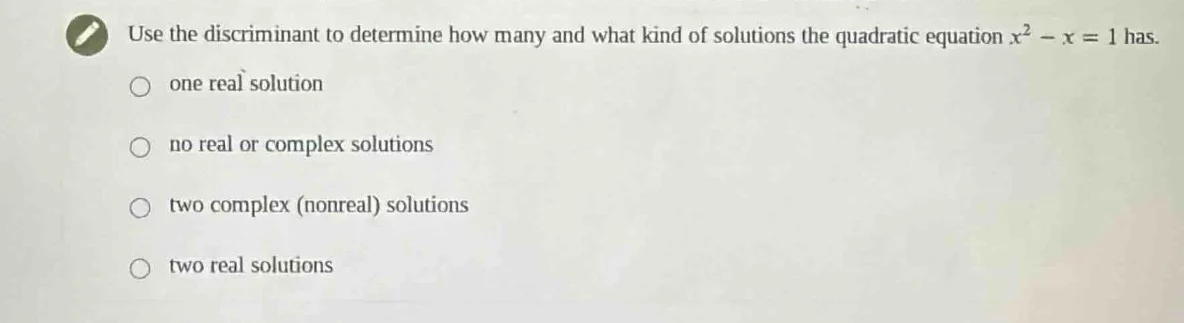
use the discriminant to determine how many and what kind of solutions the quadratic equation $x^2 - x = 1$ has.
\bigcirc one real solution
\bigcirc no real or complex solutions
\bigcirc two complex (nonreal) solutions
\bigcirc two real solutions
Step1: Rewrite the equation in standard form
The standard form of a quadratic equation is \(ax^{2}+bx + c = 0\). Given the equation \(x^{2}-x = 1\), we subtract 1 from both sides to get \(x^{2}-x - 1=0\). Here, \(a = 1\), \(b=- 1\), and \(c=-1\).
Step2: Calculate the discriminant
The discriminant \(D\) of a quadratic equation \(ax^{2}+bx + c = 0\) is given by the formula \(D=b^{2}-4ac\). Substituting the values of \(a\), \(b\), and \(c\) we found above, we have:
\[
\]
Step3: Analyze the discriminant
If the discriminant \(D>0\), the quadratic equation has two distinct real solutions. If \(D = 0\), it has one real solution (a repeated root). If \(D<0\), it has two complex (non - real) solutions. Since \(D = 5>0\), the equation \(x^{2}-x - 1=0\) has two real solutions.

Snap & solve any problem in the app
Get step-by-step solutions on Sovi AI
Photo-based solutions with guided steps
Explore more problems and detailed explanations
two real solutions (the option corresponding to "two real solutions")