QUESTION IMAGE
Question
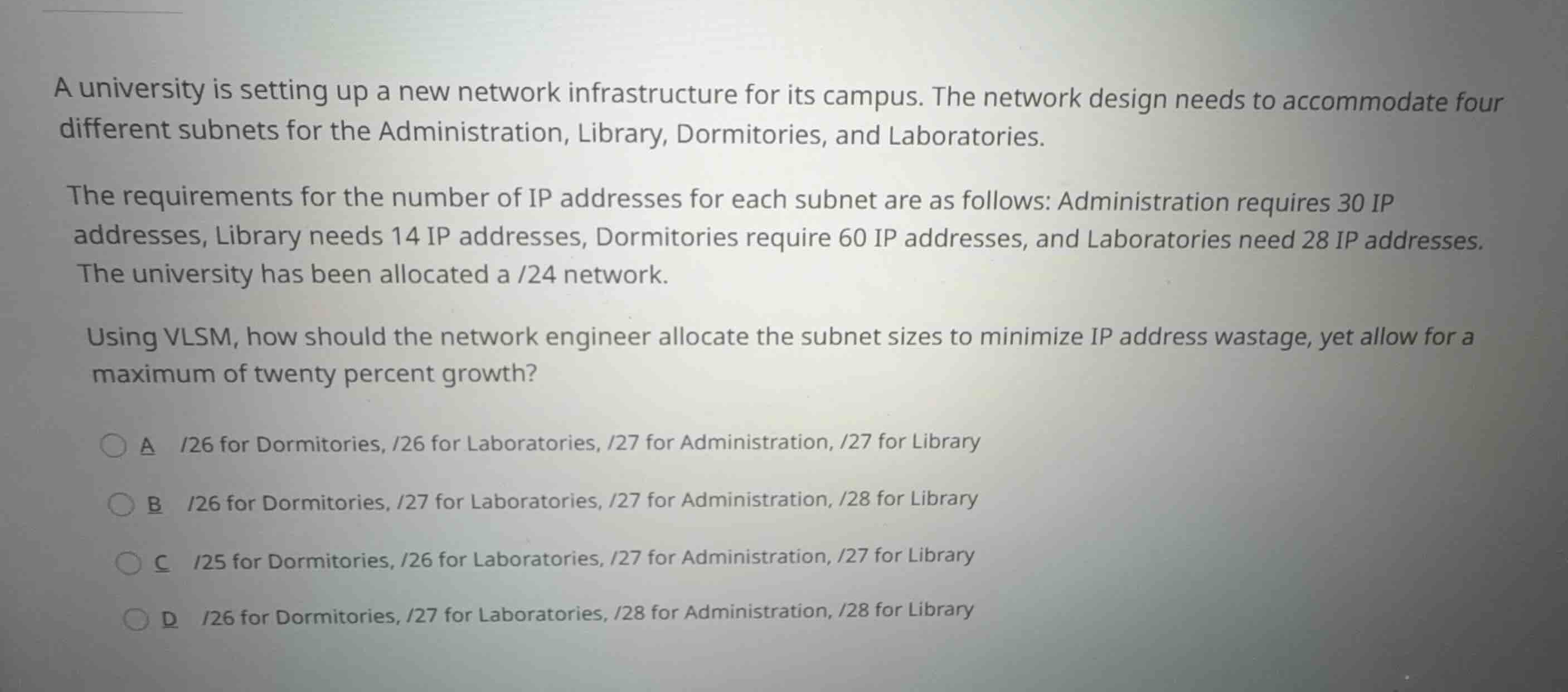
a university is setting up a new network infrastructure for its campus. the network design needs to accommodate four different subnets for the administration, library, dormitories, and laboratories.
the requirements for the number of ip addresses for each subnet are as follows: administration requires 30 ip addresses, library needs 14 ip addresses, dormitories require 60 ip addresses, and laboratories need 28 ip addresses. the university has been allocated a /24 network.
using vlsm, how should the network engineer allocate the subnet sizes to minimize ip address wastage, yet allow for a maximum of twenty percent growth?
a /26 for dormitories, /26 for laboratories, /27 for administration, /27 for library
b /26 for dormitories, /27 for laboratories, /27 for administration, /28 for library
c /25 for dormitories, /26 for laboratories, /27 for administration, /27 for library
d /26 for dormitories, /27 for laboratories, /28 for administration, /28 for library
Calculate required IP addresses with growth
Using the Network Infrastructure knowledge point, we first calculate the required IP addresses for each subnet including a maximum \(20\%\) growth factor:
- Dormitories: \(60 \times 1.2 = 72\) addresses.
- Administration: \(30 \times 1.2 = 36\) addresses.
- Laboratories: \(28 \times 1.2 = 33.6 \approx 34\) addresses.
- Library: \(14 \times 1.2 = 16.8 \approx 17\) addresses.
Determine minimum power of 2 for each subnet
We find the smallest power of 2, \(2^H\), that can accommodate the required addresses (including network and broadcast addresses, which means \(2^H - 2 \ge \text{required host IPs}\), or simply finding the block size \(2^H \ge \text{required IPs} + 2\)):
- Dormitories (72 hosts): Needs block size \(\ge 74\). Next power of 2 is \(128\) (\(2^7\)), which corresponds to a \(/25\) prefix.
- Administration (36 hosts): Needs block size \(\ge 38\). Next power of 2 is \(64\) (\(2^6\)), which corresponds to a \(/26\) prefix.
- Laboratories (34 hosts): Needs block size \(\ge 36\). Next power of 2 is \(64\) (\(2^6\)), which corresponds to a \(/26\) prefix.
- Library (17 hosts): Needs block size \(\ge 19\). Next power of 2 is \(32\) (\(2^5\)), which corresponds to a \(/27\) prefix.
Match with the given options
Let's review the calculated subnet sizes:
- Dormitories: \(/25\)
- Laboratories: \(/26\)
- Administration: \(/27\)
- Library: \(/27\)
This matches option C: "/25 for Dormitories, /26 for Laboratories, /27 for Administration, /27 for Library".

Snap & solve any problem in the app
Get step-by-step solutions on Sovi AI
Photo-based solutions with guided steps
Explore more problems and detailed explanations
- (A) /26 for Dormitories, /26 for Laboratories, /27 for Administration, /27 for Library
- (B) /26 for Dormitories, /27 for Laboratories, /27 for Administration, /28 for Library
- (C) /25 for Dormitories, /26 for Laboratories, /27 for Administration, /27 for Library (Correct answer)
- (D) /26 for Dormitories, /27 for Laboratories, /28 for Administration, /28 for Library