QUESTION IMAGE
Question
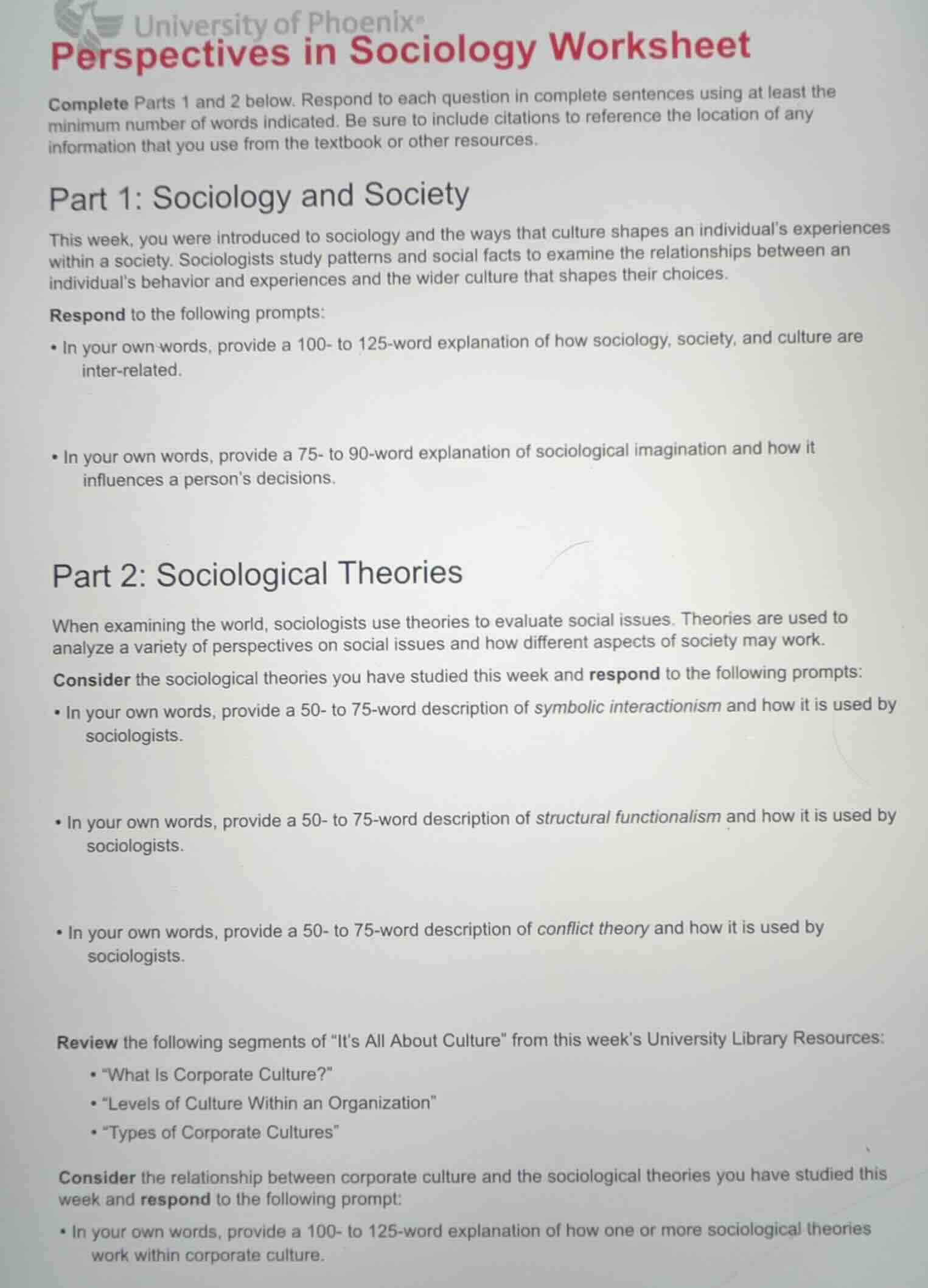
university of phoenix
perspectives in sociology worksheet
complete parts 1 and 2 below. respond to each question in complete sentences using at least the minimum number of words indicated. be sure to include citations to reference the location of any information that you use from the textbook or other resources.
part 1: sociology and society
this week, you were introduced to sociology and the ways that culture shapes an individuals experiences within a society. sociologists study patterns and social facts to examine the relationships between an individuals behavior and experiences and the wider culture that shapes their choices.
respond to the following prompts:
- in your own words, provide a 100- to 125-word explanation of how sociology, society, and culture are inter-related.
- in your own words, provide a 75- to 90-word explanation of sociological imagination and how it influences a persons decisions.
part 2: sociological theories
when examining the world, sociologists use theories to evaluate social issues. theories are used to analyze a variety of perspectives on social issues and how different aspects of society may work.
consider the sociological theories you have studied this week and respond to the following prompts:
- in your own words, provide a 50- to 75-word description of symbolic interactionism and how it is used by sociologists.
- in your own words, provide a 50- to 75-word description of structural functionalism and how it is used by sociologists.
- in your own words, provide a 50- to 75-word description of conflict theory and how it is used by sociologists.
review the following segments of \its all about culture\ from this weeks university library resources:
- \what is corporate culture?\
- \levels of culture within an organization\
- \types of corporate cultures\
consider the relationship between corporate culture and the sociological theories you have studied this week and respond to the following prompt:
- in your own words, provide a 100- to 125-word explanation of how one or more sociological theories work within corporate culture.
Analyze the worksheet requirements
The worksheet contains six distinct prompts divided into two parts. Each prompt has specific word count constraints and requires explanations in complete sentences.
Address Part 1, Prompt 1
Explain how sociology, society, and culture are inter-related (100–125 words).
- Sociology is the study of social life, change, and causes/consequences of human behavior.
- Society is a group of people sharing a defined territory and culture.
- Culture represents the shared practices, values, beliefs, and artifacts of that group.
- They are interdependent: society provides the structure, culture provides the meaning, and sociology studies their dynamic interaction.
Address Part 1, Prompt 2
Explain sociological imagination and how it influences decisions (75–90 words).
- Sociological imagination (coined by C. Wright Mills) is the ability to see the connection between personal challenges and larger social issues.
- It helps individuals realize that private troubles (like unemployment) are often public issues shaped by history and social structures, enabling more informed, socially conscious decisions.
Address Part 2, Prompts 3, 4, and 5
Describe three major sociological theories (50–75 words each):
- Symbolic Interactionism: A micro-level theory focusing on face-to-face interactions and how people interpret symbols in daily life.
- Structural Functionalism: A macro-level theory viewing society as a complex system whose parts work together to promote solidarity and stability.
- Conflict Theory: A macro-level theory viewing society as a competition for limited resources, highlighting power struggles and inequality.
Address Part 2, Prompt 6
Explain how sociological theories work within corporate culture (100–125 words).
- Corporate culture refers to the shared values, beliefs, and behaviors within an organization.
- We can apply structural functionalism (how different departments function together to maintain organizational stability) or symbolic interactionism (how employees interpret workplace symbols, titles, and daily rituals to build shared meaning).

Snap & solve any problem in the app
Get step-by-step solutions on Sovi AI
Photo-based solutions with guided steps
Explore more problems and detailed explanations
Question 1
Prompt: In your own words, provide a 100- to 125-word explanation of how sociology, society, and culture are inter-related.
Answer:
Sociology, society, and culture are deeply interconnected concepts that cannot exist without one another. Society represents the structural framework consisting of a group of people who live in a defined geographic area and interact with each other. Culture, on the other hand, acts as the shared software of that society, encompassing the beliefs, values, behaviors, and physical artifacts that dictate daily life. Sociology is the scientific study of these two elements, analyzing how social structures and cultural norms shape individual experiences and collective behaviors. Ultimately, society provides the population, culture provides the shared meaning and guidelines for interaction, and sociology offers the analytical tools to understand how these forces continuously shape and reinforce one another. (118 words)
Question 2
Prompt: In your own words, provide a 75- to 90-word explanation of sociological imagination and how it influences a person's decisions.
Answer:
The sociological imagination is the ability to connect personal, individual experiences to broader social and historical forces. Developed by C. Wright Mills, this perspective helps individuals see that their private struggles, such as job loss or debt, are often shaped by public issues like economic shifts or systemic inequalities. By understanding these external influences, individuals can make more informed decisions, moving away from self-blame and toward active, socially conscious choices that address the root structural causes of their circumstances. (83 words)
Question 3
Prompt: In your own words, provide a 50- to 75-word description of symbolic interactionism and how it is used by sociologists.
Answer:
Symbolic interactionism is a micro-level sociological perspective focusing on how individuals create and interpret meaning through daily face-to-face interactions. It suggests that society is socially constructed through shared symbols, language, and gestures. Sociologists use this theory to analyze qualitative, everyday dynamics, studying how people negotiate identity, interpret workplace communication, and establish shared understandings within specific social settings. (62 words)
Question 4
Prompt: In your own words, provide a 50- to 75-word description of structural functionalism and how it is used by sociologists.
Answer:
Structural functionalism is a macro-level perspective that views society as a complex system of interrelated parts working together to promote solidarity, order, and stability. Each social institution, like education or family, serves a specific function. Sociologists use this theory to examine how different parts of society contribute to overall social cohesion and to identify how disruptions in one institution affect the entire system. (68 words)
Question 5
Prompt: In your own words, provide a 50- to 75-word description of conflict theory and how it is used by sociologists.
Answer:
Conflict theory is a macro-level perspective that views society as an arena of inequality and competition for scarce resources, such as power, wealth, and status. It emphasizes how dominant groups maintain power by exploiting marginalized groups. Sociologists use this theory to analyze social struggles, systemic inequalities, and institutional biases, focusing on how social change is driven by conflict and resistance. (64 words)
Question 6
Prompt: In your own words, provide a 100- to 125-word explanation of how one or more sociological theories work within corporate culture.
Answer:
Sociological theories offer valuable frameworks for understanding corporate culture, which consists of the shared values, beliefs, and practices within an organization. For instance, structural functionalism can be applied to view a corporation as a unified system where distinct departments—such as human resources, sales, and management—act as organs working together to maintain organizational stability and productivity. Simultaneously, symbolic interactionism explains how employees interpret corporate symbols, such as job titles, office layouts, and company rituals, to construct their professional identities and workplace relationships. By utilizing these theories, sociologists and organizational leaders can analyze how structural systems maintain operational harmony while observing how micro-level interactions shape employee morale, communication, and overall corporate identity. (118 words)