QUESTION IMAGE
Question
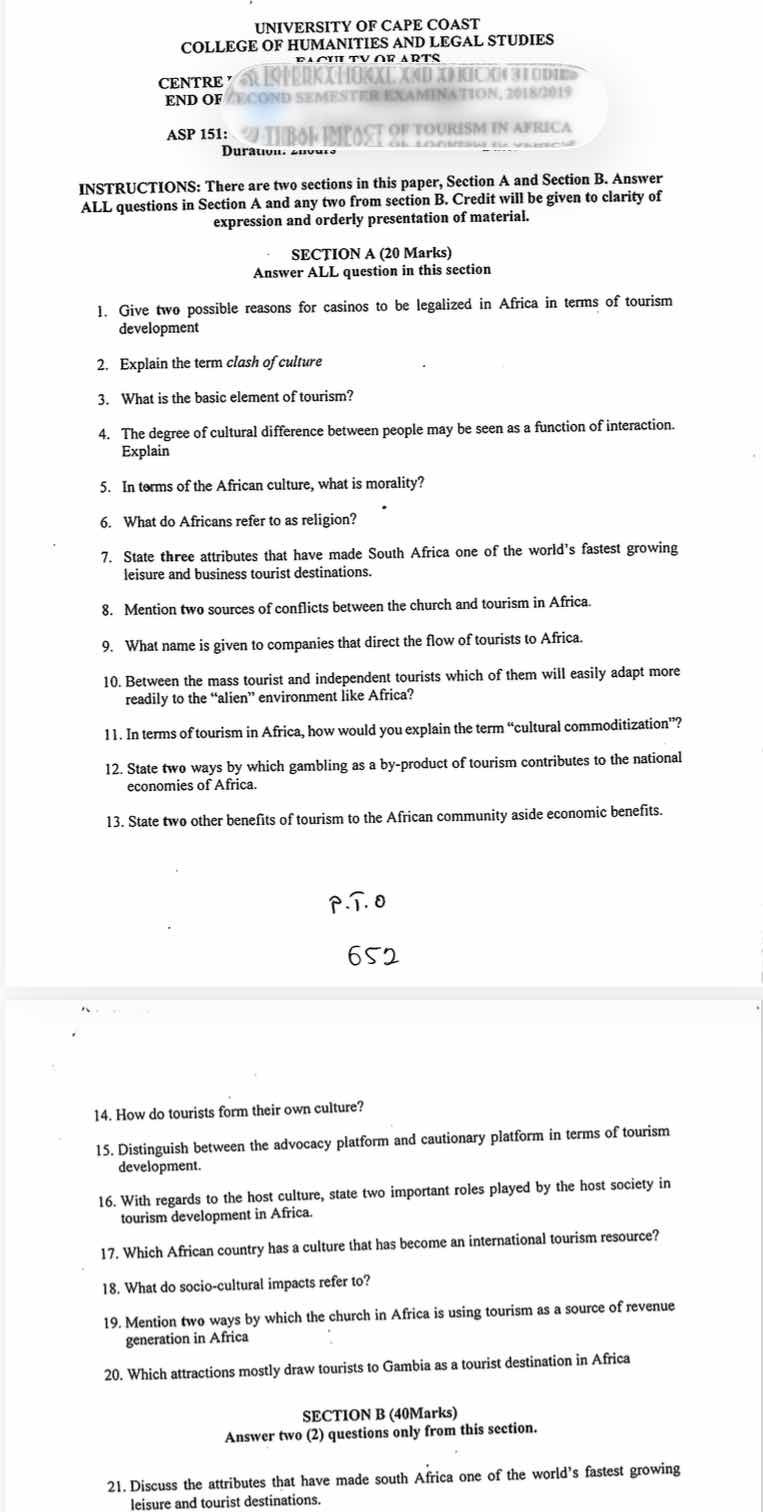
university of cape coast
college of humanities and legal studies
faculty of arts
centre for african and international studies
end of second semester examination, 2018/2019
asp 151: tourism impact in africa
duration: 2 hours
instructions: there are two sections in this paper, section a and section b. answer all questions in section a and any two from section b. credit will be given to clarity of expression and orderly presentation of material.
section a (20 marks)
answer all question in this section
- give two possible reasons for casinos to be legalized in africa in terms of tourism development
- explain the term clash of culture
- what is the basic element of tourism?
- the degree of cultural difference between people may be seen as a function of interaction. explain
- in terms of the african culture, what is morality?
- what do africans refer to as religion?
- state three attributes that have made south africa one of the worlds fastest growing leisure and business tourist destinations.
- mention two sources of conflicts between the church and tourism in africa.
- what name is given to companies that direct the flow of tourists to africa.
- between the mass tourist and independent tourists which of them will easily adapt more readily to the \alien\ environment like africa?
- in terms of tourism in africa, how would you explain the term \cultural commoditization\?
- state two ways by which gambling as a by-product of tourism contributes to the national economies of africa.
- state two other benefits of tourism to the african community aside economic benefits.
- how do tourists form their own culture?
- distinguish between the advocacy platform and cautionary platform in terms of tourism development.
- with regards to the host culture, state two important roles played by the host society in tourism development in africa.
- which african country has a culture that has become an international tourism resource?
- what do socio-cultural impacts refer to?
- mention two ways by which the church in africa is using tourism as a source of revenue generation in africa
- which attractions mostly draw tourists to gambia as a tourist destination in africa
section b (40marks)
answer two (2) questions only from this section.
- discuss the attributes that have made south africa one of the worlds fastest growing leisure and tourist destinations.
Analyze Section A Questions 1-10
- Casinos legalize for tourism: (a) Attracts high-spending international tourists, (b) Generates direct tax revenue and foreign exchange.
- Clash of culture: Conflict arising when different cultural values, beliefs, or behaviors interact and misunderstand each other.
- Basic element of tourism: The tourist (or the traveler/human element).
- Cultural difference as function of interaction: Greater interaction often reduces perceived differences, while limited interaction preserves distinct cultural boundaries.
- Morality in African culture: A community-centered system of values emphasizing character, respect, and communal harmony (Ubuntu).
- African religion: A holistic way of life integrating the physical and spiritual worlds, ancestors, and a supreme creator.
- South Africa attributes: (a) Diverse wildlife/safaris, (b) Well-developed infrastructure, (c) Rich cultural heritage.
- Church and tourism conflicts: (a) Desecration of sacred sites by tourists, (b) Commercialization of religious practices.
- Companies directing tourist flow: Tour operators (or travel agencies).
- Adaptation to "alien" environment: Independent tourists.
Analyze Section A Questions 11-20
- Cultural commoditization: Transforming local cultural traditions, rituals, and festivals into marketable commodities for tourist consumption.
- Gambling economic contributions: (a) Job creation in hospitality/entertainment, (b) Direct tax revenues for public funding.
- Non-economic benefits of tourism: (a) Preservation of local heritage/monuments, (b) Cross-cultural understanding and global goodwill.
- Tourists forming own culture: Through shared travel behaviors, symbols, language, and sub-cultural norms developed during transit.
- Advocacy vs. Cautionary platform: Advocacy promotes tourism's positive economic impacts; Cautionary highlights negative socio-cultural and environmental impacts.
- Host society roles: (a) Providing hospitality and authentic cultural interaction, (b) Managing and conserving local resources.
- Country with culture as international resource: Kenya (e.g., Maasai culture).
- Socio-cultural impacts: Changes in the daily life, values, beliefs, arts, and social institutions of host communities due to tourism.
- Church revenue from tourism: (a) Charging entry fees for historic cathedrals/shrines, (b) Selling religious souvenirs and crafts.
- Gambia attractions: Beaches (coastal resorts) and rich birdlife/nature reserves.
Analyze Section B Question 21
- South Africa attributes discussion: (a) World-class infrastructure (airports, roads, hotels), (b) Diverse natural attractions (Kruger National Park, Table Mountain), (c) Favorable exchange rates and business tourism facilities (MICE tourism).

Snap & solve any problem in the app
Get step-by-step solutions on Sovi AI
Photo-based solutions with guided steps
Explore more problems and detailed explanations
Question 1
(a) Attracts high-spending international visitors.
(b) Generates substantial tax revenue and foreign exchange.
Question 2
The conflict, misunderstanding, or tension that occurs when people of different cultural backgrounds, values, and beliefs interact.
Question 3
The tourist (the human element).
Question 4
Increased interaction between different groups can either bridge cultural gaps through mutual understanding or heighten awareness of differences, shaping how distinct they perceive each other to be.
Question 5
A community-based system of values and behaviors that promotes social harmony, respect for elders, and communal well-being (often encapsulated in the concept of Ubuntu).
Question 6
A holistic, lived experience that permeates all aspects of life, connecting the physical world with ancestors, spirits, and a supreme being.
Question 7
(a) Diverse wildlife and world-renowned national parks (e.g., Kruger National Park).
(b) Highly developed transport, hospitality, and business infrastructure.
(c) Rich cultural diversity and historical heritage sites.
Question 8
(a) Commercialization and exploitation of sacred religious ceremonies for entertainment.
(b) Disruption of local religious observances and moral values by tourist behaviors.
Question 9
Tour Operators.
Question 10
Independent tourists.
Question 11
The process where local cultural expressions, rituals, and artifacts are turned into commodities or consumer goods to be bought and sold in the tourism market.
Question 12
(a) Direct generation of government revenue through gambling taxes and licensing fees.
(b) Job creation in casinos, hotels, and supporting service industries.
Question 13
(a) Preservation and restoration of historical monuments and cultural heritage.
(b) Promotion of intercultural understanding, tolerance, and global peace.
Question 14
By developing shared behaviors, values, language, and lifestyles unique to the travel experience, distinct from their home cultures.
Question 15
The advocacy platform focuses on the positive economic benefits and growth of tourism, while the cautionary platform highlights the negative environmental, social, and cultural impacts of unregulated tourism.
Question 16
(a) Acting as custodians of local heritage and authentic cultural practices.
(b) Providing hospitality, services, and security to visitors.
Question 17
Kenya (particularly through the global recognition of Maasai culture).
Question 18
The changes created by tourism in the collective and individual value systems, behavior patterns, lifestyles, social relationships, and creative expressions of the host community.
Question 19
(a) Charging admission fees to tourists visiting historic churches, cathedrals, or shrines.
(b) Selling religious literature, crafts, and souvenirs to visitors.
Question 20
Sandy beaches (coastal tourism) and diverse birdwatching/nature reserves along the Gambia River.
Question 21
(a) World-Class Infrastructure: South Africa possesses highly developed transport networks, modern airports, and premium conference facilities that support both leisure and business (MICE) tourism.
(b) Diverse Natural and Wildlife Attractions: The country offers unique biodiversity, including the "Big Five" in Kruger National Park, scenic coastlines, and iconic landmarks like Table Mountain.
(c) Rich Cultural and Historical Heritage: A unique history, diverse local cultures, and UNESCO World Heritage sites (such as Robben Island) provide compelling educational and cultural experiences for global travelers.