QUESTION IMAGE
Question
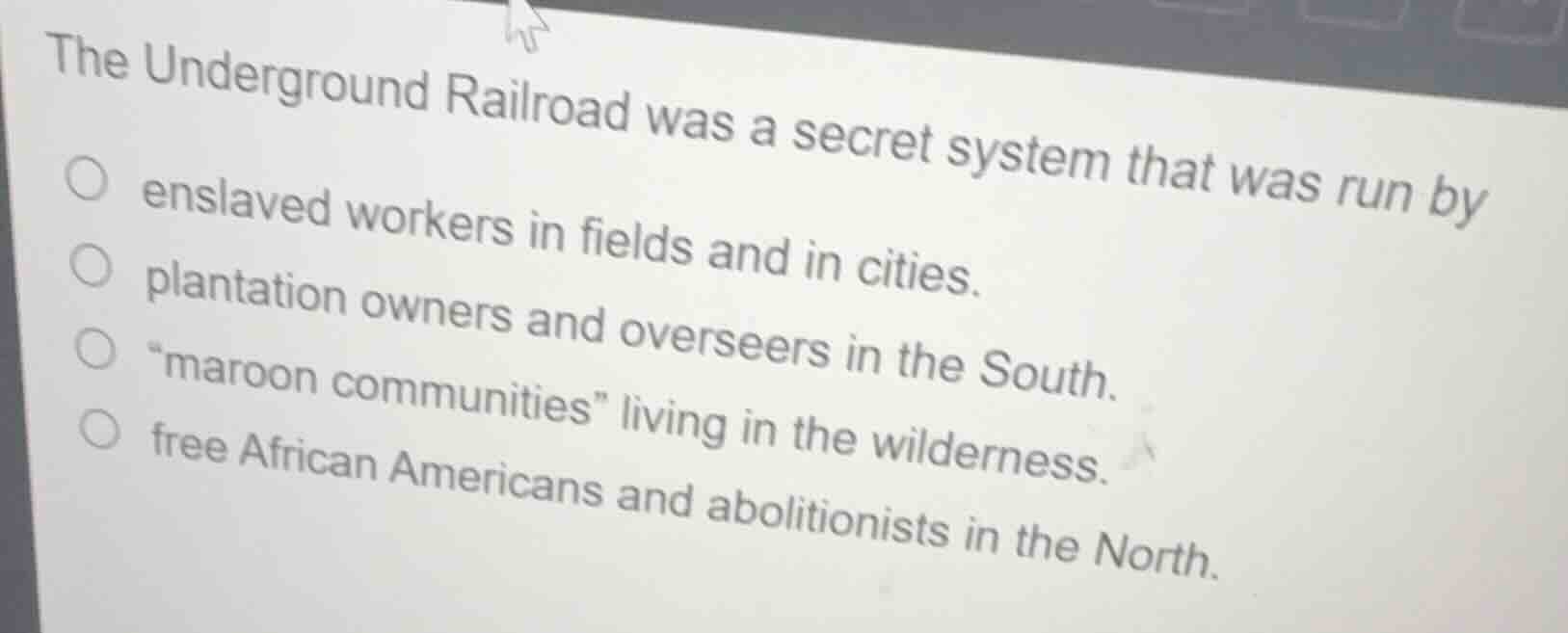
the underground railroad was a secret system that was run by
enslaved workers in fields and in cities.
plantation owners and overseers in the south.
\maroon communities\ living in the wilderness.
free african americans and abolitionists in the north.
<pre_analysis>
{
"quality": "clear",
"question_count": 1,
"skills_matched": [
"direct_cot",
"multiple_choice_formatter",
"explain_then_answer",
"tutor"
],
"needs_drawing": false,
"concepts_used": [
"Free African Americans"
],
"new_concepts": [
"Underground Railroad",
"Abolitionist Movement"
],
"current_concepts": [
"Free African Americans",
"Underground Railroad",
"Abolitionist Movement"
]
}
</pre_analysis>
<reasoning>
Analyze the question stem
The question asks about the nature of the Underground Railroad, specifically identifying who ran this secret network.
Evaluate the historical context
The Underground Railroad was a clandestine network of secret routes and safe houses established in the United States during the early-to-mid 19th century. It was used by enslaved African Americans to escape into free states and Canada.
Assess the options
- Option 1: "enslaved workers in fields and in cities" — While enslaved people used the network to escape, they did not run the organized network of safe houses and routes from within their fields.
- Option 2: "plantation owners and overseers in the South" — These individuals actively opposed escapes and sought to maintain slavery, making this option incorrect.
- Option 3: "\"maroon communities\" living in the wilderness" — Maroon communities were independent settlements of escaped slaves, but they did not operate the structured interstate network known as the Underground Railroad.
- Option 4: "free African Americans and abolitionists in the North" — This group, including Free African Americans and white allies, actively organized, funded, and operated the safe houses ("stations") and guided escaping individuals ("conductors").
Formulate the final conclusion
The network was primarily operated by dedicated abolitionists (both Black and white) and Free African Americans who risked their lives and liberty to assist those escaping bondage.
</reasoning>
<answer>
<mcq-option>enslaved workers in fields and in cities.</mcq-option>
<mcq-option>plantation owners and overseers in the South.</mcq-option>
<mcq-option>"maroon communities" living in the wilderness.</mcq-option>
<mcq-correct>free African Americans and abolitionists in the North.</mcq-correct>
</answer>
<post_analysis>
{
"subject": "Social Science",
"question_type": "Multiple Choice",
"knowledge_point": [
"Social Science",
"U.S. History",
"Underground Railroad"
]
}
</post_analysis>
Snap & solve any problem in the app
Get step-by-step solutions on Sovi AI
Photo-based solutions with guided steps
Explore more problems and detailed explanations
<pre_analysis>
{
"quality": "clear",
"question_count": 1,
"skills_matched": [
"direct_cot",
"multiple_choice_formatter",
"explain_then_answer",
"tutor"
],
"needs_drawing": false,
"concepts_used": [
"Free African Americans"
],
"new_concepts": [
"Underground Railroad",
"Abolitionist Movement"
],
"current_concepts": [
"Free African Americans",
"Underground Railroad",
"Abolitionist Movement"
]
}
</pre_analysis>
<reasoning>
Analyze the question stem
The question asks about the nature of the Underground Railroad, specifically identifying who ran this secret network.
Evaluate the historical context
The Underground Railroad was a clandestine network of secret routes and safe houses established in the United States during the early-to-mid 19th century. It was used by enslaved African Americans to escape into free states and Canada.
Assess the options
- Option 1: "enslaved workers in fields and in cities" — While enslaved people used the network to escape, they did not run the organized network of safe houses and routes from within their fields.
- Option 2: "plantation owners and overseers in the South" — These individuals actively opposed escapes and sought to maintain slavery, making this option incorrect.
- Option 3: "\"maroon communities\" living in the wilderness" — Maroon communities were independent settlements of escaped slaves, but they did not operate the structured interstate network known as the Underground Railroad.
- Option 4: "free African Americans and abolitionists in the North" — This group, including Free African Americans and white allies, actively organized, funded, and operated the safe houses ("stations") and guided escaping individuals ("conductors").
Formulate the final conclusion
The network was primarily operated by dedicated abolitionists (both Black and white) and Free African Americans who risked their lives and liberty to assist those escaping bondage.
</reasoning>
<answer>
<mcq-option>enslaved workers in fields and in cities.</mcq-option>
<mcq-option>plantation owners and overseers in the South.</mcq-option>
<mcq-option>"maroon communities" living in the wilderness.</mcq-option>
<mcq-correct>free African Americans and abolitionists in the North.</mcq-correct>
</answer>
<post_analysis>
{
"subject": "Social Science",
"question_type": "Multiple Choice",
"knowledge_point": [
"Social Science",
"U.S. History",
"Underground Railroad"
]
}
</post_analysis>