QUESTION IMAGE
Question
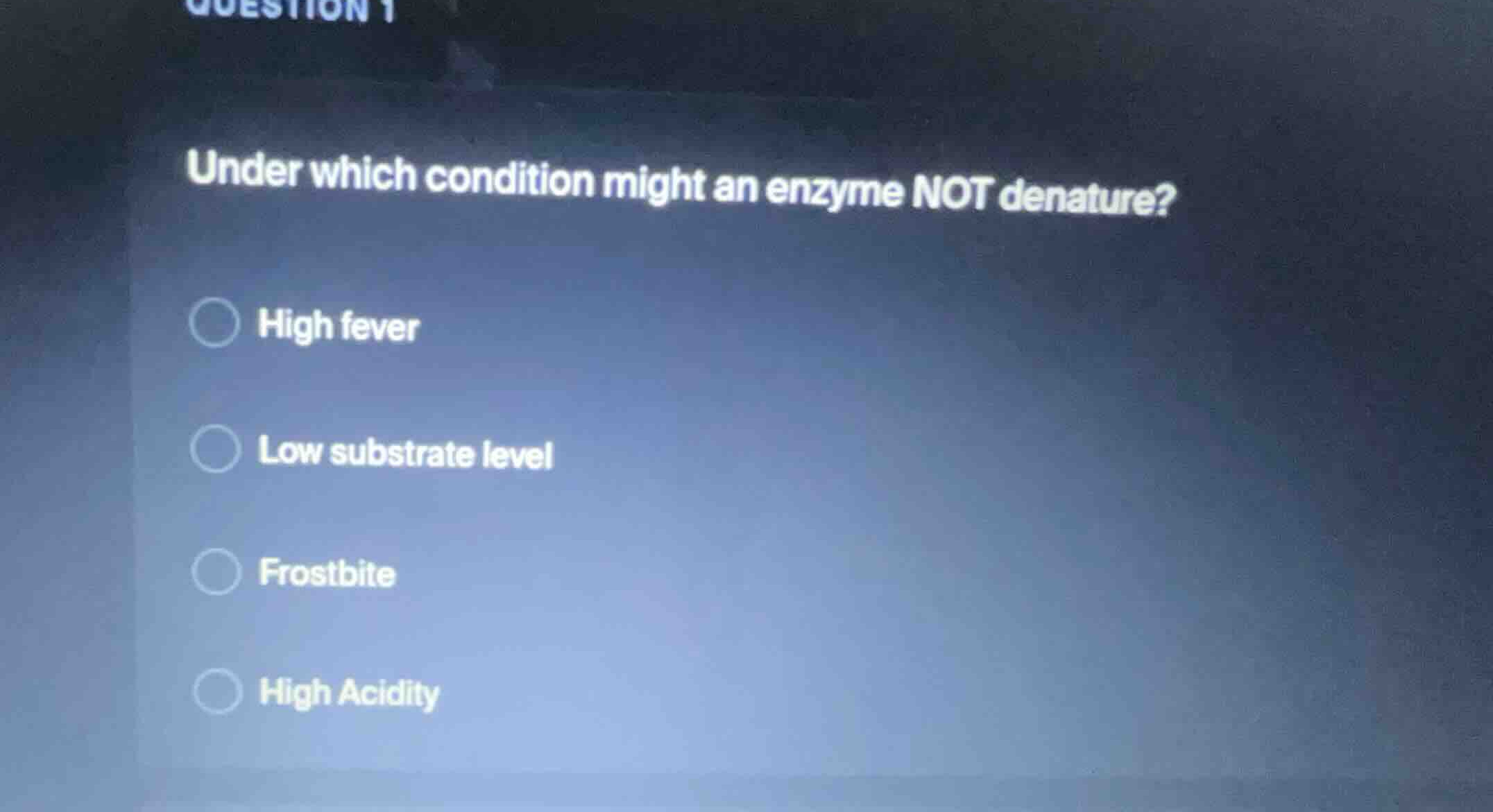
under which condition might an enzyme not denature?
high fever
low substrate level
frostbite
high acidity
Define enzyme denaturation
Enzymes are Proteins whose catalytic activity depends on their specific three-dimensional tertiary structure. Denaturation is the process where physical or chemical factors disrupt the non-covalent bonds (like hydrogen bonds and ionic interactions) stabilizing this structure, causing the protein to unfold and lose its function.
Analyze the effect of temperature
Extreme heat, such as a high fever, increases molecular kinetic energy, disrupting the delicate bonds holding the enzyme's active site together and causing denaturation. Conversely, extremely low temperatures, like those in frostbite, slow down molecular motion and reaction rates but typically do not disrupt the structural bonds of the enzyme; thus, low temperatures generally do not denature enzymes.
Analyze the effect of pH
Extreme pH levels, such as high acidity, alter the ionization states of amino acid side chains. This disrupts the ionic bonds and hydrogen bonds that maintain the enzyme's tertiary structure, leading to denaturation.
Analyze substrate concentration
Substrate concentration affects the rate of enzymatic reactions. A low substrate level means fewer collisions between enzymes and substrates, which decreases the reaction rate, but it has no physical or chemical effect on the structural integrity of the enzyme itself. Therefore, under low substrate levels, the enzyme remains fully intact and does NOT denature.

Snap & solve any problem in the app
Get step-by-step solutions on Sovi AI
Photo-based solutions with guided steps
Explore more problems and detailed explanations
- High fever
- Low substrate level (Correct answer)
- Frostbite
- High Acidity