QUESTION IMAGE
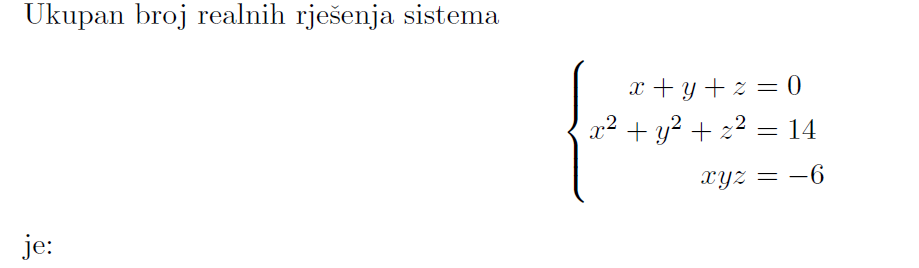
Question
ukupan broj realnih rješenja sistema
\\
\
\\
je:
🆕 New Concept Discovered: Symmetric Systems and Vieta's Formulas
Using roots of a cubic polynomial to solve symmetric systems.
Step 1: Identify symmetric sums
We are given the system of equations:
We can relate these variables to the coefficients of a cubic polynomial whose roots are \(x\), \(y\), and \(z\). Let this polynomial be:
where the elementary symmetric polynomials are:
From the system, we already have:
Step 2: Find the pairwise sum \(e_2\)
We use the algebraic identity:
Substitute the known values into the identity:
Step 3: Construct and solve the cubic equation
The cubic polynomial with roots \(x\), \(y\), and \(z\) is:
We find the roots of this polynomial. By inspection, \(t = 1\) is a root because:
We can factor out \((t - 1)\) using polynomial division or synthetic division:
Factor the quadratic part:
Thus, the roots of the cubic equation are:
Step 4: Determine the number of real solutions
The values of \(x\), \(y\), and \(z\) must be a permutation of the set of roots \(\{1, 2, -3\}\).
Since all three roots are distinct and real, any permutation of these three values yields a unique real solution triplet \((x, y, z)\).
The number of permutations of 3 distinct elements is:
The 6 real solutions are:

Snap & solve any problem in the app
Get step-by-step solutions on Sovi AI
Photo-based solutions with guided steps
Explore more problems and detailed explanations
6