QUESTION IMAGE
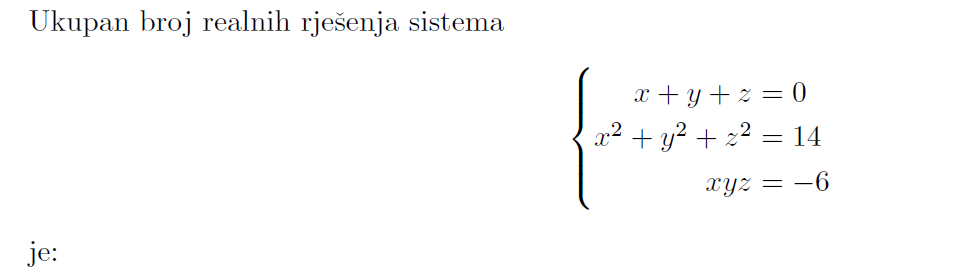
Question
ukupan broj realnih rješenja sistema
\\
\
\\
je:
🆕 New Concept Discovered: Solving Systems using Symmetric Polynomials
Using roots of a cubic equation to find system solutions.
Step 1: Relate the variables to symmetric polynomials
Let \( x \), \( y \), and \( z \) be the real roots of a cubic polynomial:
where the elementary symmetric polynomials are defined as:
From the given system of equations, we have:
Step 2: Find the value of the second symmetric polynomial
We can find \( e_2 \) using the algebraic identity:
Substitute the known values into the identity:
Step 3: Set up and solve the cubic equation
Now, substitute \( e_1 \), \( e_2 \), and \( e_3 \) back into the cubic polynomial \( P(t) \):
To find the roots of \( t^3 - 7t + 6 = 0 \), we can test small integer values.
For \( t = 1 \):
So, \( t = 1 \) is a root.
We can factor out \( (t - 1) \) from the polynomial:
Now, factor the quadratic part \( t^2 + t - 6 \):
Thus, the three roots of the cubic equation are:
Since all three roots are real numbers, any permutation of these three values \( \{1, 2, -3\} \) is a valid real solution \( (x, y, z) \) for the system.
Step 4: Count the total number of real solutions
The solutions \( (x, y, z) \) are the permutations of the set of roots \( \{1, 2, -3\} \).
The number of permutations of 3 distinct elements is:
The 6 distinct real solutions are:
- \( (1, 2, -3) \)
- \( (1, -3, 2) \)
- \( (2, 1, -3) \)
- \( (2, -3, 1) \)
- \( (-3, 1, 2) \)
- \( (-3, 2, 1) \)

Snap & solve any problem in the app
Get step-by-step solutions on Sovi AI
Photo-based solutions with guided steps
Explore more problems and detailed explanations
6