QUESTION IMAGE
Question
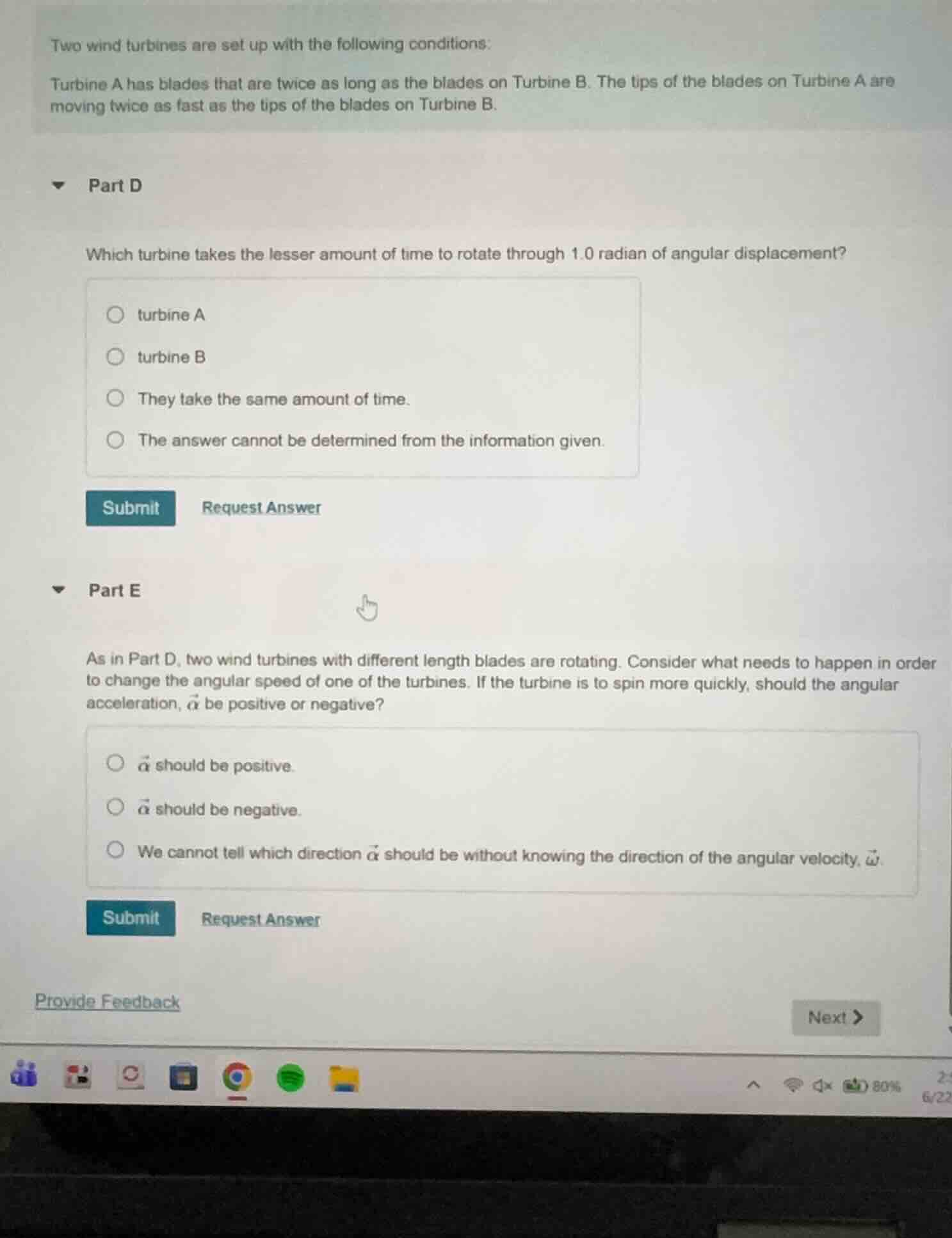
two wind turbines are set up with the following conditions:
turbine a has blades that are twice as long as the blades on turbine b. the tips of the blades on turbine a are moving twice as fast as the tips of the blades on turbine b.
part d
which turbine takes the lesser amount of time to rotate through 1.0 radian of angular displacement?
turbine a
turbine b
they take the same amount of time.
the answer cannot be determined from the information given.
part e
as in part d, two wind turbines with different length blades are rotating. consider what needs to happen in order to change the angular speed of one of the turbines. if the turbine is to spin more quickly, should the angular acceleration, \\(\vec{\alpha}\\) be positive or negative?
\\(\vec{\alpha}\\) should be positive.
\\(\vec{\alpha}\\) should be negative.
we cannot tell which direction \\(\vec{\alpha}\\) should be without knowing the direction of the angular velocity, \\(\vec{\omega}\\).
Relate linear and angular speeds
Using the Rolling Motion Relations knowledge point
Compare rotation times
Using the Rolling Motion Relations knowledge point
Determine angular acceleration sign
Using the Sign Convention in Rotation knowledge point

Snap & solve any problem in the app
Get step-by-step solutions on Sovi AI
Photo-based solutions with guided steps
Explore more problems and detailed explanations
Question 1
- turbine A
- turbine B
- They take the same amount of time. (Correct answer)
- The answer cannot be determined from the information given.
Question 2
- \(\vec{\alpha}\) should be positive.
- \(\vec{\alpha}\) should be negative.
- We cannot tell which direction \(\vec{\alpha}\) should be without knowing the direction of the angular velocity, \(\vec{\omega}\). (Correct answer)