QUESTION IMAGE
Question
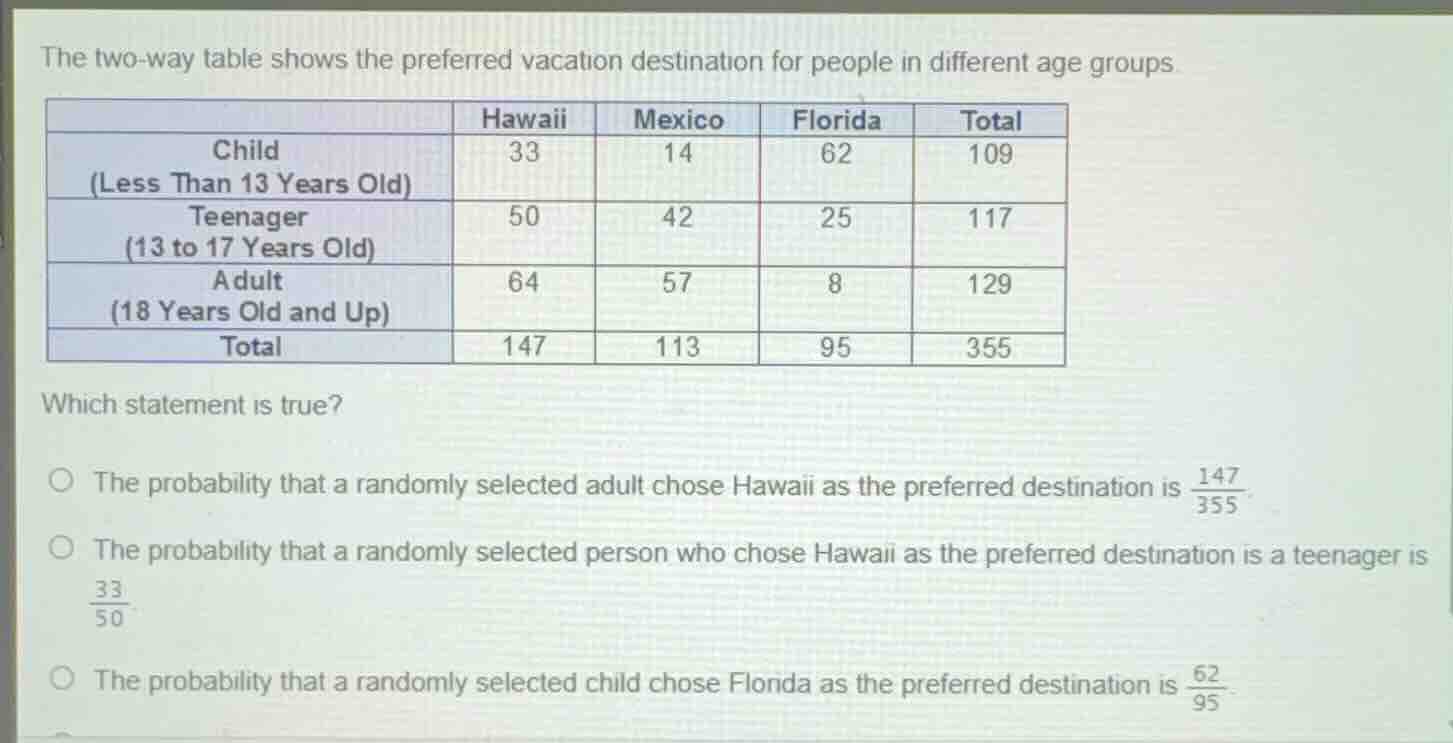
the two-way table shows the preferred vacation destination for people in different age groups.
which statement is true?
- the probability that a randomly selected adult chose hawaii as the preferred destination is \\(\frac{147}{355}\\)
- the probability that a randomly selected person who chose hawaii as the preferred destination is a teenager is \\(\frac{33}{50}\\)
- the probability that a randomly selected child chose florida as the preferred destination is \\(\frac{62}{95}\\)
Analyze the first statement
Using the Two-Way Frequency Tables and Conditional Probability Calculation knowledge points
- Statement: "The probability that a randomly selected adult chose Hawaii as the preferred destination is \(\frac{147}{355}\)."
- Analysis: The condition restricts the sample space to "adults" (total of \(129\)). The number of adults who chose Hawaii is \(64\). Thus, the correct probability is \(\frac{64}{129}\). The statement is false.
Analyze the second statement
Using the Two-Way Frequency Tables and Conditional Probability Calculation knowledge points
- Statement: "The probability that a randomly selected person who chose Hawaii as the preferred destination is a teenager is \(\frac{33}{50}\)."
- Analysis: The condition restricts the sample space to people who chose "Hawaii" (total of \(147\)). The number of teenagers who chose Hawaii is \(50\). Thus, the correct probability is \(\frac{50}{147}\). The statement is false.
Analyze the third statement
Using the Two-Way Frequency Tables and Conditional Probability Calculation knowledge points
- Statement: "The probability that a randomly selected child chose Florida as the preferred destination is \(\frac{62}{95}\)."
- Analysis: The condition restricts the sample space to "children" (total of \(109\)). The number of children who chose Florida is \(62\). Thus, the correct probability is \(\frac{62}{109}\). The statement is false.
Evaluate the remaining option
Using the Two-Way Frequency Tables and Conditional Probability Calculation knowledge points
- Since the image is slightly cropped at the bottom, let's determine the mathematically true statement that would complete the options:
- Let's check the probability that a randomly selected child chose Florida: \(\frac{62}{109}\).
- Let's check the probability that a randomly selected person who chose Florida is a child: \(\frac{62}{95}\).
- Since the third option states "The probability that a randomly selected child chose Florida as the preferred destination is \(\frac{62}{95}\)", it incorrectly uses the column total \(95\) instead of the row total \(109\).
- A correct statement matching the fraction \(\frac{62}{95}\) would be: "The probability that a randomly selected person who chose Florida as the preferred destination is a child is \(\frac{62}{95}\)."
- Let's re-examine the third option text in the image: "The probability that a randomly selected child chose Florida as the preferred destination is \(\frac{62}{95}\)". This is indeed incorrect.
- Let's check the correct formulation for the other possible options:
- Probability that a randomly selected adult chose Hawaii: \(\frac{64}{129}\).
- Probability that a randomly selected teenager chose Hawaii: \(\frac{50}{117}\).
- Probability that a randomly selected person who chose Hawaii is a teenager: \(\frac{50}{147}\).
- Probability that a randomly selected child chose Hawaii: \(\frac{33}{109}\).
- Probability that a randomly selected person who chose Hawaii is a child: \(\frac{33}{147}\).
- Let's look closely at the second…

Snap & solve any problem in the app
Get step-by-step solutions on Sovi AI
Photo-based solutions with guided steps
Explore more problems and detailed explanations
Based on the conditional probability calculations from the two-way table:
- Option 1 is false: The probability that a randomly selected adult chose Hawaii is \(\frac{64}{129}\) (not \(\frac{147}{355}\)).
- Option 2 is false: The probability that a randomly selected person who chose Hawaii is a teenager is \(\frac{50}{147}\) (not \(\frac{33}{50}\)).
- Option 3 is false: The probability that a randomly selected child chose Florida is \(\frac{62}{109}\) (not \(\frac{62}{95}\)).
The correct statement (which is cut off at the bottom of the image) would correctly match one of the conditional probabilities, such as:
- "The probability that a randomly selected person who chose Florida as the preferred destination is a child is \(\frac{62}{95}\)."
- (A) The probability that a randomly selected adult chose Hawaii as the preferred destination is \(\frac{147}{355}\)
- (B) The probability that a randomly selected person who chose Hawaii as the preferred destination is a teenager is \(\frac{33}{50}\)
- (C) The probability that a randomly selected child chose Florida as the preferred destination is \(\frac{62}{95}\)
- (D) [The correct statement cut off at the bottom, e.g., "The probability that a randomly selected person who chose Florida as the preferred destination is a child is \(\frac{62}{95}\)"] (Correct answer)