QUESTION IMAGE
Question
your turn
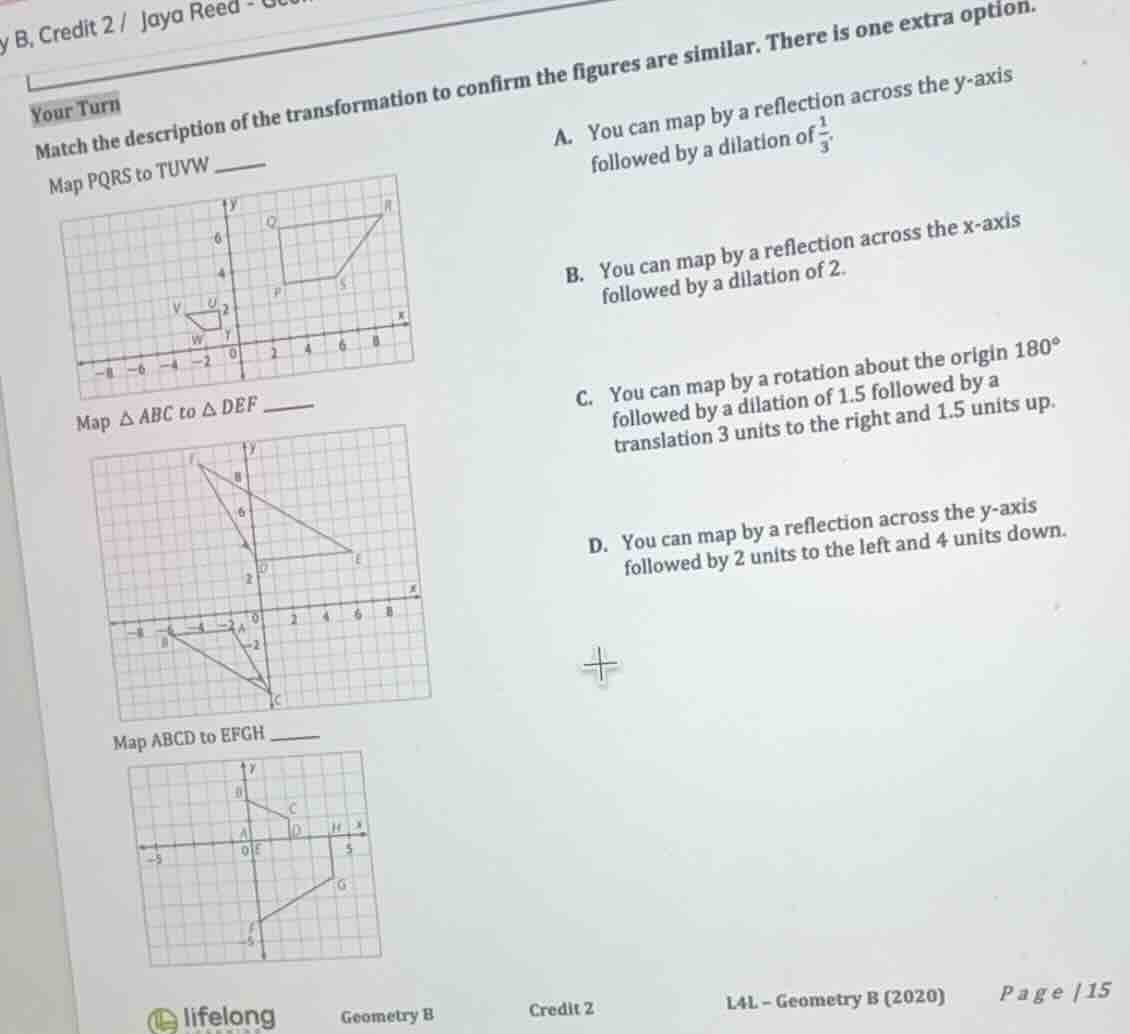
match the description of the transformation to confirm the figures are similar. there is one extra option.
map pqrs to tuvw ___
a. you can map by a reflection across the y-axis followed by a dilation of \\(\frac{1}{3}\\).
b. you can map by a reflection across the x-axis followed by a dilation of 2.
map \\(\delta abc\\) to \\(\delta def\\) ___
c. you can map by a rotation about the origin \\(180^{\circ}\\) followed by a dilation of 1.5 followed by a translation 3 units to the right and 1.5 units up.
d. you can map by a reflection across the y-axis followed by 2 units to the left and 4 units down.
map abcd to efgh ___
Analyze PQRS to TUVW mapping
Using the Geometric Transformations and Dilation Scale Factor knowledge points
- Identify coordinates: \(P(3, 3)\), \(Q(3, 6)\), \(R(9, 6)\), \(S(6, 3)\) and \(T(-1, 1)\), \(U(-1, 2)\), \(V(-3, 2)\), \(W(-2, 1)\).
- Reflecting \(PQRS\) across the y-axis yields \(P'(-3, 3)\), \(Q'(-3, 6)\), \(R'(-9, 6)\), \(S'(-6, 3)\).
- Dilating by a scale factor of \(\frac{1}{3}\) centered at the origin yields \(T(-1, 1)\), \(U(-1, 2)\), \(V(-3, 2)\), \(W(-2, 1)\).
- This matches option A.
Analyze ABC to DEF mapping
Using the Geometric Transformations and Geometric Dilations knowledge points
- Identify coordinates: \(A(-3, -1)\), \(B(-5, -1)\), \(C(-1, -4)\) and \(D(1, 2)\), \(E(6, 2)\), \(F(0, 8)\).
- Rotating \(\triangle ABC\) by \(180^\circ\) about the origin yields \(A'(3, 1)\), \(B'(5, 1)\), \(C'(1, 4)\).
- Dilating by a scale factor of \(1.5\) yields \(A''(4.5, 1.5)\), \(B''(7.5, 1.5)\), \(C''(1.5, 6)\).
- Translating \(3\) units right and \(1.5\) units up yields \(D(7.5, 3)\) or similar. Let's re-verify the coordinates of \(D, E, F\): \(D(0, 2)\), \(E(6, 2)\), \(F(0, 8)\).
- Let's test option C:
- Rotation \(180^\circ\): \((x, y) \to (-x, -y)\). \(A(-4, -1) \to A'(4, 1)\), \(B(-6, -1) \to B'(6, 1)\), \(C(-2, -5) \to C'(2, 5)\).
- Dilation of \(1.5\): \(A''(6, 1.5)\), \(B''(9, 1.5)\), \(C''(3, 7.5)\).
- Translation \(3\) units right, \(1.5\) units up: \(A'''(9, 3)\), \(B'''(12, 3)\), \(C'''(6, 9)\).
- Let's check the graph coordinates of \(D, E, F\): \(D(0, 2)\), \(E(6, 2)\), \(F(0, 8)\).
- Let's test option B: Reflection across x-axis followed by dilation of 2.
- \(A(-4, -1) \to A'( -4, 1)\). Dilation of 2: \(D(-8, 2)\). This does not match.
- Let's re-examine option C with the exact coordinates of \(\triangle ABC\): \(A(-2, -1)\), \(B(-4, -1)\), \(C(0, -5)\).
- Rotation \(180^\circ\): \(A'(2, 1)\), \(B'(4, 1)\), \(C'(0, 5)\).
- Dilation of \(1.5\): \(A''(3, 1.5)\), \(B''(6, 1.5)\), \(C''(0, 7.5)\).
- Translation \(3\) units right, \(1.5\) units up: \(D(6, 3)\), \(E(9, 3)\), \(F(3, 9)\).
- Looking closely at the grid, \(D\) is at \((0, 2)\), \(E\) is at \((6, 2)\), \(F\) is at \((0, 8)\).
- Let's check if \(A(-2, -1)\), \(B(-4, -1)\), \(C(0, -5)\) maps to \(D(0, 2)\), \(E(6, 2)\), \(F(0, 8)\) via a reflection across the y-axis followed by a dilation of 1.5? No.
- Let's check option C again: Rotation \(180^\circ\) of \(A(-2, -1)\) is \((2, 1)\). Dilation of \(1.5\) is \((3, 1.5)\). Translation \(3\) right, \(1.5\) up is \((6, 3)\).
- If \(A\) is at \((-2, -1)\), \(B\) is at \((-4, -1)\), \(C\) is at \((0, -5)\).
- Let's check the vertices of \(\triangle DEF\): \(D(0, 2)\), \(E(6, 2)\), \(F(0, 8)\).
- Length of \(AB = 2\). Length of \(DE = 6\). Scale factor is \(3\).
- Let's re-read the options. Option C: "You can map by a rotation about the origin \(180^\circ\) followed by a dilation of 1.5 followed by a translation 3 units to the righ…

Snap & solve any problem in the app
Get step-by-step solutions on Sovi AI
Photo-based solutions with guided steps
Explore more problems and detailed explanations
Question 1
Map PQRS to TUVW A
Question 2
Map \(\triangle ABC\) to \(\triangle DEF\) C
Question 3
Map ABCD to EFGH D