QUESTION IMAGE
Question
your turn
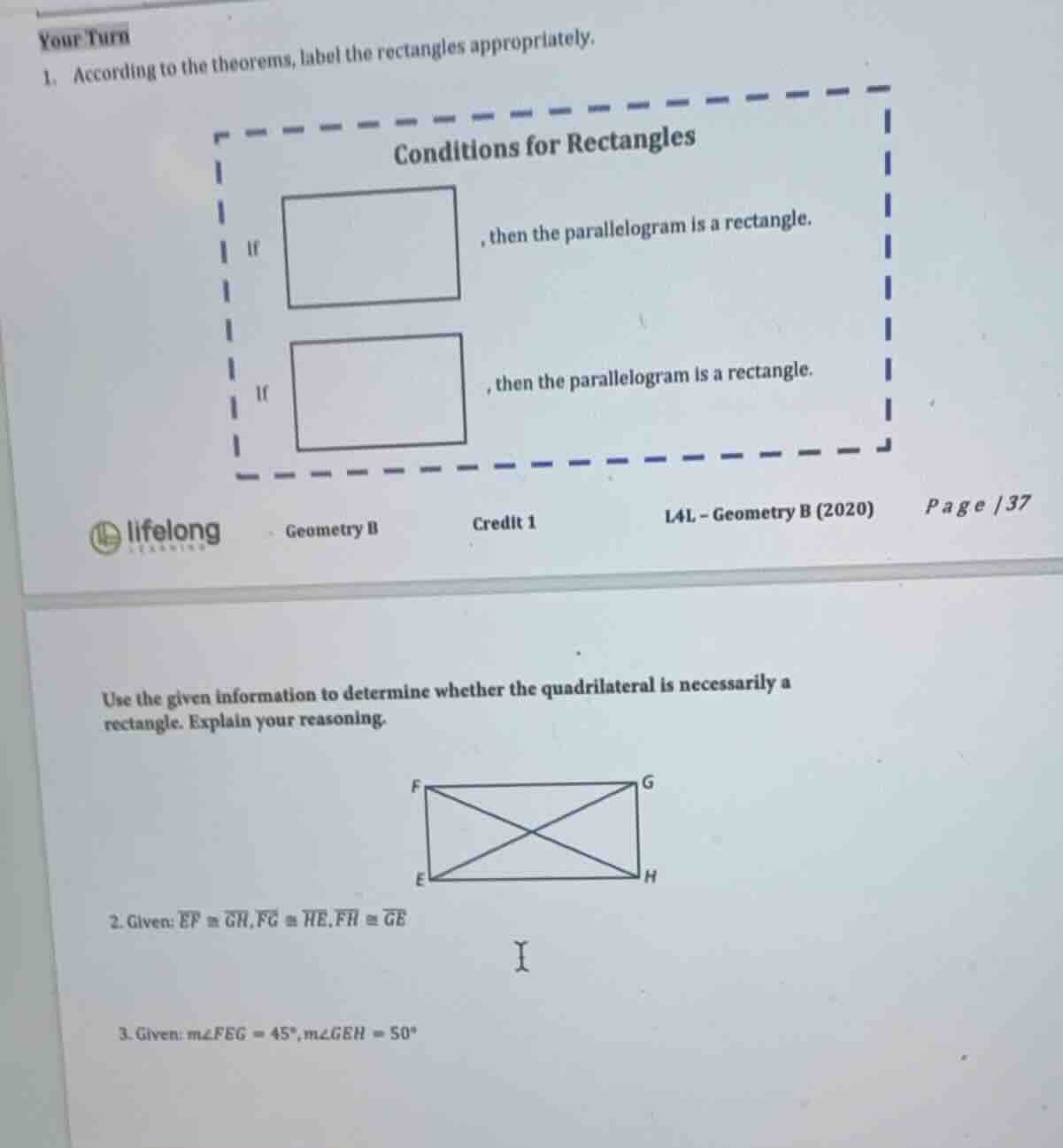
- according to the theorems, label the rectangles appropriately.
conditions for rectangles
if box, then the parallelogram is a rectangle.
if box, then the parallelogram is a rectangle.
use the given information to determine whether the quadrilateral is necessarily a rectangle. explain your reasoning.
- given: \\(ef \cong gh, fg \cong he, fh \cong ge\\)
- given: \\(m\angle feg = 45^{\circ}, m\angle geh = 50^{\circ}\\)
Identify conditions for rectangles
Using the Properties of Rectangles knowledge point
- A parallelogram is a rectangle if it has one right angle.
- A parallelogram is a rectangle if its diagonals are congruent.
Analyze Question 2
Using the Properties of Rectangles knowledge point
- Given: \(EF \cong GH\), \(FG \cong HE\), and \(FH \cong GE\).
- Since opposite sides are congruent (\(EF \cong GH\) and \(FG \cong HE\)), \(EFGH\) is a parallelogram.
- Since the diagonals are congruent (\(FH \cong GE\)), the parallelogram is a rectangle.
- Therefore, \(EFGH\) is necessarily a rectangle.
Analyze Question 3
Using the Properties of Rectangles knowledge point
- Given: \(m\angle FEG = 45^\circ\) and \(m\angle GEH = 50^\circ\).
- The measure of angle \(FEH\) is \(m\angle FEH = m\angle FEG + m\angle GEH = 45^\circ + 50^\circ = 95^\circ\).
- Since \(m\angle FEH = 95^\circ
eq 90^\circ\), the quadrilateral does not have a right angle.
- Therefore, \(EFGH\) is not necessarily a rectangle.

Snap & solve any problem in the app
Get step-by-step solutions on Sovi AI
Photo-based solutions with guided steps
Explore more problems and detailed explanations
Question 1
- First Condition: If a parallelogram has one right angle, then the parallelogram is a rectangle.
- Second Condition: If the diagonals of a parallelogram are congruent, then the parallelogram is a rectangle.
Question 2
- Conclusion: Yes, the quadrilateral is necessarily a rectangle.
- Explanation: The given conditions \(EF \cong GH\) and \(FG \cong HE\) establish that \(EFGH\) is a parallelogram because its opposite sides are congruent. The third condition, \(FH \cong GE\), states that the diagonals are congruent. A parallelogram with congruent diagonals is a rectangle.
Question 3
- Conclusion: No, the quadrilateral is not necessarily a rectangle.
- Explanation: The measure of the interior angle \(\angle FEH\) is the sum of \(m\angle FEG\) and \(m\angle GEH\), which is \(45^\circ + 50^\circ = 95^\circ\). Since a rectangle must have four \(90^\circ\) angles, a quadrilateral with an interior angle of \(95^\circ\) cannot be a rectangle.