QUESTION IMAGE
Question
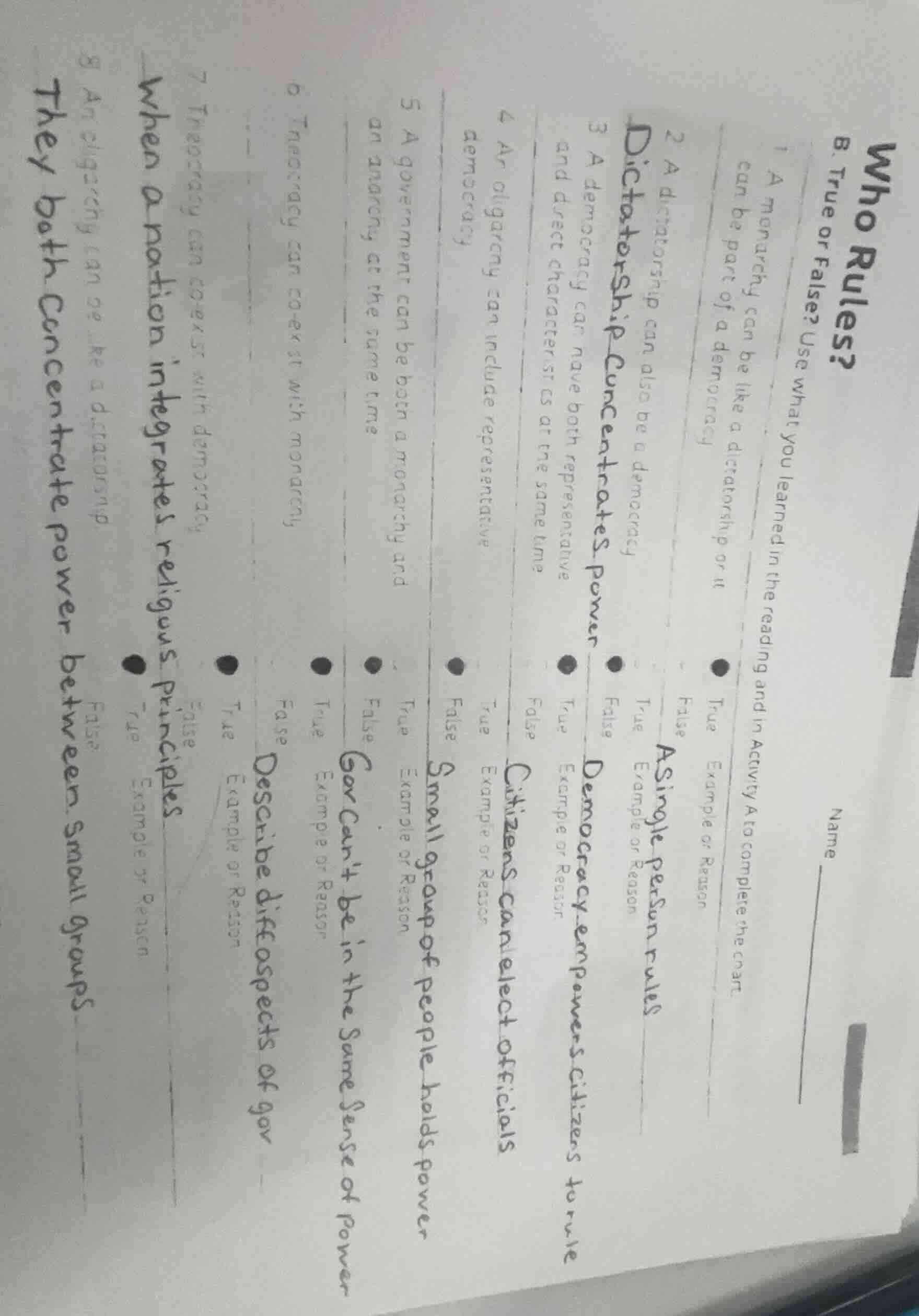
b. true or false? use what you learned in the reading and in activity a to complete the chart.
1 a monarchy can be like a dictatorship or it can be part of a democracy
true
false
example or reason
2 a dictatorship can also be a democracy
true
false
dictatorship concentrates power
example or reason
3 a democracy can have both representative and direct characteristics at the same time
true
false
example or reason
4 an oligarchy can include representative democracy
true
false
example or reason
5 a government can be both a monarchy and an anarchy at the same time
true
false
example or reason
6 theocracy can co - exist with monarchy
true
false
example or reason
7 theocracy can co - exist with democracy
when a nation integrates religious principles
true
false
example or reason
8 an oligarchy can be a dictatorship
they both concentrate power between small groups
true
false
To solve these true - false questions about different forms of government, we analyze each one based on the definitions of government types:
Question 1
- Explanation: A monarchy (where power is held by a royal family, e.g., some constitutional monarchies like the UK) can co - exist with democratic elements (the UK has a democratic parliamentary system along with a monarch). So the statement "A monarchy can be like a dictatorship or it can be part of a democracy" is True.
- Answer: True
Question 2
- Explanation: A dictatorship is a system where power is concentrated in the hands of a single person or a small group, while democracy is about the people having power (either directly or through representatives). These are opposite in terms of power distribution, so a dictatorship can't be a democracy. The statement "A dictatorship can also be a democracy" is False.
- Answer: False
Question 3
- Explanation: In a democracy, there are two main forms - representative (where citizens elect representatives) and direct (where citizens vote directly on issues, like in some small - scale democracies or referendums). So a democracy can have both representative and direct characteristics at the same time. The statement "A democracy can have both representative and direct characteristics at the same time" is True.
- Answer: True
Question 4
- Explanation: An oligarchy is a system where a small group holds power, while in a democracy, the power is with the people (either directly or through representatives). So an oligarchy can't include a representative democracy. The statement "An oligarchy can include representative democracy" is False.
- Answer: False
Question 5
- Explanation: A monarchy (power with a royal family) and an anarchy (no government) are fundamentally different in terms of power structure. A government can't be both a monarchy (which is a form of government) and an anarchy (no government) at the same time. The statement "A government can be both a monarchy and an anarchy at the same time" is False.
- Answer: False
Question 6
- Explanation: A theocracy (power based on religious authority, e.g., some historical theocratic states) and a monarchy (power with a royal family) can co - exist. For example, in some historical Islamic states with a royal family that also followed religious law. So the statement "Theocracy can co - exist with monarchy" is True.
- Answer: True
Question 7
- Explanation: A theocracy (power based on religious principles) and a democracy (power with the people) can co - exist. For example, some countries with a democratic system also have religious principles integrated into their governance (like some countries with an Islamic democratic system). So the statement "Theocracy can co - exist with democracy when a nation integrates religious principles" is True.
- Answer: True
Question 8
- Explanation: An oligarchy (power with a small group) and a dictatorship (power with a single person or small group) both concentrate power in the hands of a small number of people or a single person. So the statement "An oligarchy can be like a dictatorship. They both concentrate power between small groups" is True.
- Answer: True

Snap & solve any problem in the app
Get step-by-step solutions on Sovi AI
Photo-based solutions with guided steps
Explore more problems and detailed explanations
To solve these true - false questions about different forms of government, we analyze each one based on the definitions of government types:
Question 1
- Explanation: A monarchy (where power is held by a royal family, e.g., some constitutional monarchies like the UK) can co - exist with democratic elements (the UK has a democratic parliamentary system along with a monarch). So the statement "A monarchy can be like a dictatorship or it can be part of a democracy" is True.
- Answer: True
Question 2
- Explanation: A dictatorship is a system where power is concentrated in the hands of a single person or a small group, while democracy is about the people having power (either directly or through representatives). These are opposite in terms of power distribution, so a dictatorship can't be a democracy. The statement "A dictatorship can also be a democracy" is False.
- Answer: False
Question 3
- Explanation: In a democracy, there are two main forms - representative (where citizens elect representatives) and direct (where citizens vote directly on issues, like in some small - scale democracies or referendums). So a democracy can have both representative and direct characteristics at the same time. The statement "A democracy can have both representative and direct characteristics at the same time" is True.
- Answer: True
Question 4
- Explanation: An oligarchy is a system where a small group holds power, while in a democracy, the power is with the people (either directly or through representatives). So an oligarchy can't include a representative democracy. The statement "An oligarchy can include representative democracy" is False.
- Answer: False
Question 5
- Explanation: A monarchy (power with a royal family) and an anarchy (no government) are fundamentally different in terms of power structure. A government can't be both a monarchy (which is a form of government) and an anarchy (no government) at the same time. The statement "A government can be both a monarchy and an anarchy at the same time" is False.
- Answer: False
Question 6
- Explanation: A theocracy (power based on religious authority, e.g., some historical theocratic states) and a monarchy (power with a royal family) can co - exist. For example, in some historical Islamic states with a royal family that also followed religious law. So the statement "Theocracy can co - exist with monarchy" is True.
- Answer: True
Question 7
- Explanation: A theocracy (power based on religious principles) and a democracy (power with the people) can co - exist. For example, some countries with a democratic system also have religious principles integrated into their governance (like some countries with an Islamic democratic system). So the statement "Theocracy can co - exist with democracy when a nation integrates religious principles" is True.
- Answer: True
Question 8
- Explanation: An oligarchy (power with a small group) and a dictatorship (power with a single person or small group) both concentrate power in the hands of a small number of people or a single person. So the statement "An oligarchy can be like a dictatorship. They both concentrate power between small groups" is True.
- Answer: True