QUESTION IMAGE
Question
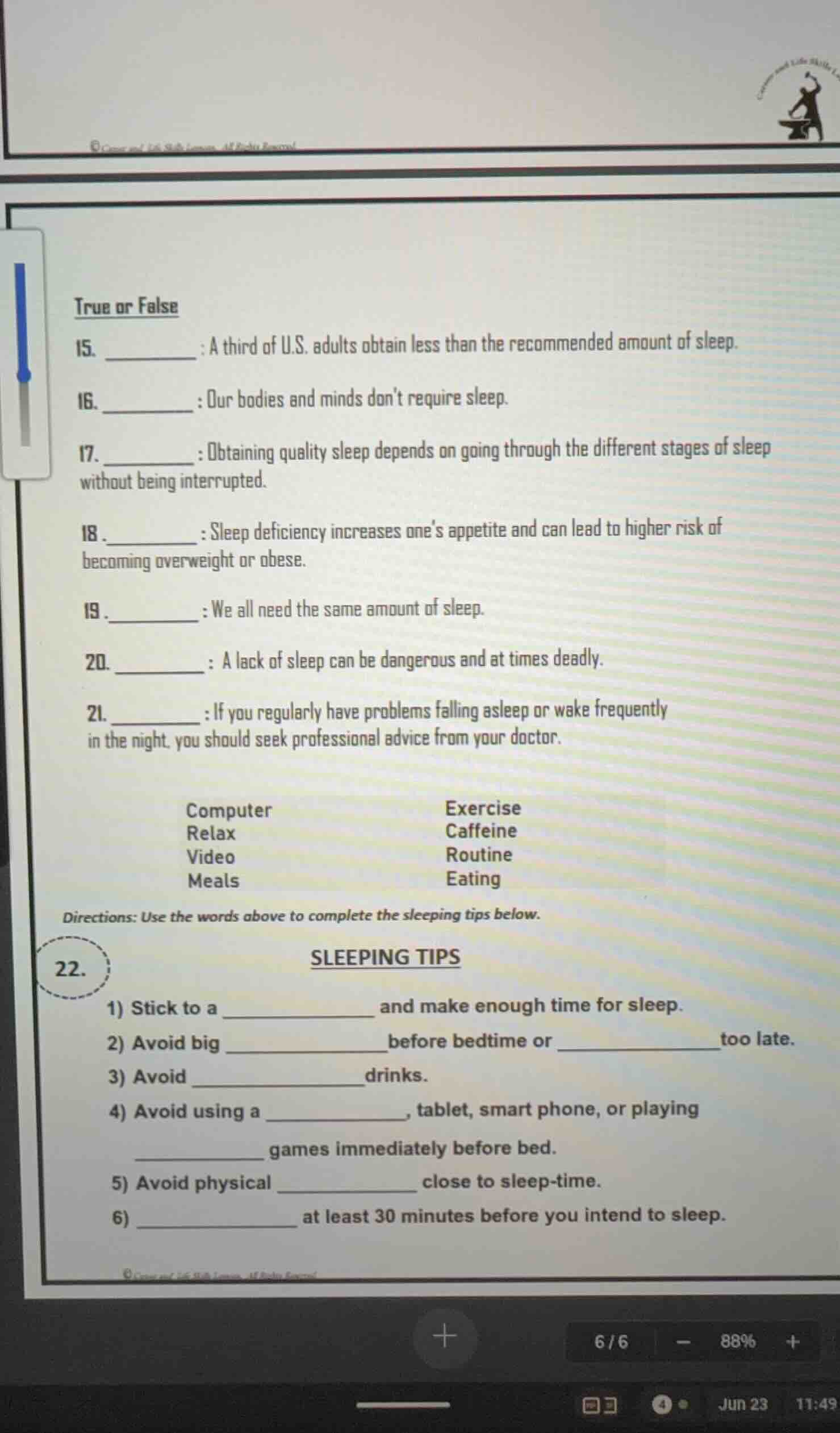
true or false
- ________ : a third of u.s. adults obtain less than the recommended amount of sleep.
- ________ : our bodies and minds dont require sleep.
- ________ : obtaining quality sleep depends on going through the different stages of sleep without being interrupted.
- ________ : sleep deficiency increases ones appetite and can lead to higher risk of becoming overweight or obese.
- ________ : we all need the same amount of sleep.
- ________ : a lack of sleep can be dangerous and at times deadly.
- ________ : if you regularly have problems falling asleep or wake frequently in the night, you should seek professional advice from your doctor.
computer exercise
relax caffeine
video routine
meals eating
directions: use the words above to complete the sleeping tips below.
sleeping tips
22.
- stick to a ________ and make enough time for sleep.
- avoid big ______ before bedtime or ______ too late.
- avoid ________ drinks.
- avoid using a ______, tablet, smart phone, or playing ______ games immediately before bed.
- avoid physical ________ close to sleep-time.
- ________ at least 30 minutes before you intend to sleep.
Analyze True or False statements
We evaluate statements 15 to 21 based on Sleep Physiology and Sleep Deprivation Effects:
- 15: According to the CDC, about 1 in 3 U.S. adults report not getting enough sleep. Thus, this is True.
- 16: Sleep is essential for biological restoration, cognitive function, and survival. Thus, this is False.
- 17: Quality sleep requires cycling through NREM and REM stages uninterrupted. Thus, this is True.
- 18: Sleep deprivation alters hunger hormones (ghrelin and leptin), increasing appetite and obesity risk. Thus, this is True.
- 19: Sleep needs vary by age, genetics, and individual health. Thus, this is False.
- 20: Severe sleep deprivation impairs reaction times, leading to fatal accidents. Thus, this is True.
- 21: Chronic insomnia or frequent awakenings warrant medical evaluation. Thus, this is True.
Complete the sleeping tips
We fill in the blanks for question 22 using the provided word bank and Sleep Quality Strategies:
- 1) "Stick to a..." requires a noun indicating consistency. "Routine" fits perfectly.
- 2) "Avoid big..." and "...too late" relate to nutrition. "Meals" and "Eating" fit respectively.
- 3) "Avoid..." drinks refers to stimulants. "Caffeine" fits perfectly.
- 4) "Avoid using a..." and "...games" relate to screen time. "Computer" and "Video" fit respectively.
- 5) "Avoid physical..." refers to late-night workouts. "Exercise" fits perfectly.
- 6) "...at least 30 minutes before..." refers to winding down. "Relax" fits perfectly.

Snap & solve any problem in the app
Get step-by-step solutions on Sovi AI
Photo-based solutions with guided steps
Explore more problems and detailed explanations
Question 15
True
Question 16
False
Question 17
True
Question 18
True
Question 19
False
Question 20
True
Question 21
True
Question 22
- Stick to a <blank>Routine</blank> and make enough time for sleep.
- Avoid big <blank>Meals</blank> before bedtime or <blank>Eating</blank> too late.
- Avoid <blank>Caffeine</blank> drinks.
- Avoid using a <blank>Computer</blank>, tablet, smart phone, or playing <blank>Video</blank> games immediately before bed.
- Avoid physical <blank>Exercise</blank> close to sleep-time.
- <blank>Relax</blank> at least 30 minutes before you intend to sleep.