QUESTION IMAGE
Question
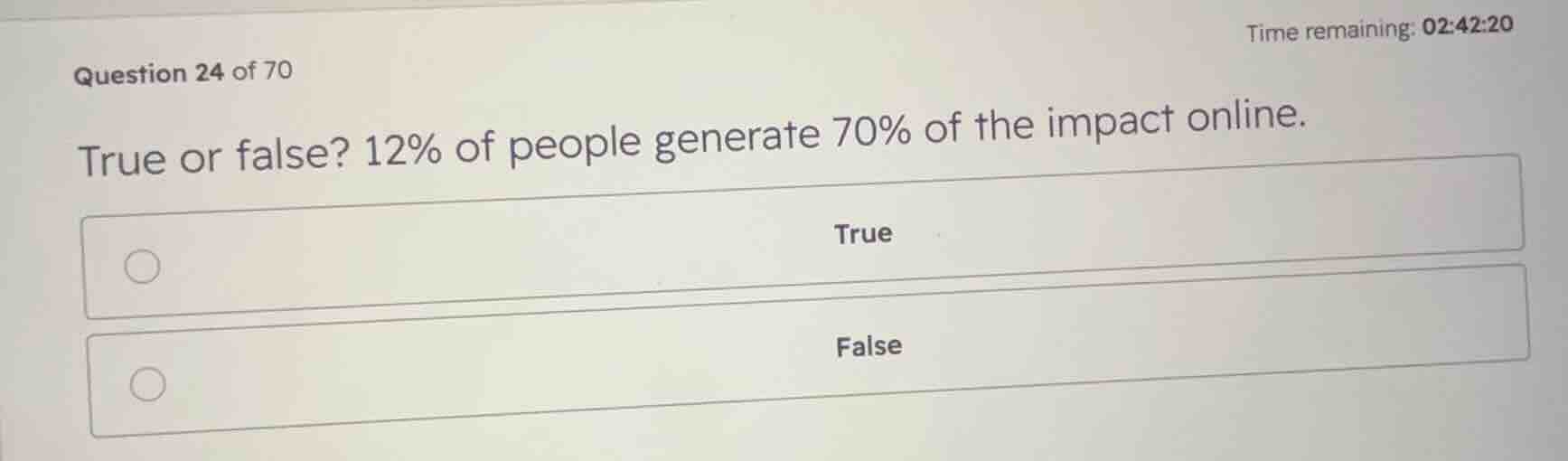
true or false? 12% of people generate 70% of the impact online.
- true
- false
🆕 New Concept Discovered: The 90-9-1 Rule of Social Media
How participation is distributed online
Step 1: Understand the 90-9-1 Rule
In social media and online communities, participation is highly unequal. This is commonly described by the 90-9-1 rule (also known as participation inequality):
- 90% of users are "lurkers" who only consume content but do not contribute.
- 9% of users contribute occasionally (intermittent participation).
- 1% of users account for the vast majority of the contributions and generate most of the impact online.
Step 2: Compare with the statement
The statement claims that:
- \( 12\% \) of people generate \( 70\% \) of the impact online.
According to established research on digital participation inequality, a much smaller group—specifically about \( 1\% \) to \( 10\% \) of highly active creators—generates the vast majority (often estimated around \( 90\% \)) of all online content and impact. The specific breakdown of \( 12\% \) generating \( 70\% \) does not align with the standard 90-9-1 rule of online participation, where a tiny sliver (\( 1\% \)) dominates almost all impact, or the Pareto principle (\( 20\% \) of people generating \( 80\% \) of the impact).
However, in many digital marketing and social media studies, the actual statistic is that \( 10\% \) of users generate \( 90\% \) of the content, or \( 1\% \) of users generate \( 90\% \) of the content. The statement "\( 12\% \) of people generate \( 70\% \) of the impact online" is False.

Snap & solve any problem in the app
Get step-by-step solutions on Sovi AI
Photo-based solutions with guided steps
Explore more problems and detailed explanations
False