QUESTION IMAGE
Question
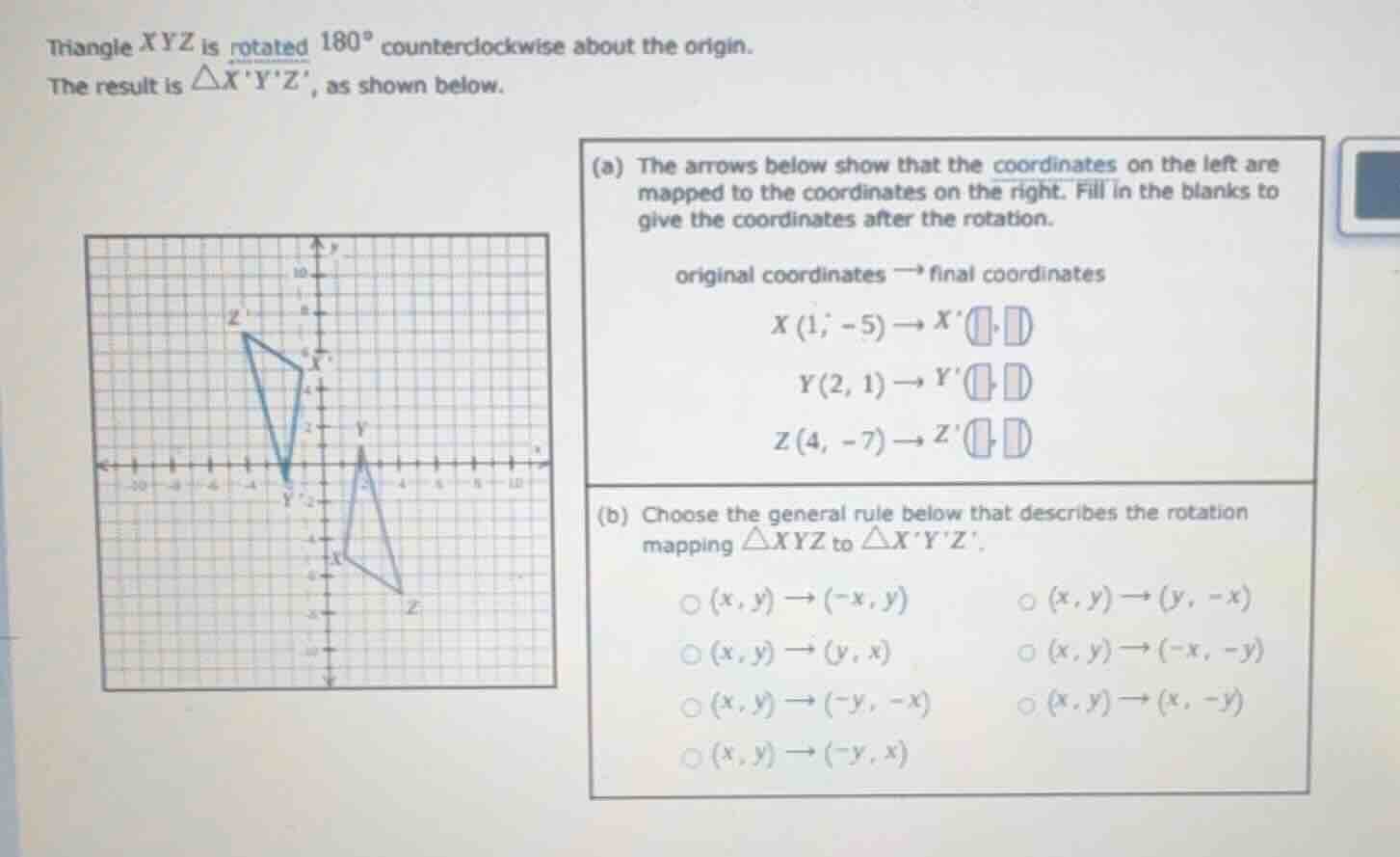
triangle \\(xyz\\) is rotated \\(180^{\circ}\\) counterclockwise about the origin.
the result is \\(\delta xyz\\), as shown below.
(a) the arrows below show that the coordinates on the left are mapped to the coordinates on the right. fill in the blanks to give the coordinates after the rotation.
original coordinates \\(\
ightarrow\\) final coordinates
\\(x(1, -5) \
ightarrow x(\square, \square)\\)
\\(y(2, 1) \
ightarrow y(\square, \square)\\)
\\(z(4, -7) \
ightarrow z(\square, \square)\\)
(b) choose the general rule below that describes the rotation mapping \\(\delta xyz\\) to \\(\delta xyz\\).
\\(\bigcirc\\) \\((x, y) \
ightarrow (-x, y)\\)
\\(\bigcirc\\) \\((x, y) \
ightarrow (y, x)\\)
\\(\bigcirc\\) \\((x, y) \
ightarrow (-y, -x)\\)
\\(\bigcirc\\) \\((x, y) \
ightarrow (-y, x)\\)
\\(\bigcirc\\) \\((x, y) \
ightarrow (y, -x)\\)
\\(\bigcirc\\) \\((x, y) \
ightarrow (-x, -y)\\)
\\(\bigcirc\\) \\((x, y) \
ightarrow (x, -y)\\)
⚡ Using what you learned: rotations
Step 1: Apply the rotation rule to coordinates
A rotation of \(180^\circ\) counterclockwise (or clockwise) about the origin maps any point \((x, y)\) to \((-x, -y)\).
Applying this rule to the given original coordinates:
- For \(X(1, -5)\):
- For \(Y(2, 1)\):
- For \(Z(4, -7)\):
Step 2: Identify the general rule
The transformation that maps each original coordinate \((x, y)\) to its image after a \(180^\circ\) rotation is:

Snap & solve any problem in the app
Get step-by-step solutions on Sovi AI
Photo-based solutions with guided steps
Explore more problems and detailed explanations
(a)
- \(X(1, -5)
ightarrow X'(-1, 5)\)
- \(Y(2, 1)
ightarrow Y'(-2, -1)\)
- \(Z(4, -7)
ightarrow Z'(-4, 7)\)
(b)
- \((x, y)
ightarrow (-x, -y)\)