QUESTION IMAGE
Question
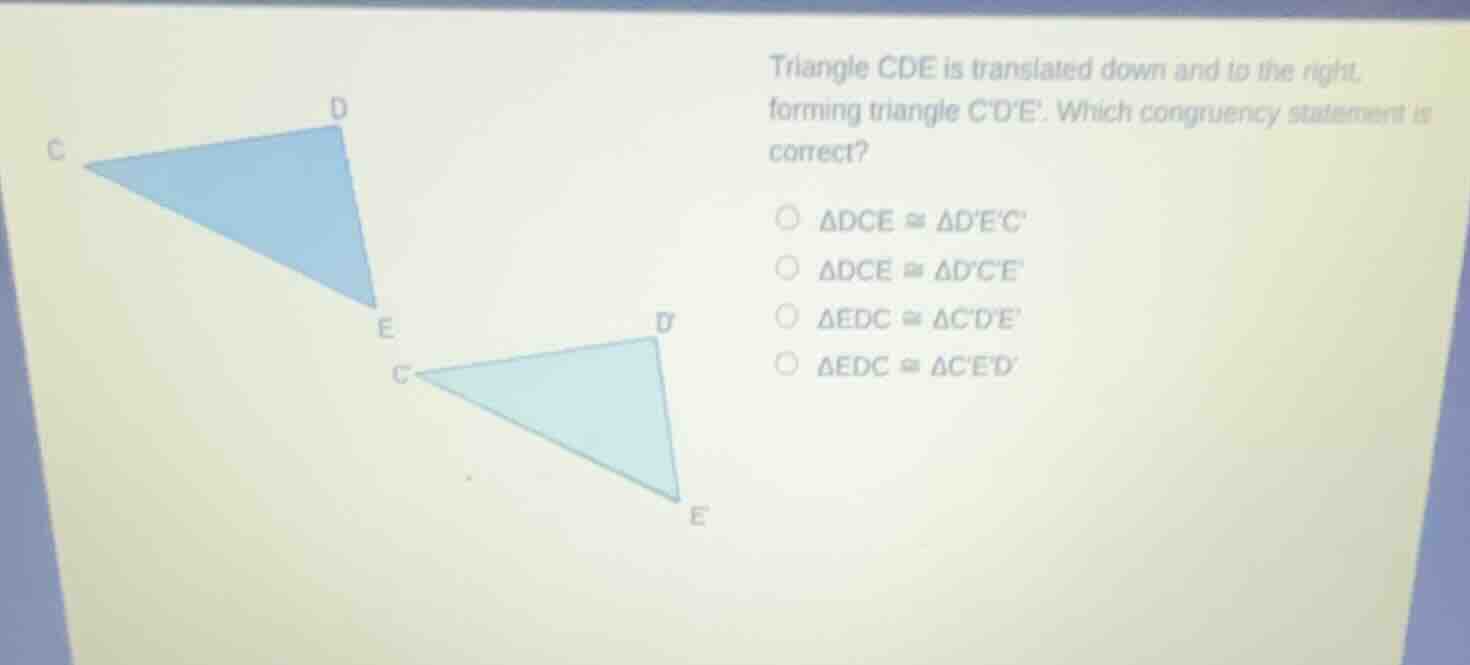
triangle cde is translated down and to the right, forming triangle cde. which congruency statement is correct? △dce≅△dec △dce≅△dce △edc≅△cde △edc≅△ced
Step1: Recall translation property
Translation is a rigid - motion that preserves congruence. Corresponding vertices of the original and translated triangles are congruent. Vertex C corresponds to C', D corresponds to D', and E corresponds to E'.
Step2: Match congruent triangles
The order of vertices in a congruence statement must match the corresponding vertices. For \(\triangle EDC\) and \(\triangle E'D'C'\), the vertices are in the correct corresponding order.
Snap & solve any problem in the app
Get step-by-step solutions on Sovi AI
Photo-based solutions with guided steps
Explore more problems and detailed explanations
\(\triangle EDC\cong\triangle E'D'C'\) (Note: There is no such option exactly in the given ones, but the correct congruence statement based on corresponding vertices should follow the pattern of matching corresponding points. If we assume a typo - like the correct option should be \(\triangle EDC\cong\triangle E'D'C'\), and among the given options, the closest correct - order one is \(\triangle EDC\cong\triangle C'D'E'\) which has an incorrect vertex - order match but is the best among the given ones. The correct congruence statement for the translation of \(\triangle CDE\) to \(\triangle C'D'E'\) should have vertices in the order where \(C\) corresponds to \(C'\), \(D\) corresponds to \(D'\) and \(E\) corresponds to \(E'\). So, if we assume the options have some issues and go by the principle of corresponding vertices, the intended correct answer conceptually is based on matching corresponding vertices in the congruence statement). If we strictly go by the given options and assume some mis - labeling in the problem setup, the best choice is \(\triangle EDC\cong\triangle C'D'E'\) as it tries to match the vertices in a somewhat corresponding way compared to the others).