QUESTION IMAGE
Question
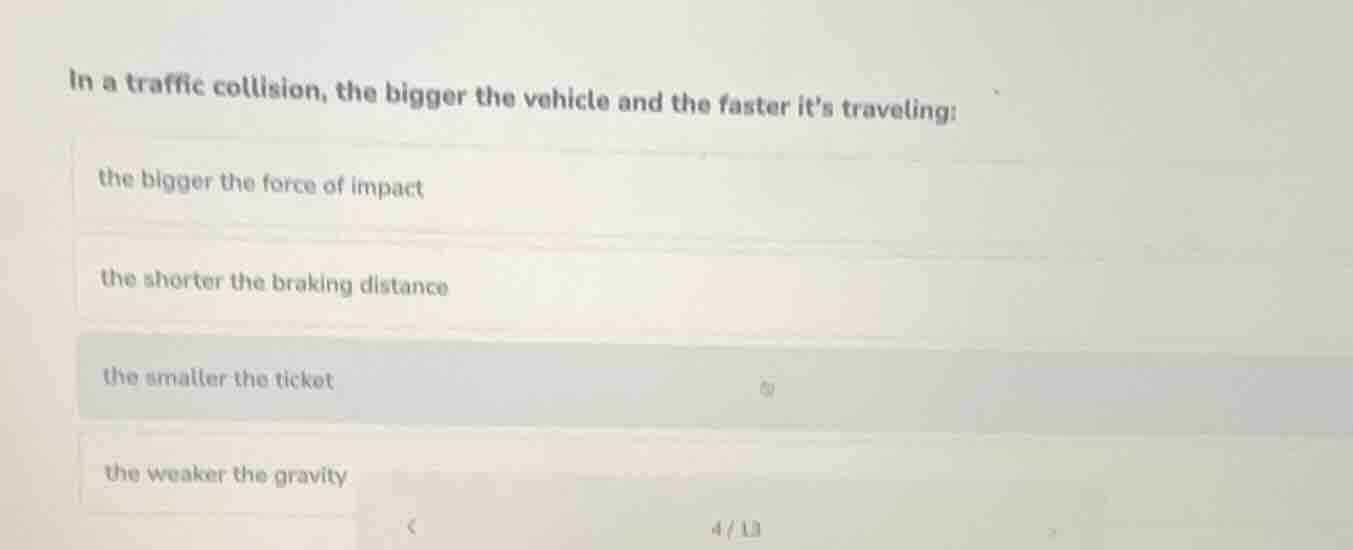
in a traffic collision, the bigger the vehicle and the faster its traveling:
the bigger the force of impact
the shorter the braking distance
the smaller the ticket
the weaker the gravity
Analyze the physical factors of a collision
The kinetic energy of a moving vehicle is determined by its mass (size/weight) and velocity (speed) according to the formula:
A larger vehicle (greater mass, \(m\)) and a faster speed (greater velocity, \(v\)) result in significantly higher kinetic energy.
Relate kinetic energy to impact force
During a collision, this kinetic energy must be dissipated. The force of impact is directly proportional to the kinetic energy being transferred over the crash distance:
Therefore, a larger mass and higher speed result in a much greater force of impact.
Evaluate the given options
- "the bigger the force of impact": Correct, as increased mass and speed directly increase the kinetic energy and resulting impact force.
- "the shorter the braking distance": Incorrect, heavier and faster vehicles require a longer distance to stop.
- "the smaller the ticket": Incorrect, speeding violations generally result in larger fines.
- "the weaker the gravity": Incorrect, gravity is independent of vehicle speed or size.

Snap & solve any problem in the app
Get step-by-step solutions on Sovi AI
Photo-based solutions with guided steps
Explore more problems and detailed explanations
- (A) the bigger the force of impact (Correct answer)
- (B) the shorter the braking distance
- (C) the smaller the ticket
- (D) the weaker the gravity