QUESTION IMAGE
Question
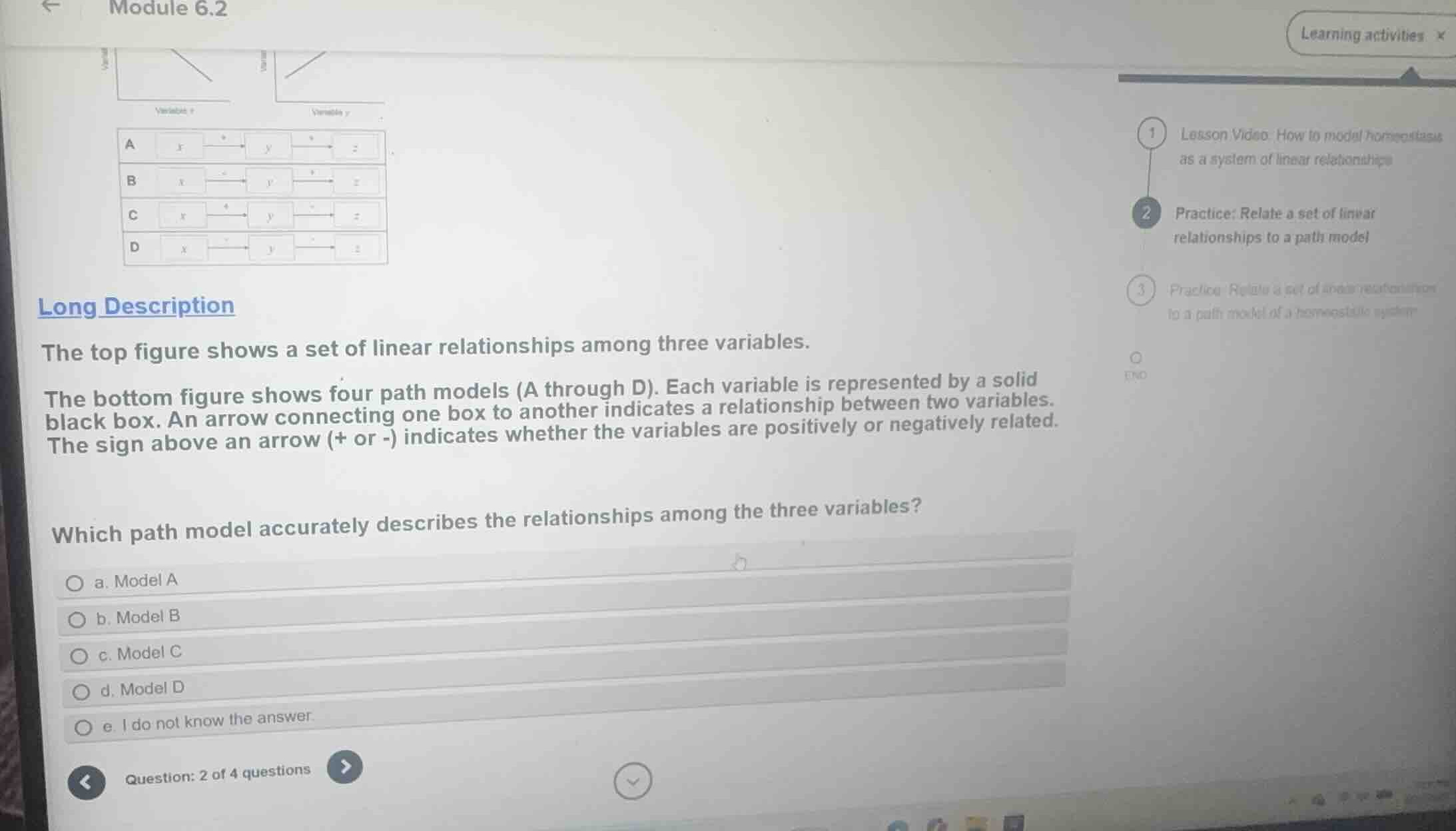
the top figure shows a set of linear relationships among three variables.
the bottom figure shows four path models (a through d). each variable is represented by a solid black box. an arrow connecting one box to another indicates a relationship between two variables. the sign above an arrow (+ or -) indicates whether the variables are positively or negatively related.
which path model accurately describes the relationships among the three variables?
a. model a
b. model b
c. model c
d. model d
e. i do not know the answer.
Analyze the linear relationships
Using the Linear Relationships knowledge point:
- The first graph shows the relationship between Variable \(x\) (horizontal axis) and Variable \(y\) (vertical axis). The line slopes downward from left to right, which indicates a negative linear relationship. Therefore, the path from \(x\) to \(y\) should have a minus sign (\(-\)).
- The second graph shows the relationship between Variable \(y\) (horizontal axis) and Variable \(z\) (vertical axis). The line slopes upward from left to right, which indicates a positive linear relationship. Therefore, the path from \(y\) to \(z\) should have a plus sign (\(+\)).
Evaluate the path models
Using the Path Models and Causal Diagrams knowledge points:
- We need a model where:
- The arrow from \(x\) to \(y\) is labeled with a minus sign (\(-\)).
- The arrow from \(y\) to \(z\) is labeled with a plus sign (\(+\)).
- Let's examine the choices shown in the bottom figure:
- Model A: Arrow \(x
ightarrow y\) has a \(+\); arrow \(y
ightarrow z\) has a \(+\).
- Model B: Arrow \(x
ightarrow y\) has a \(-\); arrow \(y
ightarrow z\) has a \(-\).
- Model C: Arrow \(x
ightarrow y\) has a \(+\); arrow \(y
ightarrow z\) has a \(-\).
- Model D: Arrow \(x
ightarrow y\) has a \(-\); arrow \(y
ightarrow z\) has a \(+\).
Select the correct model
Comparing our derived signs with the models:
- \(x
ightarrow y\) is negative (\(-\)).
- \(y
ightarrow z\) is positive (\(+\)).
- This matches Model D perfectly.

Snap & solve any problem in the app
Get step-by-step solutions on Sovi AI
Photo-based solutions with guided steps
Explore more problems and detailed explanations
- a. Model A
- b. Model B
- c. Model C
- d. Model D (Correct answer)
- e. I do not know the answer.