QUESTION IMAGE
Question
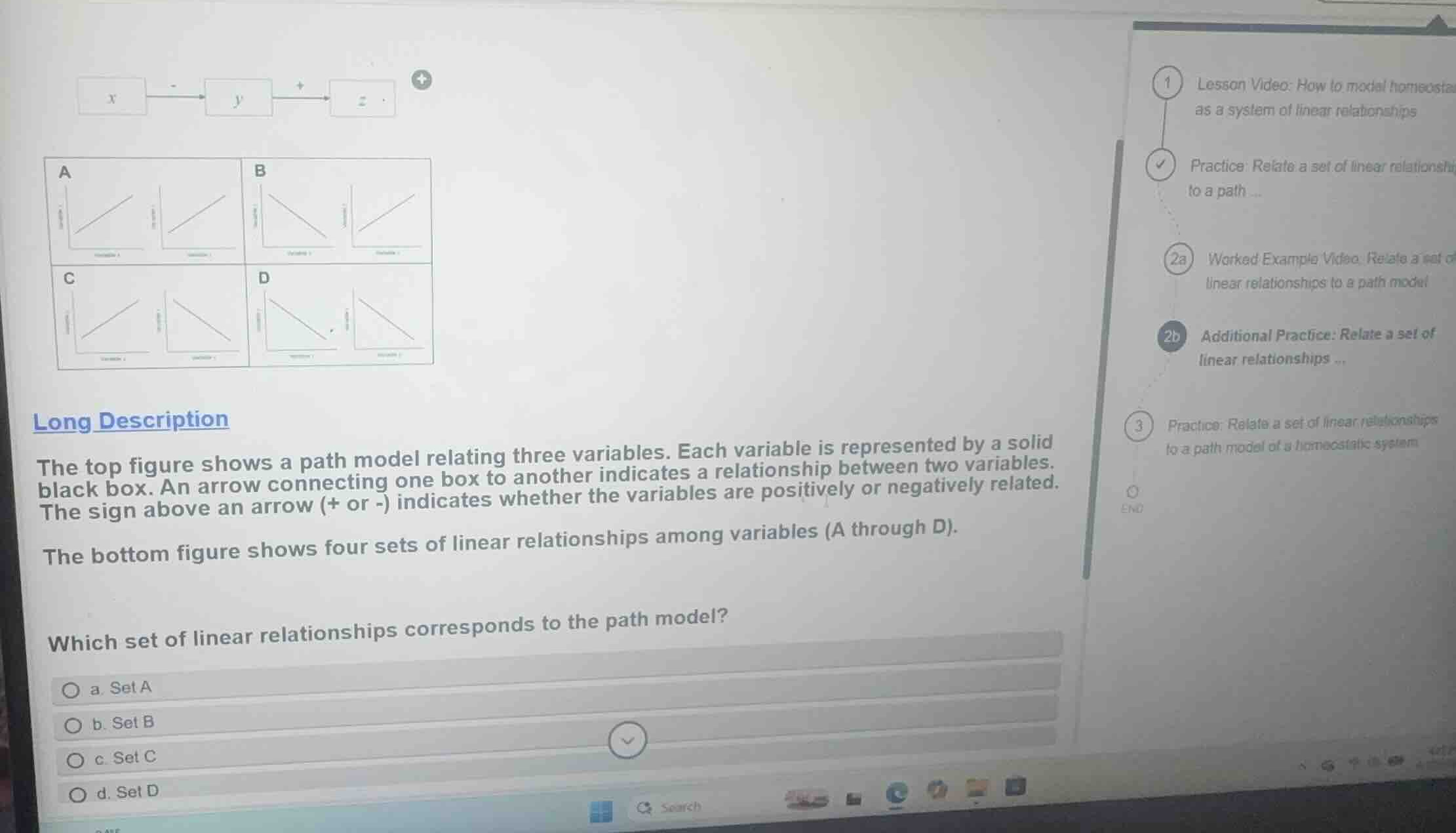
the top figure shows a path model relating three variables. each variable is represented by a solid black box. an arrow connecting one box to another indicates a relationship between two variables. the sign above an arrow (+ or -) indicates whether the variables are positively or negatively related.
the bottom figure shows four sets of linear relationships among variables (a through d).
which set of linear relationships corresponds to the path model?
a. set a
b. set b
c. set c
d. set d
Analyze the path model relationships
In the top figure, we have a Causal Diagram representing a Path Model with three variables: \(x\), \(y\), and \(z\).
- The arrow from \(x\) to \(y\) has a minus sign (\(-\)) above it. This indicates a negative Linear Relationship between \(x\) and \(y\). As \(x\) increases, \(y\) decreases (negative slope).
- The arrow from \(y\) to \(z\) has a plus sign (\(+\)) above it. This indicates a positive Linear Relationship between \(y\) and \(z\). As \(y\) increases, \(z\) increases (positive slope).
Evaluate the graph sets
We need to find the set of graphs (A through D) that matches these two relationships:
- First graph in each set (Variable y vs Variable x): Needs to show a negative slope (downward-sloping line).
- Second graph in each set (Variable z vs Variable y): Needs to show a positive slope (upward-sloping line).
Let's inspect the options:
- Set A: First graph has a negative slope; second graph has a positive slope.
- Set B: First graph has a negative slope; second graph has a negative slope.
- Set C: First graph has a positive slope; second graph has a negative slope.
- Set D: First graph has a positive slope; second graph has a negative slope.
Therefore, Set A correctly represents the negative relationship between \(x\) and \(y\), and the positive relationship between \(y\) and \(z\).

Snap & solve any problem in the app
Get step-by-step solutions on Sovi AI
Photo-based solutions with guided steps
Explore more problems and detailed explanations
- a. Set A (Correct answer)
- b. Set B
- c. Set C
- d. Set D