QUESTION IMAGE
Question
title of piece:
artist: ____ type of artwork: ____
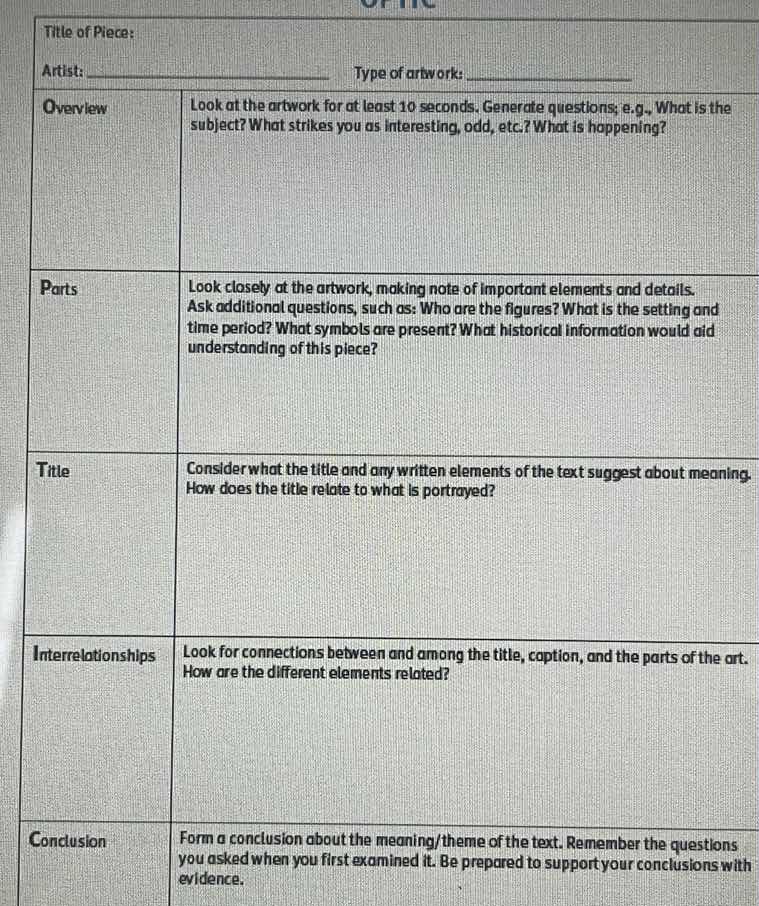
overview: look at the artwork for at least 10 seconds. generate questions; e.g., what is the subject? what strikes you as interesting, odd, etc.? what is happening?
parts: look closely at the artwork, making note of important elements and details. ask additional questions, such as: who are the figures? what is the setting and time period? what symbols are present? what historical information would aid understanding of this piece?
title: consider what the title and any written elements of the text suggest about meaning. how does the title relate to what is portrayed?
interrelationships: look for connections between and among the title, caption, and the parts of the art. how are the different elements related?
conclusion: form a conclusion about the meaning/theme of the text. remember the questions you asked when you first examined it. be prepared to support your conclusions with evidence.
Define the OPTIC strategy components
The OPTIC acronym is a structured strategy used to analyze visual texts, artworks, or images systematically. Its components are:
- O (Overview): Write a brief summary of what is happening in the image.
- P (Parts): Identify and list key details, symbols, figures, and setting elements.
- T (Title): Analyze how the title and any written text contribute to the meaning.
- I (Interrelationships): Connect the title, caption, and individual parts to see how they interact.
- C (Conclusion): Synthesize the observations to state the overall theme or meaning of the artwork.
Explain the purpose of the worksheet
The provided image is a blank template of the OPTIC graphic organizer. It serves as a guided framework for students to analyze any piece of visual art or media by breaking down their observations into these five sequential steps.

Snap & solve any problem in the app
Get step-by-step solutions on Sovi AI
Photo-based solutions with guided steps
Explore more problems and detailed explanations
The image shows a blank graphic organizer for the OPTIC strategy, which is a systematic method used to analyze visual texts, artworks, or images.
The acronym stands for:
- O - Overview: Write a brief summary of the subject and what is happening in the artwork.
- P - Parts: Note specific details, figures, settings, and symbols.
- T - Title: Consider how the title and any text elements relate to the visual.
- I - Interrelationships: Analyze how the different parts, title, and captions connect with one another.
- C - Conclusion: Formulate a final conclusion about the overall meaning or theme of the piece, supported by the gathered evidence.